OSHA estimates that US employers pay almost $1 billion every week in direct workers' compensation costs, and the National Safety Council puts the total annual cost of work injuries at more than $160 billion once lost productivity and administration are counted. In 2023, more than 5,000 US workers died from occupational injuries, according to Bureau of Labor Statistics data. A disciplined workplace safety assessment interrupts those outcomes early: a safety audit checklist for physical conditions, observation sheets for behaviors, and a scoring system that tells you whether risk is rising or falling. This guide covers what to inspect, which indicators actually predict incidents, and how to run the whole cycle without hiring an external consultancy.
What a workplace safety assessment actually covers
Three activities get lumped together, and it is worth separating them. An inspection is a point-in-time check of a location. An audit verifies that your safety management system — training records, procedures, permits — matches requirements. A workplace safety assessment is broader: it combines conditions, behaviors and system health to answer one question — where is our next incident most likely to happen, and what are we doing about it today?
OSHA reckons employers pay out nearly $170 billion a year in injury-related costs, and it also publishes the counter-argument for investing: businesses that establish effective safety programs report savings of $4 to $6 for every dollar invested. An assessment is the mechanism that turns that ratio from a slogan into a plan, because it tells you exactly which zone, behavior or procedure deserves the next dollar and the next hour.
It also changes the conversation with leadership. Instead of arguing about safety in the abstract, you arrive with scored findings, trend lines and a corrective-action log. That is a very different meeting.
The safety audit checklist: eight zones every form should cover
Your safety audit checklist should walk through the workplace zone by zone, because hazard risk is location-specific. The eight zones below cover most manufacturing, logistics, retail and office environments; add industry-specific zones such as confined spaces, working at height or vehicle operations where relevant.
| Zone | What to check | Suggested frequency |
|---|---|---|
| Emergency readiness | Clear exits, working alarms, charged extinguishers, current drill records | Monthly |
| Housekeeping and access | Clear walkways, prompt spill response, safe storage, adequate lighting | Weekly |
| Machine guarding and equipment | Guards in place, lockout/tagout followed, maintenance logs current | Monthly |
| Electrical safety | Closed panels, undamaged cords, grounding, no temporary wiring in use | Quarterly |
| PPE availability and condition | Correct stock, proper fit, actual wear rates observed on the floor | Weekly |
| Ergonomics and manual handling | Lifting tasks reviewed, workstation setup, rotation practices followed | Quarterly |
| Hazard communication | Labels intact, safety data sheets accessible, storage segregation correct | Quarterly |
| Training and documentation | Certifications current, toolbox talks held, incident and near-miss logs open | Quarterly |
Score every item consistently — pass, fail or not applicable, plus a severity rating on failures — and record corrective actions with owners and due dates on the same form. A checklist without a corrective-action loop is a filing exercise, not an assessment.
Leading indicators: the numbers that predict incidents
Lagging indicators — injury rates such as TRIR and DART — tell you what already happened. Leading indicators tell you what is about to. The classic premise comes from Heinrich's safety pyramid: for every serious injury, hundreds of near misses and unsafe acts sit underneath it. Teams that capture and act on near misses drain the base of the pyramid before the top event ever occurs.
Four leading indicators belong on every safety assessment template:
- Near-miss reports per month — rising reports with falling severity is a healthy sign, not a bad one.
- Corrective-action closure time — the days between finding a hazard and fixing it.
- Observations completed — the share of planned behavioral safety observations actually carried out.
- Training currency — the percentage of certifications and refreshers still in date.
Culture is the multiplier on all four. Gallup's meta-analysis links top-quartile employee engagement to 64% fewer safety incidents, largely because engaged employees report hazards instead of walking past them. Your assessment program and your engagement program are, quietly, the same program.
How to run a safety assessment in five steps
- Plan the scope. Pick the zones, standards and people involved; announce the assessment — the goal is safer conditions, not gotchas.
- Observe and record. Walk the floor with the checklist and observation sheets; photograph findings where appropriate.
- Score and prioritize. Rate severity and likelihood on every failure; the top of the list is your next budget conversation.
- Act. Assign every corrective action an owner and a due date; track closure time as a leading indicator in its own right.
- Re-verify and trend. Re-check closed actions after 30 days and plot your leading indicators month over month.
Where results keep pointing to the same knowledge gaps — lockout/tagout, hazard communication, manual handling — treat it as a training finding and run a structured needs analysis. The training needs assessment guide shows how to convert recurring audit findings into a curriculum your teams will actually sit through.
Build the safety assessment system without burning out your team
The most common objection to formal safety assessment is time, and it is a fair one. Building an assessment program from scratch typically takes around 24 hours of design work plus another 8 hours of validation before it is audit-ready. Customizing a ready-made, field-tested assessment takes about 2.
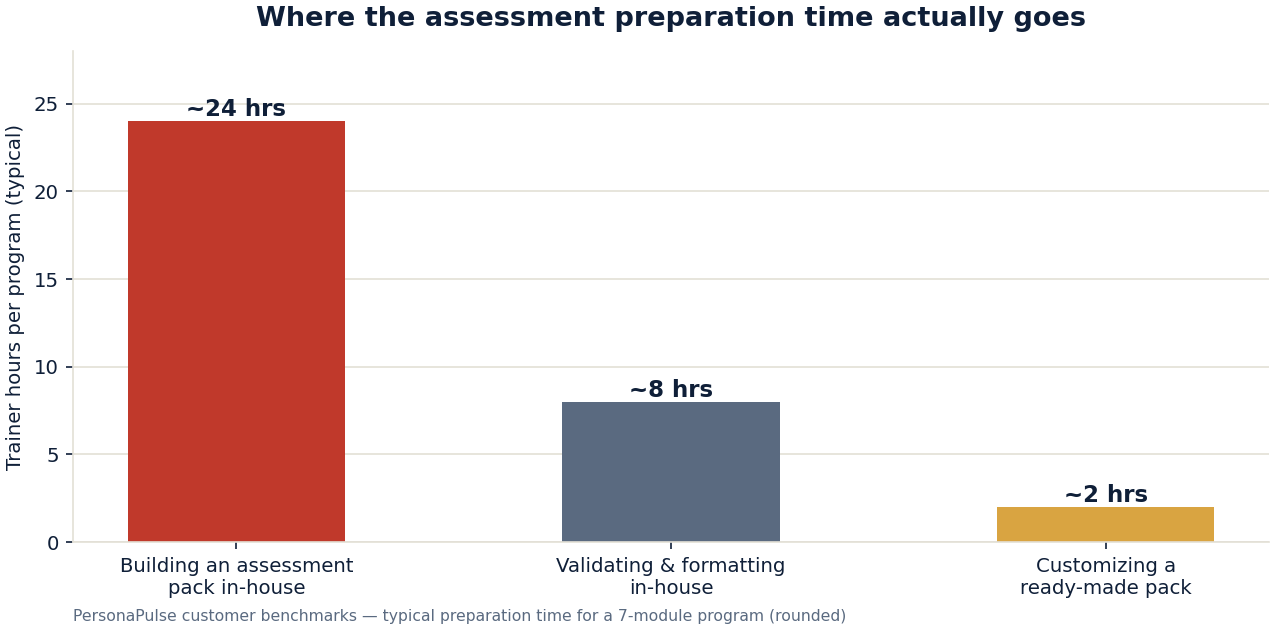
That gap is exactly why the free Safety Assessment Checklist Pack exists — audit forms covering the eight zones above, behavioral observation sheets, a scoring sheet and a corrective-action log you can deploy this week and adapt zone by zone to your site. If you also want the leadership program around the paperwork, every PersonaPulse package ships with facilitator guides, workbooks and assessments ready to run.
Frequently asked questions
What is a workplace safety assessment?
It is a structured review of physical conditions, safety behaviors and system health — records, training, procedures — scored against defined criteria. It goes beyond a single inspection by combining what you see with how people actually work.
How often should a safety audit be run?
High-risk zones warrant weekly or monthly checks, while documentation and system-level audits typically run quarterly to annually. Most organizations layer them: quick weekly observations, monthly zone checks and a deeper annual audit.
What are leading indicators in safety?
They are forward-looking measures such as near-miss reports, corrective-action closure time, observation completion rates and training currency. Tracking them lets you act on risk before it becomes an injury record.
Is a safety assessment the same as OSHA compliance?
No. Compliance confirms you meet regulatory minimums; an assessment evaluates risk comprehensively and often surfaces issues that compliance alone would miss. Strong programs use assessment findings to exceed the minimums, not just meet them.
Who should conduct the assessment?
A mix works best: supervisors for zone checks, safety officers for audits and frontline employees for behavioral observations. Involving the people who do the work improves both the findings and the follow-through.
What is included in the free checklist pack?
The pack includes audit forms covering the eight zones above, behavioral observation sheets, a scoring sheet and corrective-action log templates. Everything is editable so you can adapt it to your site and industry.
Your next step
For the leadership layer that makes checklists stick, explore PersonaPulse's Workplace Safety Leadership program, which includes ready-made assessments, a facilitator guide and participant workbooks alongside the safety content. Related reading: the corporate assessment tools guide compares assessment approaches across HR use cases, and the competency assessment framework shows how to structure behavioral scoring. All 169 programs are listed in the PersonaPulse library.
Free Safety Assessment Checklist Pack — Audit Forms, Observation Sheets & Scoring
Get the free downloads for this topic — module 1, training plan, workbook sample, assessments and the table of contents.