McKinsey and LeanIn.Org's Women in the Workplace research has tracked the same structural fault line for a decade: the broken rung — the first step from individual contributor to manager. In recent editions, for every 100 men promoted into management, only about 81 women made the same step, and the gap compounds at every level above it. Zoom out and the picture persists: Grant Thornton's international tracker places women at roughly a third of senior management roles globally, and the World Economic Forum's Global Gender Gap report projects well over a century until full parity. The case for dedicated programs is settled; the open question is design. Which program ingredients actually move representation — and which are theatre? This guide is the design brief.
What the data says moves the needle
Programs that correlate with representation gains share five ingredients, consistently:
- Sponsorship, not just mentorship. Mentors advise; sponsors spend political capital. Catalyst's research has repeatedly linked active sponsorship to higher rates of advancement, stretch-assignment requests and pay negotiations. Design sponsors in with named protégés and named advocacy commitments.
- Negotiation and visibility skills. The competency gaps women most consistently report — negotiation, self-advocacy, managing visibility — respond quickly to targeted training with rehearsal on real, current asks rather than hypotheticals.
- Executive presence work calibrated to the audience it faces. The behaviors are universal (composure, concision, command of the room); the application — interruption dynamics, credit dynamics — needs honest scenario design, as our executive presence guide details.
- Network architecture. Formal introductions into the informal power map, because access — not talent — is the scarce resource at the broken rung.
- Line-manager accountability. Participants' managers receive the competency goals and the 90-day review; development without stakeholder accountability evaporates.
What the data does not support: resiliency-themed events detached from sponsorship and accountability. Well-intentioned programming that tells women to adapt to a broken ladder leaves the ladder broken. The broken rung is a systems problem with a skills component — programs fail when they treat it as a confidence problem with a scheduling component.
The six-month architecture that works
Effective programs run long enough for sponsorship and stretch assignments to produce evidence. The arc below is the design that recurs in successful corporate programs:
| Month | Block | Non-negotiable artifact |
|---|---|---|
| 0 | Intake: 360 baseline, career-goal contract, sponsor matching | Named sponsor two levels up, signed contract |
| 1–2 | Skills: negotiation rehearsal, visibility strategy, presence video rounds | One rehearsed real ask per participant |
| 3–4 | Application: stretch assignment or visibility project with executive air-cover | Delivered project plus logged sponsor check-ins |
| 5 | Network integration: participant presents at a senior forum | Real agenda, real stakes |
| 6 | Review: competency re-rating, sponsorship outcomes, promotion-readiness conversation | Participant-vs-comparison data pack |
The Women in Leadership program packages this arc as facilitator-ready modules — including the sponsorship playbook and negotiation rehearsal materials — for $89.50 with unlimited internal delivery. It slots into the broader leadership development program blueprint as a dedicated track, and the intake instruments map cleanly onto standard leadership assessments.
The retention dividend
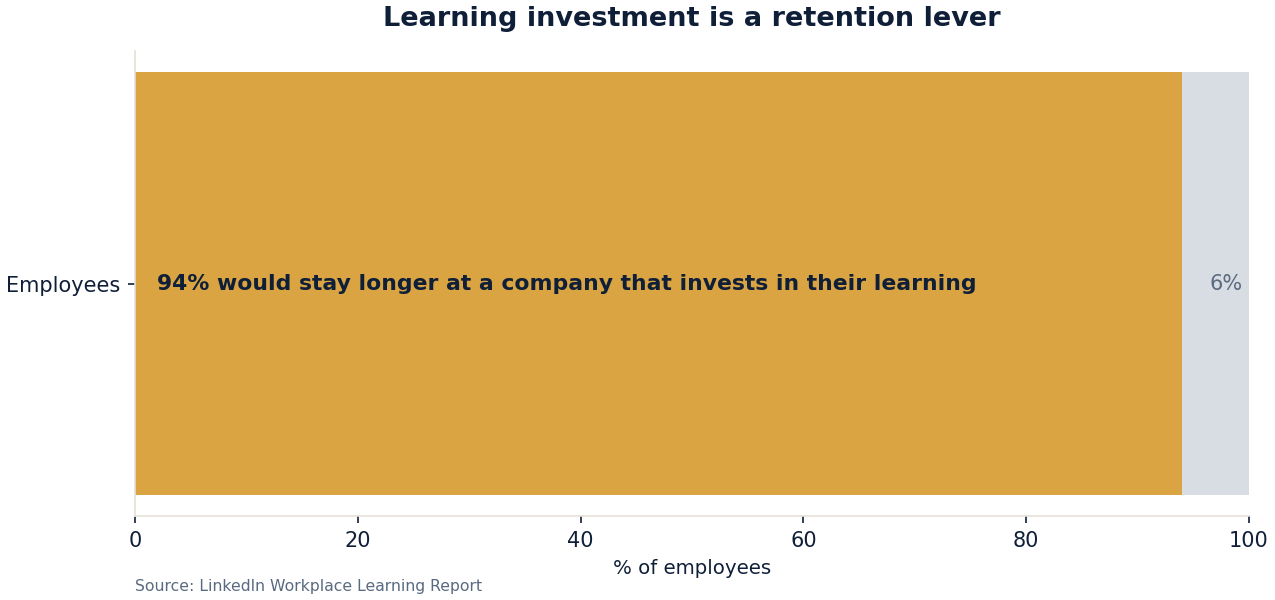
Representation programs are also retention programs, and the economics argue for treating them that way. LinkedIn's Workplace Learning Report has found 94% of employees say they would stay longer at a company that invests in their learning — and the employees most likely to leave for development elsewhere are exactly the high performers these programs target.
McKinsey and LeanIn.Org have also tracked women leaders leaving at markedly higher rates than men in recent years, with senior women citing advancement and development as decisive factors more often than men do. Against SHRM's benchmark that replacing an employee can cost the equivalent of one-half to two times annual salary, one retained senior leader typically funds a cohort. Gallup's engagement data adds a further note: teams led by women post engagement scores as high as or higher than teams led by men, so each retention win compounds into an engagement win.
Four design mistakes that sink programs
The failure patterns are predictable, which means they are preventable:
- Mentorship substituted for sponsorship. Advice without advocacy leaves the political mechanics of promotion untouched — the rung stays broken while the meeting calendar fills.
- Sponsors without named commitments. "Support" is not a contract; the program needs specific advocacy acts logged per sponsor per quarter.
- Skills training without stretch application. Negotiation rehearsed only on case studies evaporates; every skill module must attach to a live, current ask.
- No comparison group. Without matched non-participants, month-twelve results collapse into anecdotes, and anecdotes do not survive a budget review.
Each mistake is cheap to fix at intake and expensive to discover at renewal. The architecture above was built specifically to close all four before launch rather than after the first annual report.
The measurement discipline that keeps it funded
Representation metrics move slowly; program metrics move quarterly. Track both:
- Pipeline — share of women at each management level, reported quarterly.
- Program — promotion/readiness rate of participants versus matched non-participants at 12 months; this is the comparison that survives budget review.
- Behavior — negotiation outcomes logged, visibility projects delivered, sponsor advocacy acts (nominations, introductions, airtime) counted.
The 12-month participant-versus-comparison read is the single number that decides whether the program becomes an institution or a line item, so wire it at launch — the Kirkpatrick guide shows the mechanism. McKinsey's Diversity Wins research, finding top-quartile gender-diverse executive teams 25% more likely to achieve above-average profitability, gives you the ceiling argument; the participant comparison gives you the floor. One caution: measurement design is not an afterthought. Programs that cannot name their comparison group at intake usually cannot defend their budget at month twelve.
Handling the objections you will meet
Program sponsors meet the same five objections; prepared answers keep the initiative alive. "Why a separate program?" — because the broken rung is a documented structural gap, the program fixes access and sponsorship gaps the general system leaves unaddressed, and its system-change modules benefit everyone. "Isn't this reverse discrimination?" — the program allocates development resources to a documented gap; it lowers no bar, and its measurement exists precisely to prove impact rather than preference. "We promoted X, so is the problem solved?" — individual exceptions do not move distributions; that is what the pipeline metrics track. "Budgets are tight." — the replacement-cost math for one avoided senior exit covers the program many times over. "What if participants leave after we invest?" — invert it: what if they stay un-developed and disengaged?
Pair the one-page FAQ with the artifact that persuades hardest: a two-line audit of your own last promotion calibration — who was named, on what evidence. Objections collapse faster in front of an honest mirror than in front of a benchmark chart. One inclusion trap remains: a single-track program can tokenize if the surrounding system is untouched, so ship a light audit of promotion-meeting mechanics alongside — the inclusive leadership toolkit supplies the behaviors those reviews check for.
Frequently asked questions
What makes a women-in-leadership program effective?
Sponsorship with named commitments, skills rehearsal on the gaps that actually gate advancement (negotiation, visibility, presence), network access, and line-manager accountability — wrapped in measurement that compares participant advancement to a matched comparison group.
Are these programs still necessary?
The structural data — broken rung, senior-representation gaps, century-scale parity projections — says yes. Well-designed programs address documented access and sponsorship gaps rather than implying women need fixing.
Should men be excluded from the content?
Sponsorship and calibration modules should include the men who control those systems. The development track itself is a safe-space design choice; the system-change modules are deliberately mixed.
How is sponsorship different from mentorship in practice?
A mentor advises you; a sponsor spends their capital on you — nominates you for the role, says your name in the room you are not in. Programs must contract for specific advocacy acts, not good intentions.
How do we measure program success?
Twelve-month participant-versus-matched-non-participant comparison on promotion and readiness, plus quarterly pipeline movement, plus logged behavior evidence: negotiations, visibility projects, advocacy acts.
Where can I get a complete program kit?
The Women in Leadership kit delivers the six-month arc as ready-to-facilitate modules for $89.50 one-time, including the sponsorship playbook. Review the quality first with the free Module 1 pack, then compare the rest of the PersonaPulse library.
Your next step
If representation targets matter to your organization, treat the program as a system intervention with a skills track, not a skills track hoping the system cooperates. The Women in Leadership program ships the full six-month arc ready to facilitate, and the inclusive leadership behaviors guide supplies the system audit that keeps it credible. Browse the full PersonaPulse library to assemble the surrounding leadership curriculum.
Free Women in Leadership Program Pack — Module 1, Sponsorship Playbook, Workbook & Assessments
Get the free downloads for this topic — module 1, training plan, workbook sample, assessments and the table of contents.