Kirkpatrick's four levels have told learning teams what changed since 1959 — but according to ATD research on evaluation practice, only about 9% of organizations ever calculate what that change was worth in dollars. That gap is why L&D budgets are among the first casualties of a downturn: when you cannot translate a program into money, finance treats it as a cost. The Phillips ROI model, developed by Jack Phillips and the ROI Institute, extends Kirkpatrick with a fifth level that isolates the monetary benefits of training, converts them into hard currency, and compares them to fully loaded program costs. This guide explains the model, the math, and the practical shortcuts that make training ROI measurement workable without a data-science team.
From Kirkpatrick to Phillips: what the fifth level adds
Kirkpatrick gives you four lenses: did people react well, did they learn, did behavior change on the job, and did business results move. Phillips keeps all four and adds a fifth question — did the financial benefits exceed the costs — plus two disciplines Kirkpatrick never required. First, you must isolate the effects of training from every other influence on the result. Second, you must convert the improvement into money using defensible values rather than enthusiasm.
The adoption statistics show how rarely that last step happens. ATD's research on evaluation practice finds that 92% of organizations measure reaction, 72% measure learning, 45% measure behavior, 28% measure results, and only about 9% calculate ROI:
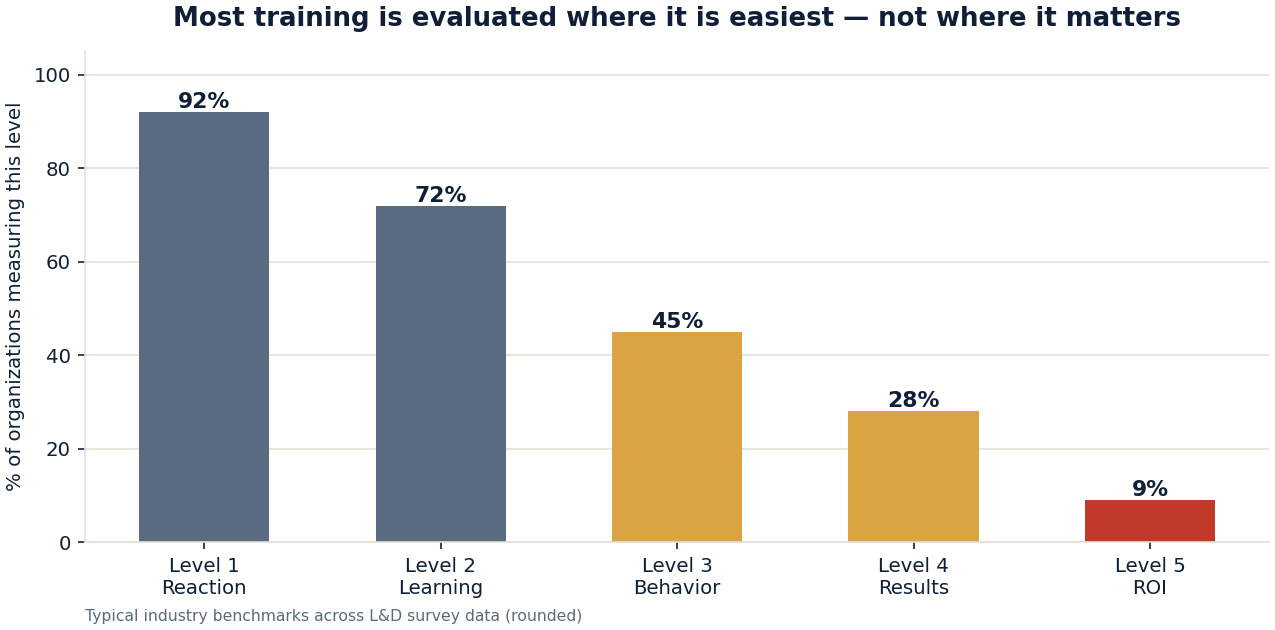
The cliff between levels 4 and 5 is not laziness — it is the difficulty of isolation and conversion, which is precisely what the Phillips ROI methodology was built to standardize.
The five levels of the Phillips ROI methodology
| Level | What you measure | Typical evidence | Example for a leadership program |
|---|---|---|---|
| 1 Reaction | Perceived relevance and quality | Post-workshop surveys | 4.5/5 satisfaction; 90% "will apply" |
| 2 Learning | Knowledge, skills, confidence | Tests, simulations, confidence scales | Coaching skills scores up 30% |
| 3 Behavior | On-the-job application | Observation, 360s, manager checks | Weekly 1:1s held by 85% of managers |
| 4 Impact | Business measures | Operations and HR data | New-manager turnover down 6 points |
| 5 ROI | Monetary return | Finance-validated benefits vs costs | 52% ROI with payback in 7 months |
Phillips also asks you to report intangible benefits that resist conversion — morale, reputation, confidence — and to state your assumptions openly. The core formula is simple: ROI% equals net program benefits divided by program costs, multiplied by 100. A benefit-cost ratio (benefits divided by costs) is usually reported alongside it, since ratios are easier for non-financial audiences to read than percentages.
Intangibles deserve their own line in the report, not a footnote. Reduced stress, better succession coverage, stronger employer brand, and customer goodwill all move with good training but resist honest conversion; Phillips' guidance is to list them, describe the evidence behind each, and let the reader weight them. The discipline matters because sponsors who see their intangibles named are more likely to accept the conservative ROI number that accompanies them — and far more likely to fund the program again.
Isolating the effects of training
The isolation step is what separates ROI work from wishful math. Choose at least one method, and triangulate two when the stakes are high:
- Comparison group: run the program with one cohort and hold a matched group back, then compare outcomes.
- Trend-line analysis: project the pre-program trend and attribute only the deviation above it to the program.
- Participant estimation: ask participants to estimate the program's contribution and adjust for their stated confidence — an answer given at 80% confidence counts as 80%.
- Expert estimation: have independent managers or analysts review the attribution and discount it.
Phillips' insight is that imperfect isolation, applied consistently and disclosed honestly, beats perfect isolation that never ships. Most organizations get defensible results with participant estimation plus trend lines alone.
Converting outcomes into money
Conversion has four moves. Identify each unit of improvement (one avoided resignation, one saved hour, one extra closed deal). Assign a monetary value to the unit using sources finance will accept — SHRM's benchmark that replacing a salaried employee costs six to nine months of salary is a common anchor for turnover savings. Annualize the benefit stream. Then total the fully loaded costs: design, delivery, materials, platform, and participants' time, which is usually the largest line.
A worked example keeps it concrete. Suppose a first-line manager program for 60 managers costs $120,000 all-in, and new-manager turnover falls from 20% to 14% — four avoided departures a year. At $45,000 per replacement, benefits total $180,000, giving ROI of ($180,000 − $120,000) ÷ $120,000 × 100 = 50%. Even if a skeptical CFO argues the program deserves only half the credit, isolation methods exist to make that adjustment explicitly — and a 25% ROI still clears most corporate hurdle rates.
When ROI measurement earns its cost
Full ROI measurement is expensive, so the ROI Institute recommends reserving it for roughly 5-10% of programs: the strategic, expensive, highly visible, or repeated ones. For everything else, track levels 1-3 and report impact stories, not percentages. Context on spend makes the case for rigor: ATD's State of the Industry puts average training investment at about $1,280 per employee per year, and industry estimates put US training spend above $160 billion annually — money that mostly disappears without level 4 and 5 evidence. For the programs that do get the full treatment, pair the numbers with a narrative; our guide to getting executive buy-in for L&D budget shows how to sequence that conversation. And when benefits are mostly behavioral — as in executive coaching, where ICF has reported company returns of roughly seven times the investment — say so with the caveat rather than forcing a soft outcome into a hard formula.
Frequently asked questions
What is the Phillips ROI model?
The Phillips ROI model extends Kirkpatrick's four levels of evaluation with a fifth level: return on investment. Developed by Jack Phillips and the ROI Institute, it adds two required disciplines — isolating the effects of training and converting outcomes to money. It is the most widely used framework for financial evaluation of training programs.
How is the Phillips model different from Kirkpatrick?
Kirkpatrick measures change through four levels; Phillips adds the money question and the method to answer it credibly. Phillips requires you to isolate training's contribution from other factors and convert benefits to currency, then compare against fully loaded costs. Think of Kirkpatrick as the thermometer and Phillips as the profit-and-loss statement.
What is a good ROI percentage for training?
A 25% ROI is generally considered respectable, 50% strong, and anything above 100% exceptional but scrutinized hard. Many organizations require programs to clear their internal hurdle rate, often 15-30%. What matters more than the single number is that your isolation and conversion methods survive a finance review.
What counts as a program cost?
Everything: design, facilitator fees, materials, platform licenses, travel, venue, and the prorated salaries of participants for the time they spend away from work. Participant time is typically the largest cost and the most commonly omitted. Undercounting costs inflates ROI and destroys credibility with finance.
How long after a program should we measure ROI?
Wait long enough for behavior and results to move — usually three to six months for behavior and six to twelve for business impact. Measuring too early captures enthusiasm, not change. Announce the measurement window at program launch so data collection is planned, not improvised.
Which programs justify full ROI measurement?
Reserve it for programs that are strategic, expensive, high-visibility, or repeated at scale — typically 5-10% of the portfolio. A compliance refresh does not need level 5; a flagship leadership academy does. Choose programs where the decision the data will inform is worth more than the measurement itself.
Your next step
If you are building or upgrading a leadership academy, PersonaPulse's Leadership Development Mastery program (course page here) comes with ready-made assessments, workbooks, and evaluation forms, so levels 1-3 data collection is built in from day one. Pair it with our deep dives on the Kirkpatrick model and how to prove training ROI and the four levels of training evaluation. To see how evaluation fits into program economics, read our comparison of in-house versus ready-made leadership training. And browse the full PersonaPulse library to compare all 169 ready-to-deliver programs.