Organizations worldwide pour close to $400 billion into workplace training every year, with US companies alone spending more than $100 billion — yet McKinsey survey work finds 87% of companies either have a skill gap now or expect one within a few years. Those two facts are connected: training budgets flow toward topics that are easy to buy, not toward gaps that are proven. A training needs assessment is the discipline that reverses the order. It converts scattered complaints, survey guesses and manager instincts into evidence about who needs which skill, how large the gap is, and what it will cost the business if it stays open. Done well, a training needs analysis is also the single most persuasive document an L&D team can put in front of a CFO.
What a training needs assessment actually is
A training needs assessment — often shortened to TNA, or called a training needs analysis — is a structured process for identifying the gap between the skills an organization has and the skills its strategy requires. It answers four questions in order: what does the business need to achieve, what capabilities does that require, which capabilities are missing, and which of those gaps can training realistically close. Skip the last question and the TNA becomes a course catalog instead of a diagnostic.
Classic TNA theory divides the work into three levels, and keeping them separate prevents most confusion:
| Level | Core question | Typical data sources |
|---|---|---|
| Organizational | Where must the business be in 1-3 years, and what skills does that demand? | Strategy plans, KPI trends, workforce data, leadership interviews |
| Task or role | What must people in each role do to perform well? | Job analysis, competency frameworks, process reviews |
| Individual | Who is missing which skills today? | Skills tests, 360 feedback, manager check-ins, performance data |
The final step matters most: not every performance gap is a training gap. If salespeople know the process but leadership changed it three times last quarter, the fix is process clarity, not another workshop. A credible TNA separates can't-do from won't-do before any budget is requested.
Why the TNA process wins budget (when most requests don't)
Executives approve spending that maps to a number they already care about. The TNA process is how you supply that map. Instead of "we need communication training," the request becomes: exit-interview data and manager feedback show frontline leaders cannot run difficult conversations, teams with weak manager quality show measurably lower engagement, and here is a 12-week intervention with pre and post measures attached.
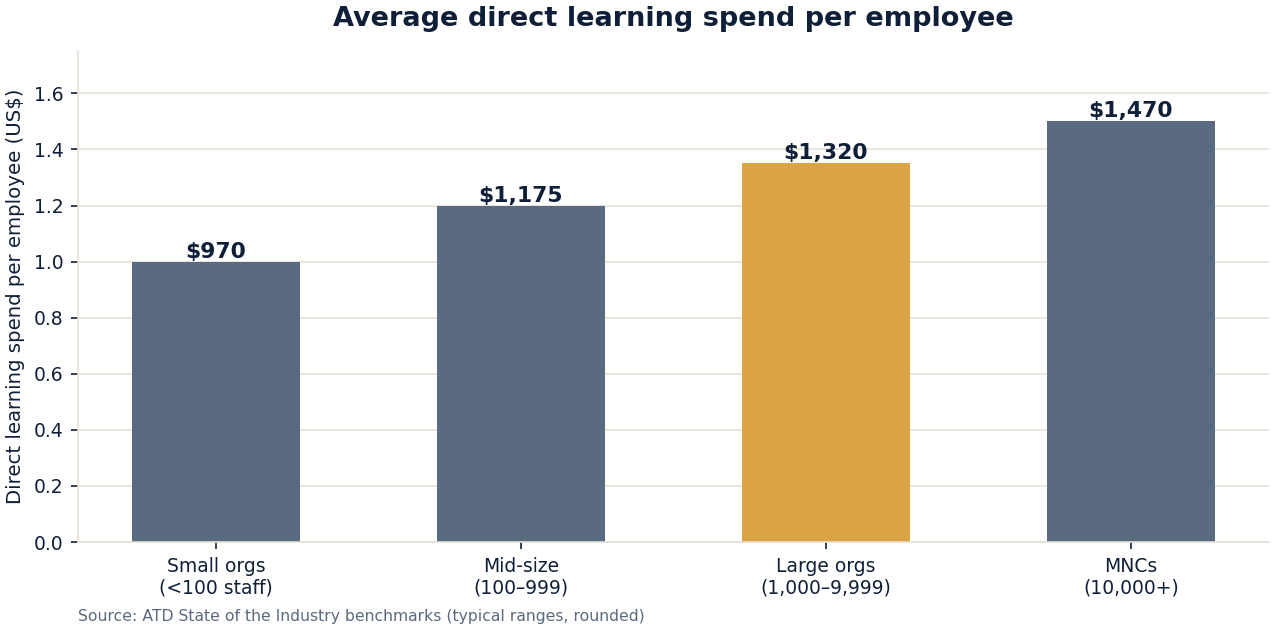
The context is urgent, not just tidy. The World Economic Forum's Future of Jobs analysis estimates that 44% of workers' core skills will be disrupted by 2027, and the same report ranks analytical thinking and technology literacy among the fastest-growing skill requirements. Meanwhile Gallup estimates that replacing an employee costs one-half to two times their annual salary — a cost that targeted development directly attacks — and ATD's State of the Industry benchmarks put average direct learning spend at roughly $1,300 per employee. Money is being spent somewhere in your organization right now, with or without your analysis guiding it. A training needs assessment is how you compete for that spend with evidence instead of entitlement.
The step-by-step TNA process
A pragmatic TNA takes two to four weeks for a single department. Seven steps cover it:
- Start from business goals. Interview the sponsoring executive and translate one or two strategic objectives into required capabilities.
- Define the target population. Decide the level — organization, role, or individual — and exactly who is inside the scope.
- Collect evidence from at least two sources. Combine what people say (surveys, interviews, focus groups) with what they do (performance data, quality reports, skills tests). Single-source TNAs inherit single-source bias.
- Analyze the gap. For each required competency, rate current proficiency against the required level and size the gap. Existing instruments — including the ready-made skill checks that ship with complete training packages — give you a defensible baseline fast.
- Prioritize ruthlessly. Score gaps on business impact and urgency; you cannot fund everything, and a short, sharp list is more credible than a long one.
- Choose solutions, not just courses. For each priority gap, consider coaching, process changes, job aids or role redesign before defaulting to training.
- Package the findings. Produce a one-page summary: top gaps, evidence, recommended interventions, costs, and the measures that will prove movement.
If you want the instruments behind each step, our employee skills assessment framework guide covers the measurement side in detail, and the corporate assessment tools guide helps you pick the right instruments to collect it.
Turning analysis into a budget-winning proposal
The final deliverable is a persuasion document, so write it for a CFO. Lead with the business risk, not the learning design: quantify the cost of the gap in turnover, rework, slower ramp-up or lost deals, and put the proposed intervention next to it with pre-agreed success measures. Benchmark context helps — showing that your per-employee learning spend sits below the ATD average is a legitimate argument, but showing that the spend is scattered across unconnected programs is a stronger one.
Two tactical tips raise approval rates sharply. First, bring a phased option: approve the pilot cohort now, scale on results. Second, pre-wire the meeting — the analysis earns its keep when the CFO has already seen the top-three-gap summary before the budget discussion starts. For the meeting itself, our guide to getting executive buy-in for L&D budget walks through the stakeholder sequencing in detail.
Common training needs analysis mistakes
The same errors appear in almost every failed TNA:
- Survey-only data. People are poor reporters of their own skill gaps; pair self-reports with tests or performance evidence.
- Asking employees what they want. Wants are useful context; performance requirements are the decision criterion.
- Ignoring non-training causes. If tools, incentives or role clarity explain the gap, training will burn budget and credibility.
- Boiling the ocean. A TNA covering every department in one pass produces shallow findings; depth beats coverage.
- No baseline. Without a before-measurement you cannot show movement later — which is exactly what the next budget cycle will ask for.
- Treating it as one-off. Skill requirements shift; a light annual refresh keeps the analysis current.
Teams that shortcut the assessment step usually rediscover these mistakes during program evaluation, when Kirkpatrick-style results never materialize because the starting point was never measured.
Frequently asked questions
What are the three levels of a training needs assessment?
The three levels are organizational, task (or role), and individual. Organizational analysis identifies strategic capability needs, task analysis defines what good performance requires in each role, and individual analysis locates who is missing which skills. Running all three keeps training aligned from strategy to desk.
What is the difference between a training needs assessment and a training evaluation?
A needs assessment happens before training and decides what should be built or bought; an evaluation happens after and measures whether it worked. They share instruments — the baseline you set during the TNA becomes the pre-measurement for evaluation. Skipping the TNA is the most common reason post-training evaluation shows nothing.
How long does a training needs assessment take?
For one department or role group, plan two to four weeks including data collection and analysis. An organization-wide TNA typically runs six to twelve weeks depending on how many stakeholder interviews and skill tests you include. Ready-made assessment templates cut the setup phase substantially.
What tools do I need to run a TNA?
A minimal toolkit: a short skills self-assessment, a structured manager interview guide, existing performance and KPI data, and a simple gap-scoring sheet. Skills tests and 360 feedback add rigor where the stakes are high. Most of these templates exist inside complete training program packages, so you rarely need to build from zero.
How do you prioritize training needs when budget is limited?
Score each gap on two axes: business impact if closed and urgency of the risk if left open. Fund the top quadrant first and design a lower-cost intervention — job aids, coaching, e-learning — for the second tier. A funded pilot with measured results usually unlocks the next tranche.
Can a small company run a TNA without an L&D team?
Yes, and it is often easier because leadership has direct visibility of performance. Run a half-day workshop with department heads, use a simple skills matrix, and validate the top gaps with a few skills tests. The discipline matters more than the tooling.
Your next step
A needs assessment earns its value when the recommended program is ready to ship. The Leadership Development Mastery program includes pre-program skills assessments, workbooks and facilitator guides, so the gaps your TNA surfaces can go straight into delivery with measurement built in. For the conversation that follows the analysis, read our guide to getting executive buy-in for L&D budget, and structure what you measure with the employee skills assessment framework. The full PersonaPulse library lists every ready-to-deliver package with its assessment contents.