Only 21% of employees strongly agree their performance is managed in a way that motivates them to do outstanding work, according to Gallup. That means roughly four out of five people are working under evaluation systems that lean on memory, mood and one awkward conversation a year. A team performance assessment fixes this by making evaluation a routine rather than an event: defined dimensions, scheduled evidence gathering, calibrated scoring and documented follow-through. This article lays out a four-layer system any manager can run — plus a performance assessment template you can adapt in an afternoon — and the scoring habits that keep team evaluation fair across different managers.
Why most team evaluation efforts fail
Most failures are structural, not personal. Annual-only reviews reward whoever did something memorable last month, so recency bias quietly rewrites the whole year. Unstructured judgment varies wildly between managers, so two equally strong performers can receive very different ratings depending on who rates them. And when evaluation has no documented follow-through, people conclude it was ceremony and act accordingly.
The cost of getting this wrong compounds quietly. Gallup research attributes about 70% of the variance in team engagement to the manager, and SHRM estimates that a bad hire — or a misjudged promotion — costs roughly 30% of first-year earnings. The World Economic Forum's Future of Jobs report expects 44% of workers' core skills to be disrupted by 2027, which means last year's evaluation of last year's skills is already out of date by the time the form is filed.
A working system needs four things annual reviews rarely provide: clear dimensions, real evidence, calibration and follow-up. The next sections build them in order.
The four-layer team performance assessment system
The system works because each layer feeds the next: definitions make evidence collection focused, evidence makes scoring defensible, and scoring makes action specific.
| Layer | What happens | Cadence | Output |
|---|---|---|---|
| 1. Define | Set three to five outcome goals plus three to four behavioral competencies with anchored definitions | Annually, refreshed quarterly | Scoring rubric everyone has seen |
| 2. Gather | Collect KPI data, observed work examples, peer input and a short self-assessment | Monthly, inside 15-minute check-ins | Evidence log per person |
| 3. Score and calibrate | Rate against anchors; hold a manager calibration session to align standards | Quarterly | Team evaluation summary |
| 4. Act | Agree a development plan, workload or role changes, and a review date | Quarterly | Documented next steps |
Layer two is where most systems die, because evidence gathering sounds like extra work. It is not, if you fold it into routines you already run: project retros, standups and one-to-ones all generate evidence. The discipline is writing it down while it is fresh — two minutes now versus an unreliable memory in December.
Layer three is where fairness is manufactured. Ratings produced independently and then compared surface genuine disagreement; ratings produced in a group discussion first simply spread the loudest manager's opinion across the whole team.
A performance assessment template you can reuse
A good performance assessment template fits on one page per person and takes about 45 minutes to complete once the evidence exists. At minimum it should include:
- Header facts: role, review period, assessor and date.
- Results versus goals: each outcome goal with target, actual and a one-line variance note.
- Competency ratings: three to four behaviors rated on anchored scales, with an evidence line under each rating.
- Self-assessment: the employee's own ratings and comments, collected before the manager scores.
- Strengths and risks: one or two of each, written specifically rather than generically.
- Development actions: no more than three, each with an owner and a review date.
- Sign-off: both parties, plus a short note wherever they disagreed.
Consistency beats sophistication. A simple template completed on time by every manager is worth more than an elaborate one completed by half of them. And if design time is the bottleneck, know that building forms from scratch typically consumes around 24 hours, while customizing a validated ready-made template runs about two — a trade most overloaded L&D teams should not have to think hard about.
Calibrated scoring keeps team evaluation fair
Calibration is the step that separates a system from a suggestion. Put two or three managers in a room, score the same anonymous work example independently, compare ratings and reconcile the differences out loud. Forty-five minutes of calibration per cycle removes most of the rating drift that makes employees quietly distrust the process.
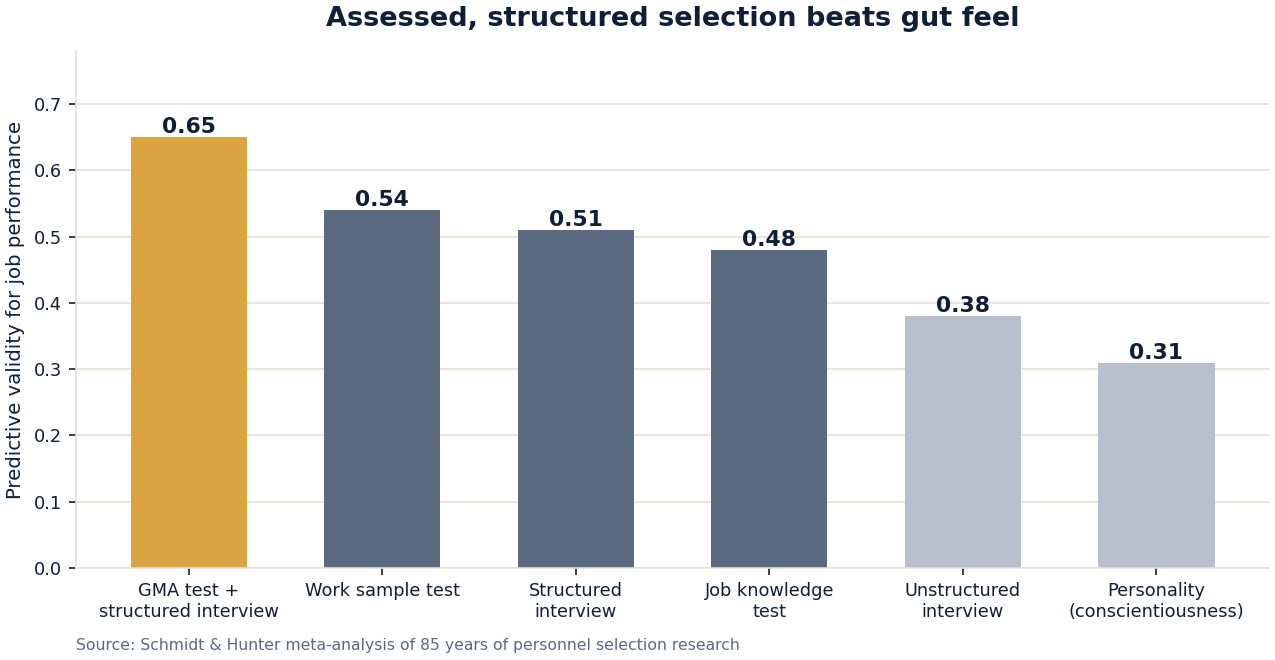
Structure helps here too. Behaviorally anchored rating scales — short descriptions of what low, medium and high performance actually look like — measurably reduce noise, and structured approaches echo the broader evidence base: Schmidt and Hunter's meta-analysis puts the validity of structured interviews around 0.51, dramatically better than unstructured judgment.
Expect the first calibration session to be uncomfortable. That discomfort is the sound of standards being aligned, and it gets easier every cycle after.
From scores to team development plans
Scores are the input; development is the product. Each quarterly cycle should end with three artifacts: an individual development plan per person, a team-level picture of skill gaps, and at most one process change the team agrees to test. Feed the skill-gap picture straight into your training priorities rather than into a drawer.
The payoff for closing those gaps is well measured. LinkedIn's Workplace Learning Report found that 94% of employees would stay longer at a company that invests in their learning, and Gallup ties high engagement — which visible development strongly supports — to 18% higher productivity and 81% lower absenteeism. For managers who inherit a struggling team, delegation is often the highest-leverage skill to build first; the delegation skills guide is a practical starting point. Remote and hybrid leaders should adapt the evidence-gathering layer to documented outcomes using this remote team leadership playbook. PersonaPulse packages include the workbooks and assessments for both, so every development plan has materials attached from day one.
Frequently asked questions
What is a team performance assessment?
It is a structured process for evaluating how a team and its members perform against defined outcomes and behaviors, using evidence rather than impressions. A solid system defines dimensions, gathers evidence on a schedule, scores with calibration and ends in documented development actions.
How is a team evaluation different from an individual performance review?
An individual review rates one person against their goals; a team evaluation looks at shared results, collaboration quality and how work flows between people. You need both — team-level assessment exposes systemic issues that individual ratings hide.
How often should managers run the process?
Quarterly evidence gathering with an annual summary is the practical default. Monthly fifteen-minute check-ins keep evidence fresh, and a quarterly scoring rhythm gives people enough time to act on feedback before the next cycle begins.
What should a performance assessment template include?
Outcome goals with actual results, three to four anchored competency ratings with evidence, a self-assessment section, strengths and risks, no more than three development actions, and sign-off. Anything beyond that tends to go unread.
How do you assess remote or hybrid teams fairly?
Judge on documented outcomes and written artifacts rather than visibility or response speed, and standardize in advance which evidence counts. Explicit criteria matter even more when you cannot observe people working in person.
How do we keep scoring fair across different managers?
Use anchored scales, require an evidence line under every rating, and hold a calibration session where managers score the same examples and reconcile differences. Then publish the standards so employees know what high performance means in your organization.
Your next step
PersonaPulse's Project Leadership Mastery program includes ready-made team assessments, facilitator guides and workbooks, so your managers can run this system without building materials from scratch. To go deeper, read the employee skills assessment framework for structuring skill ratings, or the training needs assessment guide for turning team gaps into a funded training plan. The full PersonaPulse library lists all 169 ready-to-deliver programs.