Only about 35% of organizations maintain a formal succession plan, and DDI's Global Leadership Forecast finds just 12% confident they have a strong bench — enough ready talent to fill critical roles from within. The exposure compounds in three places at once: emergency external hires at premium prices with integration risk, institutional knowledge walking out the door, and high-potential employees leaving for the visibility the internal system failed to give them. Succession planning fixes this — but not the way most organizations attempt it, with an annual grid and a confidentiality shroud. This guide is the working design for HR leaders building a pipeline that holds: critical-role mapping, readiness definitions with evidence, the development mechanics that move candidates, and the board reporting that keeps the system funded.
Why succession planning as an annual spreadsheet fails
The classic artifact — a 9-box grid reviewed once a year — fails for structural reasons: it rates, but does not develop; it names names without readiness evidence; and it ages on contact with the first reorg. Survey-based estimates regularly find most organizations lack a documented, current succession plan for their critical roles, and where one exists it is often a confidentiality-shrouded list of the usual suspects rather than a working system.
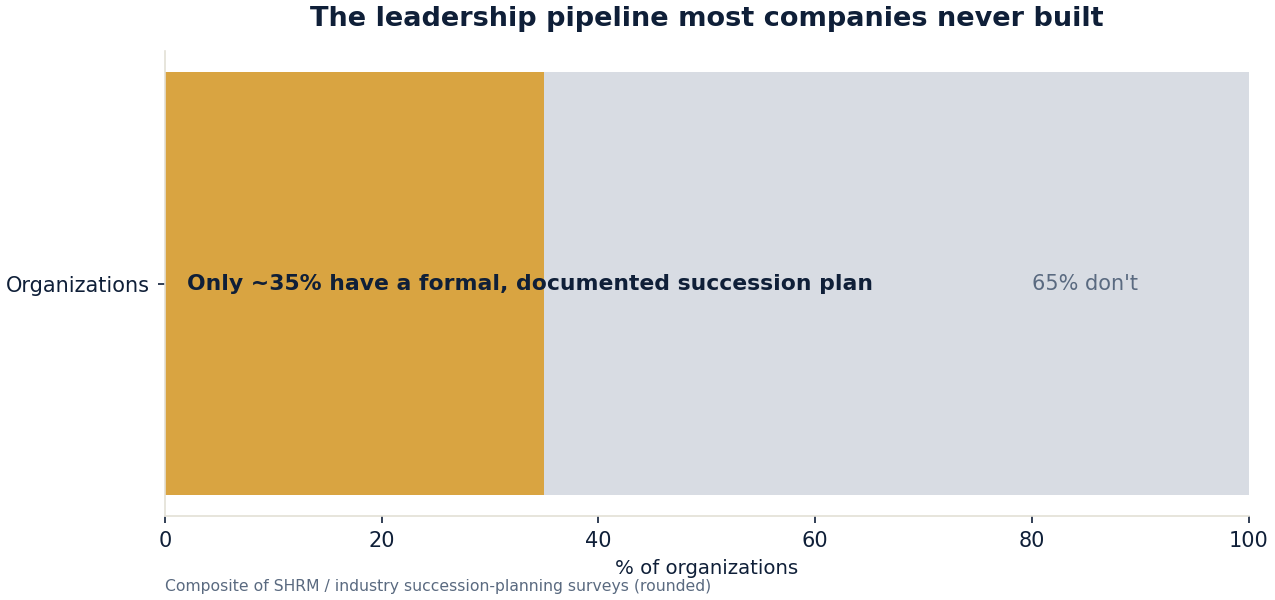
The roughly 65% without a formal plan are not all negligent; most tried once and watched the process collapse into politics. Grids reward the visible, the recent and the well-networked — Gallup's finding that organizations pick the wrong manager 82% of the time is the same selection failure wearing a different hat. What replaces the spreadsheet is a running system, and it starts from roles rather than people.
Critical-role mapping: where the pipeline actually starts
Start from the ~10-15 roles whose vacancy would hurt most — knowledge concentration, revenue dependence, risk exposure, key relationships — not from the org chart's top boxes alone. Critical individual contributors belong here too; the research lead nobody can replace is a succession risk as real as the CFO. For each role, document what it actually takes: the decisions, the relationships, the context a resume never captures.
This role-first lens also disciplines the assessment evidence you collect on candidates. Behavior data from a 360 instrument, structured assessment center exercises and a leadership assessment test all read against the role's real demands rather than against charisma. Aura gets people named; evidence gets them developed.
The working pipeline, step by step
- Step 1 — Map critical roles with the exit-impact lens; refresh semi-annually, because reorgs mutate the list.
- Step 2 — Identify candidates through evidence, not aura: performance history plus demonstrated behaviors. The 360 supplies the behavior data; aura supplies reorgs' favorite candidates.
- Step 3 — Contract the development: each ready-in-2 candidate gets a named stretch assignment at the next scale — leading the integration, owning the turnaround, running the region's worst P&L problem.
- Step 4 — Create visibility deliberately: pipeline candidates present to senior forums; access is the scarce resource, so allocate it on purpose.
- Step 5 — Have the candor conversations: the pipeline advances in real discussions between the role-holder, the candidate and HR — not in silent grids. Readiness bands get named out loud, with evidence.
- Step 6 — Re-measure twice a year: readiness changes, candidates leave (the bench is also a retention signal), and critical roles mutate.
A bench that is never exercised is not a bench. If your "ready now" candidates have not done the next job's work, you have a list of names, not a pipeline.
Readiness needs definitions sharp enough to argue with:
| Readiness band | Definition | Evidence required | Development commitment |
|---|---|---|---|
| Ready now | Has done substantially this job, at this scale | Named sponsor; delivered comparable scope | Interim plan; 90-day handover brief |
| Ready in 1-2 years | Demonstrated the core behaviors one level up | A running development plan | Named stretch assignment this half |
| Ready in 2+ years | High-potential, unproven at scale | 360 baseline; strong performance history | Program seat plus exposure plan |
| Not yet | Capable contributor, not pipeline | None yet | Honest feedback; revisit next cycle |
The 70-20-10 logic from the Center for Creative Leadership governs the engine: readiness is built by assignments (70), exposure and mentoring (20), and targeted learning (10) — the program blueprint supplies the learning layer so the 10% actually arrives on schedule.
The board report: one page, three numbers, two stories
Pipeline systems survive governance when they report in the board's own format. The page carries three numbers — coverage (critical roles with two credible successors), internal-fill rate (trailing 24 months), and assignment completion (ready-in-2 candidates whose stretch assignments ran this half) — against the same numbers from the prior period. Movement matters more than level: a coverage number rising from 30% to 45% tells a better story than a static 60%.
Two stories accompany the numbers, chosen for governance relevance. The risk story: for each critical role still below coverage, the interim plan — who acts if the person leaves this quarter. Boards forgive gaps with interim plans; they do not forgive gaps without them. The win story: one candidate who moved a readiness band this period because of a named assignment, told in three sentences. The win story is not decoration; it teaches the board what the pipeline actually does, which is what protects the budget when the cycle turns.
Twice a year, one page, three numbers, two stories — that cadence is the difference between succession as a system and succession as a slide. It also quietly solves the retention problem the survey data keeps surfacing: LinkedIn's Workplace Learning Report finds ~94% of employees would stay longer at a company that visibly invests in their development, and a named pipeline candidate who gets a real assignment and a senior forum is investment made visible to exactly the people most likely to leave.
The metrics that keep the pipeline honest
- Coverage: share of critical roles with at least two credible successors — the DDI benchmark says most organizations fail this; track it anyway.
- Conversion: internal-fill rate for critical roles over the trailing 24 months. External replacement costs one-half to two times annual salary by Gallup's estimate, with SHRM's research adding recruiting and productivity drag — every point of conversion is avoided cost.
- Movement: share of ready-in-2 candidates whose stretch assignments actually ran this half — the single best predictor of whether the pipeline is real or decorative.
Report the three numbers to the board twice a year. Pipelines survive budget cycles when they are measured; spreadsheets survive until the next reorg. When the metrics stall, the fix is usually development capacity, not more names on the grid.
Where ready-made programs fit
The pipeline's binding constraint is development capacity: every ready-in-2 candidate needs the leadership modules that match their gap, delivered without waiting for a bespoke design cycle. Licensed curricula solve the capacity problem — the Advanced Leadership Mastery kit provides the full senior module set (strategic leadership, coaching, 360-based development, plan templates) for $89.50, deliverable cohort after cohort. Pair it with the Kirkpatrick measurement wiring so readiness claims carry evidence, and the bench stops being a rumor.
Frequently asked questions
What is succession planning?
A running system that maps the roles whose vacancy would hurt most, builds internal candidates toward them through evidence-based readiness definitions and stretch development, and re-measures twice a year — so critical departures trigger a handover, not a crisis.
How many successors should each critical role have?
Two credible successors per critical role is the working standard — one ready now, one ready in 12-24 months. Single-successor benches are fragile: people leave, and "ready" claims without a second name are usually untested.
Is the 9-box grid still useful?
As a conversation-starter about performance and potential, yes; as the system itself, no. Grids rate people; pipelines develop them through assignments, visibility and candor conversations. Use the grid to find candidates, the pipeline to build them.
How does succession planning retain high performers?
Directly: high potentials leave when visibility and growth are allocated informally. A working pipeline allocates both on purpose — named development, senior-forum access, real assignments — which is why strong benches correlate with retention.
What is the first step to start succession planning?
Map critical roles by exit impact, not just seniority, then pick the five with the weakest coverage and build real development contracts for two candidates each. A small, honest, moving pipeline beats a complete, stale grid.
Where do I get the development programs for pipeline candidates?
The Advanced Leadership Mastery kit ($89.50, unlimited cohorts) covers the senior module set, including development-plan templates and 360-based design.
Your next step
Start with five roles, not fifty. Map them, name two candidates each, contract the stretch assignments, and put the learning layer underneath with the Advanced Leadership Mastery program — $89.50 with unlimited internal delivery. Then wire in the re-measure with our 360 implementation guide and browse the PersonaPulse library for the supporting curriculum.