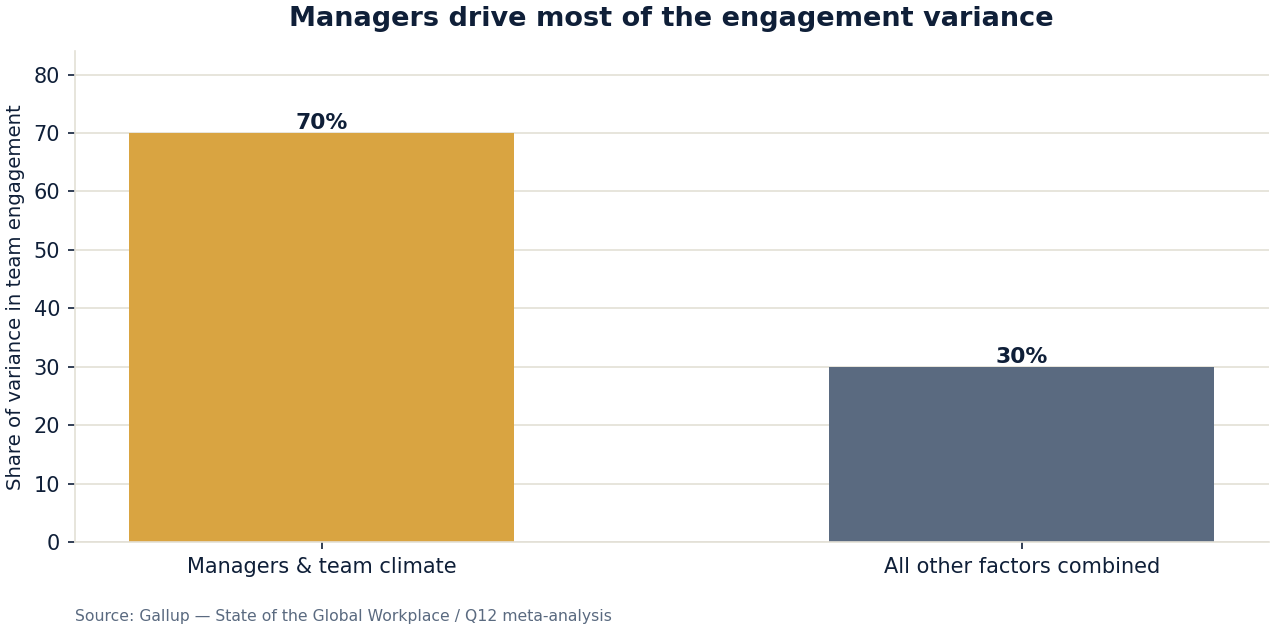
Gallup's engagement research puts a hard number on the lever most organizations still under-train: the manager accounts for roughly 70% of the variance in team engagement — more than pay, perks, or the mission statement on the wall. Situational leadership attacks that lever at the exact point where engagement is won or lost: the interaction between one manager and one person, on one task, on a specific Tuesday. Developed by Paul Hersey and Ken Blanchard in the late 1960s and refined across four decades of manager development, the model makes a deceptively simple promise — there is no single best leadership style, only the right style for this person on this task at this time. The gap between knowing that sentence and doing it under deadline pressure is where training earns its fee. This guide goes deep on the four styles, the two diagnostics that drive them, the failure modes, the development arc and the workshop design that turns a 1970s model into a daily management habit.
The four styles at a glance
The model crosses two dimensions of leader behavior — directive behavior (how much task instruction you give) and supportive behavior (how much relational encouragement you give) — producing four styles. Every manager carries a default style, usually inherited from a previous boss or from whatever worked in their last role. The training's first job is making that default visible, because a style you cannot see is a style you cannot flex. Blanchard's own research has repeatedly found that leaders over-use their preferred style whatever the situation demands, which is exactly why diagnosis gets drilled as a separate skill rather than absorbed as a diagram.
| Style | Behavior mix | Best when the person is... | Opener that signals it | Typical failure mode |
|---|---|---|---|---|
| Directing (S1) | High direction, low support | New to the task; needs exact steps | "Here is exactly how and when — I'll check daily." | Overused, it reads as distrust |
| Coaching (S2) | High direction, high support | Some skill, shaky confidence | "Here's the approach — talk me through your questions." | Becomes hand-holding that never ends |
| Supporting (S3) | Low direction, high support | Capable but hesitant to own it | "You own the how; pressure-test the plan with me." | Thins into absent management |
| Delegating (S4) | Low direction, low support | Proven and confident on this task | "This is yours — flag me if the trajectory changes." | Applied to the wrong task, it is abandonment |
The pairing principle is the whole game: match the style to the person's competence and confidence on that specific task — not to their seniority, tenure, or how much you enjoy working with them. The stakes of getting this wrong are structural, because Gallup's manager-selection research found organizations fail to pick the candidate with genuine management talent about eight times in ten. Many current managers arrive with a single improvised style and no diagnostic habits at all. The four-cell grid is small enough to learn in an afternoon and demanding enough to practice for years.
The two diagnostics that do the real work
Practice fails when managers diagnose by impression — gut feel produces flattering answers and the same style for everyone. Two questions fix the diagnosis:
- Competence evidence: "Has this person done this specific task successfully before, here or anywhere else?"
- Confidence evidence: "If I stepped away for two weeks, would they start without asking me first?" — the honest proxy for motivation.
The four answer combinations map cleanly onto S1 through S4. The model's sharpest insight is that readiness is task-specific: a star analyst can be S4 on financial modelling and S1 on her first hostile client meeting the same morning. Managers who apply one style per person across every task have not yet understood the model they claim to use.
Diagnosis also improves with data. A leadership assessment or 360 baseline gives the manager an evidence-based starting read instead of a first impression — our guide to leadership assessment tests covers the instrument options — and the same discipline applies to reading team members before you hand over the stretch project.
The most common situational-leadership error in the wild: over-supporting an S4 performer. High performers experience S1–S2 behaviors as micromanagement — and Gallup's exit research, which finds roughly half of employees have left a job at some point to get away from a manager, says that is precisely how good people start job hunting.
Where the model breaks (and the recovery moves)
Honest training covers the failure edges, because managers meet them in week one:
- Time pressure snaps managers back to S1. Under deadline stress, everyone directs. Teach the recovery script — name the shift out loud ("I'm going directive this week because of the audit; back to normal after") — because teams forgive the style, not the silence.
- Style is not the person. Managers who "prefer" a style apply it everywhere, which is the one-style failure in kinder language. The diagnostic beats the preference every time.
- Readiness is movable — and that is the point. A style match that never changes is a bench that never grows. The developmental arc below is the model's actual ROI engine.
- Mixed-readiness teams are normal. One person's S1 is another's S4 on the same project. Announce the style per person and per task, never per team, or the over-supported half starts scanning job boards.
The development arc: engineering readiness, not just matching it
The model's ROI engine is not style-matching; it is the deliberate movement of people toward S4 on whole task families. A ready-arc has three stages: structure (S1–S2, you provide the scaffolding and the vocabulary), supported attempts (S2–S3, they act while you pressure-test plans), and ownership (S3–S4, they run it and report by exception). Each stage hands over one thing in sequence: information, then decisions, then narrative. The manager who narrates the handover — "you own this now; I'll ask about it monthly" — converts a private judgment call into a public contract the team can rely on.
Two accelerants move people up the arc faster. Shadow-then-lead rotations put the person next to you on the task family before they run it alone, compressing months of readiness into weeks. Failure previews walk them through the two most likely mistakes and the recovery for each before the first unsupervised run; both accelerants cost minutes and both shave months off readiness. For managers who want the fuller handover system, our delegation guide builds the ladder rung by rung.
This is also the quiet bridge to succession planning. A manager running ready-arcs on core tasks is building exactly the bench that formal succession planning later needs, and DDI's Global Leadership Forecast has found only about one in ten organizations report strong bench strength. Style-flexible managers who develop readiness are the mechanism that moves that ratio.
Designing the workshop so it sticks
A three-hour session that works, module for module:
- Style self-audit (30 min) — participants plot their default style against their last five real interactions; the spread, or the lack of it, is the hook that opens minds.
- Diagnostic pairs (45 min) — real team members, the two questions, style selection, then peer challenge of every diagnosis.
- Mismatch theatre (45 min) — the facilitator plays the same high-competence performer receiving S1 and then S4 treatment; the room feels the difference, which no slide can teach.
- Week assignment — one deliberate style shift with one named person, logged in the workbook and reviewed at the next session.
With ATD's State of the Industry benchmarking direct learning spend at roughly $1,300 per employee per year, a module that produces observable style flexibility in 60 days is one of the stronger returns in the management curriculum. The Situational Leadership program ships this exact arc — deck, facilitator script, workbook pages and assessment — ready to deliver for $89.50, and slots into the broader complete leadership program blueprint as the style-matching module.
Measuring style flexibility at 60 days
Beyond the standard Kirkpatrick levels, situational leadership leaves two behavioral fingerprints. Style spread — how many distinct styles the manager's team reports receiving; a one-style manager is the smell test for the whole intervention. Task-level accuracy — whether the team experiences the style matching the task's readiness, not just varying at random. A five-question pulse to each participant's team at 60 and 90 days captures both, and the delta against the pre-program pulse is the Level-3 evidence that survives budget review.
Set that against the backdrop Gallup's State of the Global Workplace keeps documenting — only about one in four employees engaged at work — and the measurement case writes itself. Cohorts that pair the pulse with one-to-one cadence tracking catch regression early, because stress regression to S1 shows up in a pulse survey weeks before it shows up in resignations.
Frequently asked questions
What are the four situational leadership styles?
Directing, Coaching, Supporting and Delegating — combinations of high/low directive and supportive behavior. The correct style is selected by the person's competence and confidence on the specific task, not by their seniority or your preference.
Is situational leadership still relevant?
More than ever. Hybrid teams mix expertise levels on unfamiliar tools constantly — exactly the condition the model was built for — and project-based work shifts roles monthly. Gallup's manager-variance data keeps the one-to-one interaction at the center of the engagement problem.
What is the difference between situational leadership and servant leadership?
Situational leadership is a style-matching diagnostic; servant leadership is a values stance in which the leader exists to grow the team. They combine well — the servant leader still chooses Directing for a safety-critical task — as our servant leadership evidence review discusses.
How do you diagnose readiness without offending people?
Diagnose the task, never the person. "For this specific launch, have you run this sequence before?" reads as planning, not judgment, and keeps the conversation diagnostic rather than evaluative.
Can one manager realistically flex styles?
Yes, with rehearsal rather than willpower. Facilitated style-shift practice produces visible flexibility in weeks; the residual failure mode is stress regression to S1, which the recovery script handles.
Where can I get ready-made situational leadership training materials?
The Situational Leadership kit includes slides, facilitator script, workbook and assessment under a one-time license with unlimited internal delivery. Compare it with the wider PersonaPulse library before you build from scratch.
Your next step
If you are building a manager curriculum, install situational leadership early — it is the diagnostic layer every later module assumes. The Situational Leadership program gives you the full workshop ready to facilitate for $89.50 one-time, and the first-90-days guide shows how to sequence it for new managers. For the skill that pairs most closely with style-matching, see coaching skills for managers, and browse the full PersonaPulse library for the rest of the LDR track.