LinkedIn's Workplace Learning Report found that 94% of employees would stay longer at a company that invests in their learning and development — and no leadership philosophy leans harder into that investment than servant leadership. Yet the style remains polarizing: some executives treat it as culture-building, others as a polite recipe for indecision. The research literature, now several decades and hundreds of studies deep, supports neither caricature. This evidence review gives HR leaders and trainers an honest read on what servant leadership measurably predicts, where it breaks down, and how to train it without producing either cult or cynicism.
What the research base actually shows
Robert Greenleaf, a retired AT&T executive, coined the term in his 1970 essay The Servant as Leader, proposing that the best test of a leader is whether the people served "grow as persons — become healthier, wiser, freer, more autonomous." Half a century later the construct has been operationalized, validated and meta-analyzed, and the practitioner signal is remarkably consistent. Three findings matter most for anyone designing training around the philosophy:
- Trust is the mediating engine. Servant leadership's strongest, most replicated relationship runs through team trust and psychological safety: leader behavior builds trust, and trust drives everything downstream. Neuroeconomist Paul Zak's research, summarized in Harvard Business Review, quantifies the stakes — employees at high-trust organizations report 74% less stress, 106% more energy and 40% less burnout than those at low-trust organizations.
- Engagement, citizenship and service climate. Studies consistently link servant leadership with more organizational citizenship behavior and a stronger service climate — the mechanism behind the customer-experience gains service organizations report. Gallup's quartile research supplies the business case for chasing that engagement: top-quartile teams outperform bottom-quartile teams by 23% in profitability and 18% in productivity.
- Performance effects are positive but conditional. The effect on hard output metrics is real on average, strongest in service contexts and collaborative work, and weakest where the wider system rewards pure short-term extraction.
Read honestly, the literature positions servant leadership as a trust-building operating style with measurable second-order effects — not a moral accessory, and not a magic growth formula. It is also scarcer than its reputation: Gallup finds only about one in three US employees strongly agrees they received recognition or praise for good work in the past seven days, a deficit servant practices attack directly. Teams notice the difference, and the retention data above suggests they repay it.
The one-sentence evidence summary: servant leadership works through trust, and trust compounds — which is why its effects show up strongest in the metrics (engagement, citizenship, retention) that compound too.
Where it breaks: the four honest failure modes
- Servitude without standards. "Servant" misread as "never discomfort anyone" produces avoided feedback and tolerated underperformance — which is neither service nor leadership. SHRM has long estimated that replacing an employee costs the equivalent of six to nine months of that person's salary, so tolerated underperformance is a quiet, compounding invoice. The corrective: servant leadership includes the hard conversation, delivered in service of the person's growth.
- Boundary collapse. Leaders absorb unlimited load "for the team" and burn out or quietly resent. McKinsey Health Institute surveys find roughly one in four employees reporting burnout symptoms, and servant leaders who treat self-erasure as a virtue join that quarter. Sustainable service requires boundaries as an explicit, taught skill.
- Cultural mismatch without adaptation. In steep, speed-obsessed cultures the vocabulary can read as weakness; the behaviors — grow people, remove obstacles — still work but need framing in the local operating language.
- Executive-system contradiction. If promotion criteria reward empire-building, servant-leader middle managers get crushed in the middle. Training without a system review manufactures cynicism faster than no training at all.
Every failure mode above is a design problem, not a character problem — which is good news, because designs can be trained, coached and audited. Program designers should build the countermeasures into the curriculum rather than hoping cohorts improvise them under pressure.
The five trainable practices
Practice-based training converts the philosophy into five recurring behaviors. Each has a behavioral anchor and a metric, so cohorts leave with definitions they can be observed against:
| Practice | What it looks like in the calendar | Metric it moves |
|---|---|---|
| Obstacle-removal rounds | A standing question in every one-to-one: "what is blocking you that I can remove this week?" | Blocker cycle time; pulse item "my leader removes obstacles" |
| Growth conversations | One named development goal per direct report, actively worked | Internal mobility; pulse item "my leader grows my career" |
| Standards with care | Situation-behavior-impact feedback delivered within 48 hours of the event | Performance distribution; regretted attrition |
| Credit routing | Public credit to the team, private accountability for failures | Recognition pulse; discretionary effort |
| Boundary rituals | Explicit load-limit conversations each quarter | Burnout pulse; after-hours work trends |
The Servant Leadership in Practice program packages exactly this practice core — scenarios, facilitator script, workbook, assessment — for $89.50 unlimited delivery, with the failure modes addressed head-on rather than glossed over.
Adapting the stance: operations, sales and technical teams
The philosophy travels, but the practices need local dialects. In operations, servant leadership speaks reliability: obstacle-removal rounds become visible unblocker boards reviewed at shift handovers, and credit routing happens where the team actually hears it rather than in all-hands slides nobody remembers. The measures that matter are flow measures — queue lengths, handover defects — and servant leaders earn credibility by clearing them.
In sales, the trap is incentive contradiction: a servant-leader language layered on top of purely individual compensation produces cynicism within a quarter. The adaptation is team-goal components plus public credit for assists, so the scoreboard and the sermon agree. Coaching-heavy sales managers already practice the growth conversation; the training names it and makes it routine.
In technical teams, the entry point is craft respect: leaders who unblock by removing dependencies and shielding focus time earn the right to be heard on standards, while leaders who open with "service" vocabulary and no demonstrated competence get tuned out. The consistent rule across all three contexts: demonstrate one practice visibly before naming the philosophy. Teams extend trust to leaders who remove an obstacle first and explain the stance second. Training cohorts should therefore leave each module with one practice to run within the week, because servant leadership adopted as vocabulary without practice is indistinguishable from ordinary management with better adjectives.
Measuring it without the mush
The retention payoff is real but lagging, so measurement starts with the leading indicators. 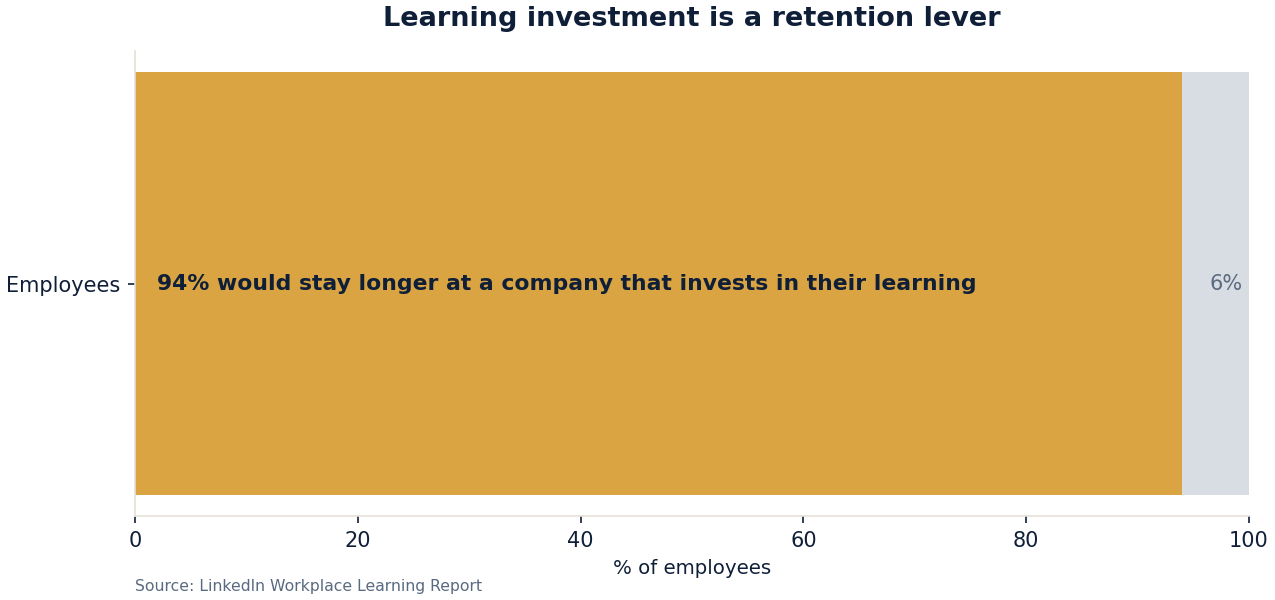
Trust and safety items are the earliest signals you can move: "I can raise problems here without fear," "my leader removes obstacles for me," "my leader actively grows my career" — baselined before the program and re-pulsed at 90 days, wired into the standard Kirkpatrick evaluation. Retention, citizenship ratings and internal-mobility rates follow with a one-to-two-quarter lag, so promise them as trends rather than day-one guarantees. The discipline matters doubly here because servant leadership attracts more skepticism than most styles — a cohort that cannot show its own evidence will be remembered for the slides, not the service.
How it connects to the wider leadership stack
Servant leadership pairs naturally with the diagnostic flexibility of situational leadership: the values stance sets the goal (grow people), and the situational toolkit chooses the style for each task and each person's readiness. It also supplies the philosophical spine for the inclusion behaviors in our inclusive leadership guide — equitable airtime and transparent opportunity allocation are servant practices with rubrics attached. And because growth conversations are the engine room of the whole stance, the coaching skills toolkit supplies the conversation mechanics servant leaders need on Monday morning.
Frequently asked questions
What is servant leadership in simple terms?
A leadership stance where the leader's primary job is to grow people and remove obstacles so the team can perform — with standards held firmly and credit routed to the team. It is defined by observable practices such as obstacle-removal rounds and growth conversations, not by softness.
Does servant leadership improve performance?
The research shows positive average effects operating mainly through trust, engagement and citizenship behaviors, strongest in service and collaborative contexts. It is a trust engine rather than a direct performance lever, and it fails when practiced without standards or in systems that contradict it.
Is servant leadership the same as being a pushover?
No — that is the most common misreading. The evidence-based version includes direct challenge delivered with care; avoiding hard feedback is a documented failure mode of the philosophy, not a feature of it.
Can servant leadership work in a fast, competitive culture?
Yes, with framing adaptation: the behaviors — obstacle removal, growth focus, credit routing — survive translation even where the vocabulary does not. The system check, whether promotion criteria reward the behavior, matters more than the culture's volume.
How do you train servant leadership?
Practice, not sermon: five trainable practices rehearsed with real scenarios, each wired to a pulse item or business metric, with 90-day re-measurement. Cohorts leave every module with one practice to run within the week.
Where can I get practice-based servant leadership materials?
The Servant Leadership in Practice kit delivers the full program — deck, facilitator script, workbook, assessment — for $89.50 one-time, with unlimited internal delivery.
Your next step
If you want the philosophy to survive contact with your operating culture, start with the Servant Leadership in Practice program — the five practices, the failure-mode countermeasures and the measurement wiring in one facilitator-ready package. Deepen the conversation layer with our coaching skills for managers guide, and pair the stance with the style-flexibility logic in situational leadership in practice. Browse the full PersonaPulse library to see every program in the leadership series.