CEB, now part of Gartner, famously found that B2B buyers complete about 57% of their purchase journey before they ever talk to a salesperson. That single number rewired what effective selling looks like — and it should have rewired what sales training tries to fix. Yet most companies still buy sales training the way they buy office supplies: a generic workshop rolled out to everyone, with no diagnosis of who needs what. A structured sales team assessment reverses the order. It tells you which selling skills are actually broken, where, and by how much — before you spend a dollar on training.
Why diagnose before you buy sales training
The economics of guessing are ugly. CSO Insights' sales performance studies have repeatedly put quota attainment at roughly half of reps — meaning about half the investment in seats, enablement, and training produces below-target output. Salesforce's State of Sales research finds reps spend only about 28% of their week actually selling, so even motivated teams have thin capacity for learning that does not directly address their bottlenecks. Training a rep whose real problem is pipeline discipline with a negotiation workshop is not development; it is a very expensive placebo.
An assessment changes the conversation from "who do we send to training" to "what, specifically, is costing us deals." It gives managers evidence for coaching priorities, gives L&D a defensible scope, and gives executives a baseline to measure against later. Skipping the diagnosis does not save money — it just moves the waste downstream, where it is harder to see and impossible to refund.
The anatomy of a sales skills assessment
Effective assessments measure the full arc of the sale, not just closing. A practical model covers:
- Pipeline discipline: coverage ratios, stage progression, forecast accuracy.
- Discovery and questioning: how well reps surface needs before pitching.
- Value articulation: linking features to the buyer's business outcomes.
- Objection handling and negotiation: holding price and trading value instead of discounting.
- CRM and follow-through hygiene: the unglamorous behaviors that compound.
- Post-sale handoff: protecting the customer relationship after the signature.
Rate each cluster on a shared 1-4 scale, combining rep self-ratings, manager observations, and — where possible — scored role-plays. The triangulation matters: self-ratings reveal confidence gaps, manager ratings reveal perception gaps, and simulations reveal actual capability. Where all three disagree, you have found the coaching conversation.
Keep the instrument lean and the language plain. Reps will disengage from anything that reads like a performance audit, so frame every item as "what strong selling looks like here" rather than "where you fall short." Brief the managers before the reps, not after: managers who understand the scoring give more consistent ratings and can defend the process when a rep pushes back. And keep a visible artifact — a one-page team heat map on the sales floor or the Slack channel — because sales teams rally around scoreboards in a way no other function quite does.
Sales assessment test options compared
No single tool does everything, and the tool you choose should match the decision you are making. Here is the landscape:
| Tool | What it predicts | Best use | Watch-outs |
|---|---|---|---|
| Behavioral skills assessment (rater-scored) | Discovery and consultative behaviors | Development planning | Needs trained, calibrated raters |
| Cognitive and aptitude tests | Learning agility, ramp speed | Hiring and territory expansion | Review for adverse impact |
| Selling-style and personality inventories | Motivation, resilience, work style | Self-awareness and team design | Never use as a pass/fail filter |
| Role-play simulations | Live skill under pressure | Pre-training baseline | Requires a scoring rubric |
| CRM and activity analytics | Discipline and pipeline hygiene | Coaching priorities | Measures activity, not skill |
For development decisions, lead with rater-scored behavioral assessments and simulations, because they measure what coaching can actually change. For hiring, add cognitive and style inventories — but validate them on your own top performers before trusting the vendor's benchmark. If your scope extends beyond sales, our guide to corporate assessment tools maps the full toolkit, and our training needs assessment guide shows how to prioritize what to fix first across functions.
A four-week rollout managers will actually run
Week 1: baseline. Run the assessment, pull six months of CRM data, and let each rep self-rate. Week 2: debrief. Every rep gets a thirty-minute one-on-one on their profile, and each manager leaves with three coaching priorities per rep. Week 3: plan. Reps choose one or two behaviors to change, matched to the clusters that scored lowest. Week 4: measure and iterate — schedule scored role-plays for 60 and 90 days out, and agree upfront which pipeline metrics should move if the training works.
Keeping the whole cycle inside a month matters for adoption. Sales cultures respect speed, and an assessment that drags across a quarter gets abandoned mid-flight. The managers who run this well treat it as the opening move of coaching, not as an HR paperwork exercise.
Engagement sets the ceiling on sales performance
Skills set the floor of what a rep can do; engagement decides how close to the ceiling they actually operate. Gallup's long-running engagement research finds that business units in the top quartile of engagement outperform bottom-quartile units by about 23% on profitability and 18% on sales productivity, alongside materially lower turnover and absenteeism:
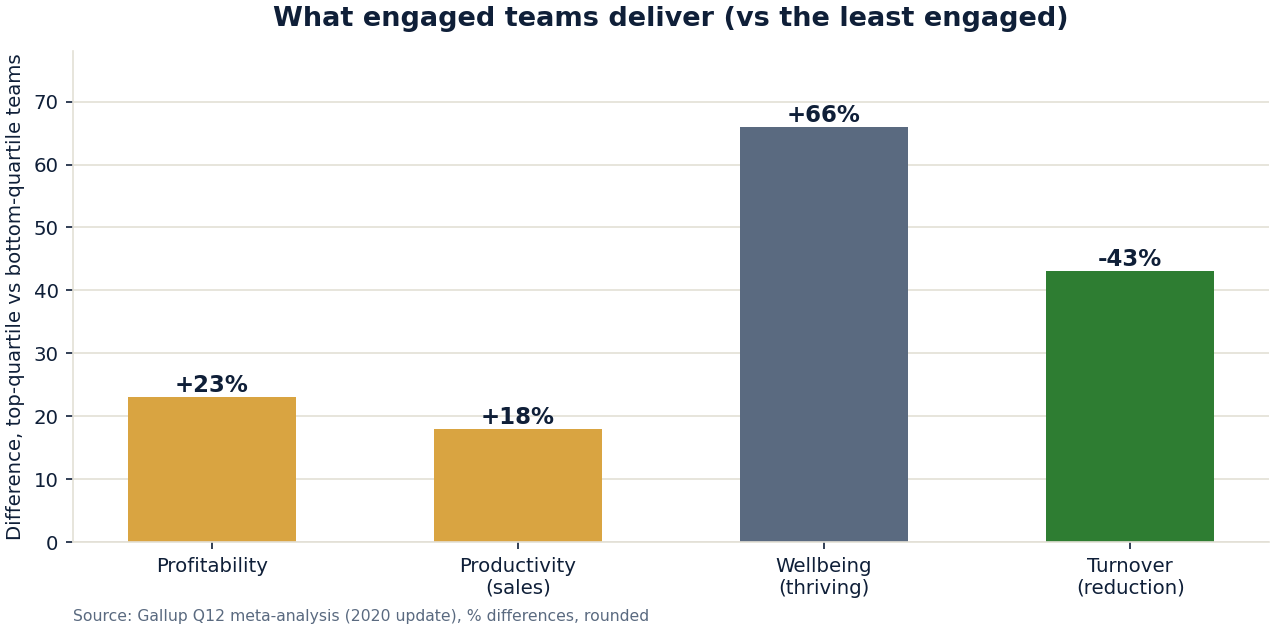
The implication for assessment design is direct: measure the manager's coaching behaviors alongside rep skills, because Gallup's manager research shows managers explain most of the variance in team engagement. Gartner's buying research adds the urgency — buyers now spend only about 17% of their purchase journey meeting with any supplier's salespeople, so every buyer-facing behavior counts double. A rep with excellent discovery skills who is disengaged will still lose to a modestly skilled but fully engaged competitor more often than leadership expects.
Frequently asked questions
What is a sales team assessment?
It is a structured measurement of your sales team's skills and behaviors against the demands of your sales motion — typically covering discovery, value articulation, negotiation, and pipeline discipline. Output is usually a per-rep profile, manager-level coaching priorities, and a team heat map. The point is diagnosis before investment, not grading for its own sake.
What is the best sales assessment test for hiring versus development?
For hiring, use validated cognitive or aptitude tests plus a structured interview and, where feasible, a role-play simulation. For development, lead with rater-scored behavioral assessments and simulations, because they measure coachable behaviors. Using a personality inventory as a hiring pass/fail filter is the single most common misuse.
How long does a sales skills assessment take?
A well-designed cycle needs about 20-30 minutes of assessment per rep plus 30 minutes of manager debrief, with the full rollout fitting inside four weeks. Simulations add an hour per rep but deliver the most decision-useful data. Anything longer tends to stall in a busy sales quarter.
Should we use personality tests with salespeople?
Yes, as a self-awareness and team-design input — no, as a hiring verdict. Selling-style inventories help reps understand how they come across and help managers tailor coaching. They predict success far less reliably than vendors imply, so never let one decide who joins or stays.
How do we know if sales training actually worked?
Agree on the measure before training starts: scored role-play improvement at 60-90 days, plus one or two pipeline metrics the skills should move — stage progression, discount rate, or win rate. Compare against the assessment baseline rather than vague impressions. If nothing was measured before the workshop, the honest answer is that no one will ever know.
How often should we assess the sales team?
Once or twice a year for the full cycle, with lightweight coaching check-ins quarterly. Twice a year gives enough separation for development to show up in the data. Re-baseline after major changes — a new sales motion, a new product line, or a reorganization — because the old scores no longer describe the job.
Your next step
If the diagnosis points to consultative selling gaps, PersonaPulse's Consultative Selling Mastery program (course page here) includes ready-made assessments, role-play scoring sheets, and workbooks — so your managers can run the baseline before the workshop, not after. To widen the lens, read our guide to the team performance assessment system for whole-team diagnostics, or see how the same logic applies to support functions in our customer service assessment guide. Browse the full PersonaPulse library to compare all 169 ready-to-deliver programs.