Hybrid work settled into permanence; the leadership capability did not settle with it. Buffer's State of Remote Work survey consistently finds around 98% of remote-capable workers want at least partial location flexibility, while Microsoft's Work Trend Index found 85% of leaders saying hybrid has made it hard to be confident their people are productive — even as 87% of those employees say they are productive. Researchers named the gap productivity paranoia. Meanwhile the randomized controlled trial Nick Bloom's team ran with Trip.com, published in Nature, found hybrid working cut attrition by roughly a third with no productivity loss. The evidence verdict: distributed work works when — and largely only when — the leadership layer is rebuilt for it. This playbook is that rebuild, written for HR leaders designing the capability and trainers delivering it.
The trust architecture: from surveillance to outcome contracts
The paranoia gap is a measurement-model failure, not a motivation failure. Leaders trained in office-era signal-reading — who arrives, who lingers, who looks busy — have no calibrated replacement, so they substitute surveillance: activity metrics, camera checks, green-dot watching. Surveillance reliably destroys the trust the arrangement depends on, and Gallup's research finds about nine in ten remote-capable employees prefer some remote flexibility, so the trust tax gets paid by nearly everyone. The rebuilt operating model has three layers:
- Outcome contracts — each person knows what "a good week" looks like in delivered outcomes, not hours or presence.
- Visible work streams — shared boards and written updates replace corridor awareness; the work becomes the status report.
- Sacred synchronous time — meetings must justify synchrony (decisions, conflict, connection) and everything else goes async.
Managers do not adopt that model from a memo. It needs the same rehearsal discipline as any other leadership skill, which is why we package it as facilitator-led modules in the Remote and Hybrid Team Leadership program rather than as an intranet policy.
The cadence stack that replaces the office
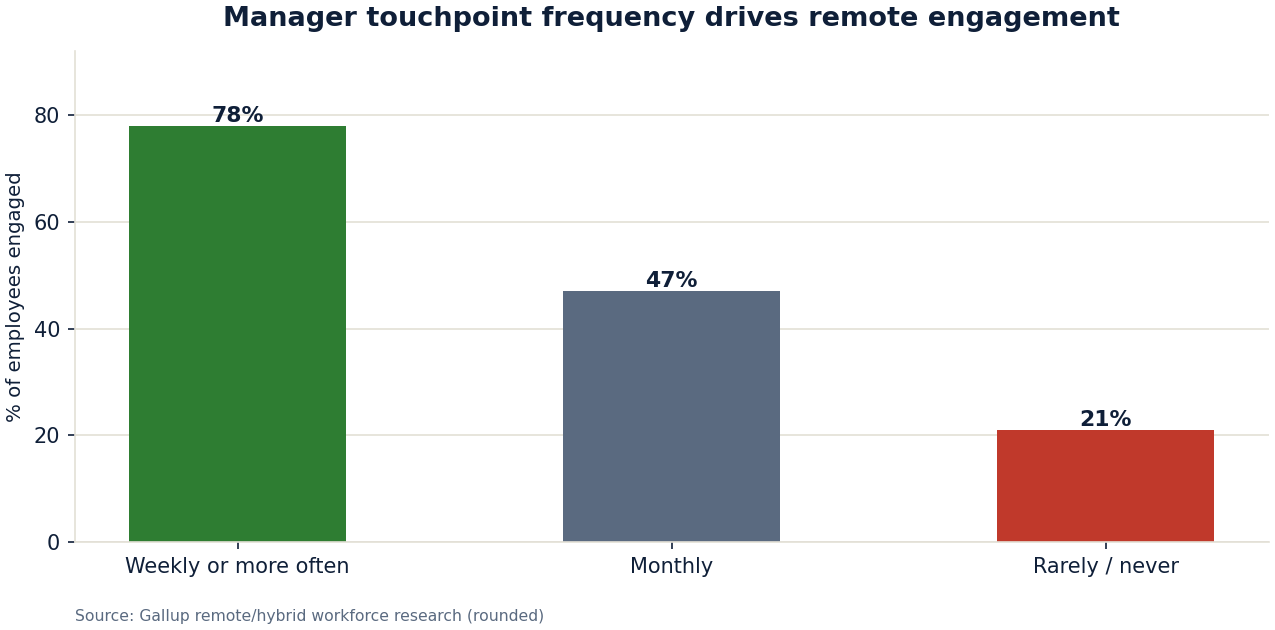
Distributed teams fail by drift, not explosion, and the cadence stack is the anti-drift system. Gallup's engagement research shows why the manager's rhythm carries so much weight: engagement runs dramatically higher when managers check in weekly than when contact thins to monthly or rarer.
| Cadence | Ritual | What it replaces | KPI to track |
|---|---|---|---|
| Daily | Written standup: yesterday, today, blockers | Corridor awareness | Standup participation |
| Weekly | Team meeting where the agenda is decisions, not updates | Status theatre | Decisions logged per week |
| Biweekly | One-to-one that starts with the person, not the pipeline | Office osmosis | 1:1 cadence attainment |
| Quarterly | Deliberate in-person gathering with a purpose | Culture-by-proximity | Pulse on connection |
The one-to-one is the single meeting hybrid managers most consistently under-run — and the one with the highest engagement cost when skipped. Track the cadence KPI before anything else, and treat a missed one-to-one as an operational incident rather than a scheduling accident. For the mechanics of those early conversations with a brand-new manager, our first-90-days toolkit scripts the first three one-to-ones line by line.
Inclusion mechanics: the two-camera rule and beyond
Hybrid's hidden failure is the two-tier meeting: the room, and the boxes. Microsoft's Work Trend Index found the most-cited hybrid challenge for employees is not the commute — it is not knowing when or why to come in, which is a coordination failure that managers own. Inclusion is mechanical or it is fiction:
- One person, one screen — if anyone is remote, everyone joins from their own camera; the room buys its own equality.
- Remote-first artifacts — documents and boards live where everyone edits equally; the room does not get the whiteboard.
- Rotation discipline — who speaks first, who gets the early slots, who presents: rotate deliberately, because hybrid defaults silently reward proximity.
- Equal-challenge norm — remote questions get the same depth of answer as in-room ones; no "let's discuss after the call" for the boxes.
Train these as mechanics with a checklist, not as values with a slide — the behaviors survive contact with Tuesday precisely because they are mechanical.
Async decision-making: the written leadership craft
Hybrid organizations run on decisions, and the cheapest quality upgrade available is moving routine decisions from meetings to documents. The mechanics are teachable in one module: a decision brief (context, options considered, recommendation, what breaks if we are wrong) posted with a comment window; a silence-is-consent rule with an explicit deadline — objections by Thursday 16:00 or we proceed; and a decision log recording what was decided, by whom, and the review trigger. Together they replace the meeting where the loudest voice wins with a paper trail the whole team can audit.
Three habits make the craft stick. Decisions get classified at the top of every brief — reversible, so the process stays deliberately fast; irreversible, so it widens input, the same split our leading-through-uncertainty toolkit trains. Disagreement moves into the comments, where it is searchable, rather than into side channels, where it festers. And the manager's role shifts from decider to editor: tighten the options, name the real constraint, let the owner sign. Teams that adopt the discipline usually discover their meeting load was mostly decision theatre — and the recovered hours are the first dividend of good hybrid leadership.
What to train — and what to retire
A credible hybrid-leadership curriculum covers six capabilities: outcome-contract writing, written communication as a leadership tool, asynchronous decision-making, trust calibration without surveillance, hybrid meeting facilitation, and recognizing distance-burnout signals early. Each maps to an observable artifact a facilitator can score — a contract, a brief, a decision log — which is what makes the program measurable rather than inspirational.
What it should retire: "camera-on means engagement" folklore, any module that treats remote as a temporary inconvenience, and productivity-surveillance tooling presented as a leadership solution. Where the module sits inside a wider manager curriculum, our complete leadership program guide shows the sequencing — hybrid leadership lands best after core one-to-one and feedback skills, when the rehearsal can attach to real meetings instead of role-plays.
Measurement that respects the model
Level-3 behavior evidence for hybrid leadership uses artifacts, not vibes: one-to-one cadence attainment, outcome-contract coverage (share of team members with a written good-week definition), decision-log adoption, and team pulse items on inclusion — "my contributions are equally visible regardless of location." The Kirkpatrick wiring is identical to co-located programs; only the artifacts differ.
The stakes justify the measurement. SHRM's cost-of-turnover research puts replacing an employee at the equivalent of six to nine months of salary — and the Nature trial's finding that good hybrid management cuts attrition by a third makes the program's business case arithmetic rather than aspiration. Teams that track cadence attainment weekly catch the drift early; teams that measure only annual engagement inherit the drift as a resignation letter.
Frequently asked questions
What is the biggest mistake leaders make with hybrid teams?
Importing office-era management signals instead of rebuilding for outcomes. Surveillance-flavored management measurably erodes the trust that makes hybrid work, and drives exactly the attrition the arrangement was meant to reduce.
How often should remote one-to-ones happen?
Biweekly minimum, weekly for anyone new, struggling or remote-only. Gallup's check-in data shows engagement falling steeply as contact thins past weekly, and the Nature trial's engagement gains came with structured management attention — cadence is the load-bearing wall.
How do you build culture in a distributed team?
Through deliberate connection points — virtual coffees with actual structure, quarterly in-person gatherings with purpose — plus visible appreciation rituals in written channels. Culture in distributed teams is what gets repeated in writing, because writing is the medium.
Do cameras need to be on?
For connection-heavy moments (one-to-ones, difficult conversations, team socials) yes; for execution-heavy blocks, no. Mandatory all-day cameras are a trust tax paid by everyone to solve a problem only weak outcome contracts create.
How do you measure productivity without micromanaging?
Outcome contracts plus delivery evidence on shared boards. If "a good week" is undefined, no measurement will feel fair; once it is written, the conversation moves from activity to results.
Where can I get ready-made hybrid leadership training?
The Remote and Hybrid Team Leadership kit delivers the full playbook — deck, facilitator script, workbook, assessment — for $89.50 one-time with unlimited internal delivery. Compare it with the rest of the PersonaPulse library before building in-house.
Your next step
If hybrid is now your default operating model, train the leadership layer before you redesign the policy layer — the capability is the constraint. The Remote and Hybrid Team Leadership program packages this playbook ready to facilitate, and the leadership development program guide shows where it slots into a full manager curriculum. Browse the complete PersonaPulse library for adjacent tracks, from first-time-manager essentials to leading through ambiguity.