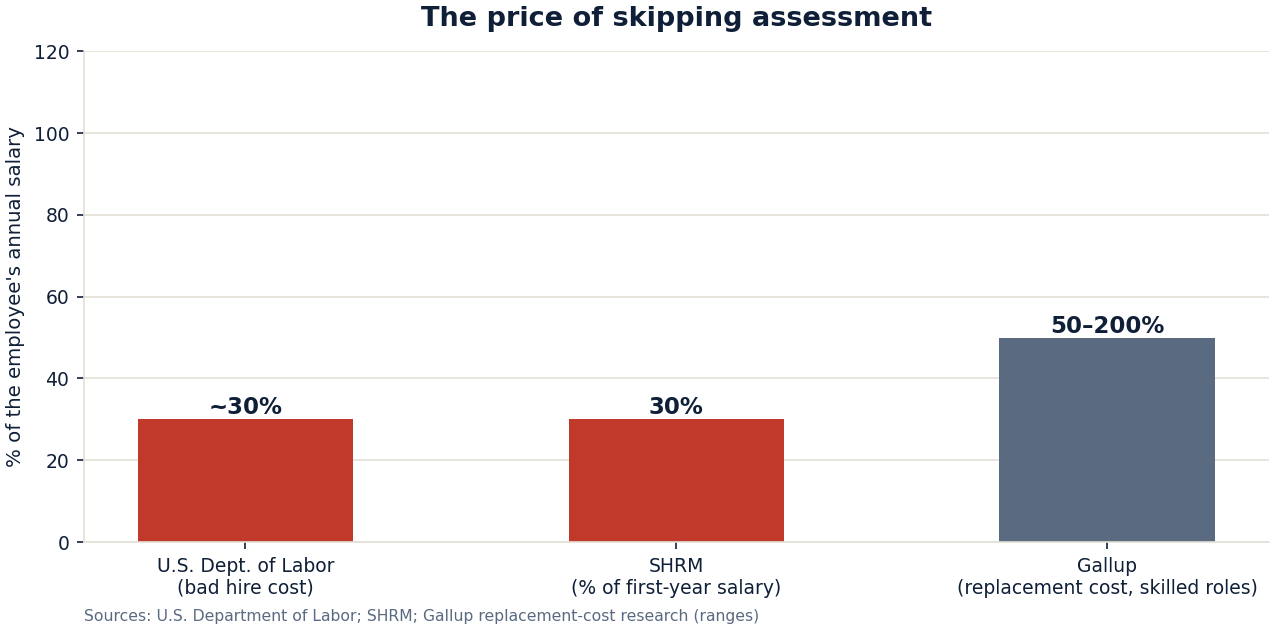
The U.S. Department of Labor estimates that a bad hire costs an organization at least 30% of that employee's first-year salary, and CareerBuilder's employer survey put the average loss per failed hire at nearly $17,000 once wasted time and re-recruiting are counted. With SHRM benchmarking average cost-per-hire at roughly $4,700, few organizations can afford to keep selecting on résumé polish and interview charm. A pre-employment assessment test replaces impressions with evidence by measuring a candidate's skills, abilities and behavioral fit before an offer is made. Used well, a hiring assessment test is the most predictive and most defensible step in your recruiting funnel. Used carelessly, it creates legal exposure and drives good candidates away. This guide covers both sides — what these candidate assessments are, which types predict performance, and how to deploy them fairly.
What is a pre-employment assessment test?
A pre-employment assessment test is a structured instrument administered during hiring to measure job-relevant capabilities — hard skills, cognitive ability, personality traits, judgment or integrity — using consistent scoring so candidates can be compared on evidence rather than gut feel. It sits alongside, not instead of, the interview and reference checks: the assessment generates comparable data, while interviews probe context and motivation.
Placement matters. Screening assessments work best early, when the funnel is wide and the per-candidate cost must be low; deeper work samples and simulations fit the shortlist stage, where investment per candidate is justified. The economics justify the discipline: beyond the U.S. Department of Labor's 30% rule of thumb, replacement costs for skilled and leadership roles commonly run from 50% to 200% of annual salary once recruiting, onboarding and lost productivity are counted.
Treat every candidate assessment as one data point in a structured decision, and document the role it played — that record is your first line of defense if a rejected candidate ever asks why.
Types of hiring assessment tests
Different tests answer different questions, so the first design decision is which question you need answered. The main categories:
| Type | What it measures | Predicts best | Key watch-out |
|---|---|---|---|
| Cognitive ability | Reasoning, learning speed, problem solving | Performance in complex, changing roles | Adverse impact risk; keep it job-relevant |
| Skills and job knowledge | Hands-on proficiency with tools, methods, knowledge | Immediate productivity in technical roles | Content ages quickly |
| Personality inventories | Work style, conscientiousness, motives | Fit, retention, team dynamics | Never use as a standalone screen |
| Situational judgment | Decision quality in realistic scenarios | Role-specific judgment, service quality | Scenario realism matters |
| Integrity tests | Attitudes toward rules and counterproductive behavior | Reliability in high-trust roles | Candidate reaction requires care |
| Work samples | Output on a realistic task | Short-term job performance | Takes longer to score |
A practical pattern for most roles: a short cognitive or skills screen for all applicants, a work sample or simulation for the shortlist, and a behavioral interview scored against the same competencies. Layering methods matters because each adds predictive power — the research below shows why.
What the research says about predictive validity
Frank Schmidt and John Hunter's famous synthesis of 85 years of selection research remains the clearest guide to what works. Work samples predicted job performance at 0.54, structured interviews at 0.51, and general mental ability combined with a structured interview reached 0.65 — the highest value in the study. Unstructured interviews, still the default at most companies, managed only 0.38.
Read that as hiring advice rather than academic trivia. Choose assessments that mirror the actual job, score conversations with structure, and combine two valid methods rather than relying on any single instrument. The same logic extends into leadership selection, where the stakes multiply — our leadership assessment test guide covers that domain in depth.
Legal and fairness rules you cannot skip
Assessments used for hiring are employment selection tools, and in the United States that places them under EEOC uniform guidelines. The practical requirements are straightforward: the test must measure something the job actually requires, you must be able to show evidence of job-relatedness, and you should monitor selection rates for adverse impact across demographic groups. Candidates with disabilities are entitled to reasonable accommodations in test administration, and several jurisdictions — New York City's Local Law 144 is the prominent example — now require independent bias audits for automated hiring tools.
None of this argues against assessment; it argues against unvalidated assessment. A skills test built from a proper job analysis is usually more defensible than an improvised interview, because its content and scoring can be documented. Keep validation evidence on file, apply cut scores consistently, and hold AI-assisted screening to the same standard as it matures.
How to add candidate assessments to your hiring process
Six steps take a team from curiosity to a working process:
- Define the success profile. Run a short job analysis: the tasks that matter, the competencies behind them, the minimum proficiency needed. A competency framework makes this reusable — our competency assessment framework guide is the scaffolding.
- Pick job-relevant instruments. Match each competency to one test type; resist buying a platform before the profile exists.
- Set cut scores before you see candidates. Decide in advance what "good enough" looks like, based on the role, not on whoever applies.
- Respect candidate time. Keep screening under 30 minutes, explain why you ask, and share feedback where possible. Candidate experience is part of the assessment's validity.
- Structure the interview around the results. Use the assessment to target interview probes — evidence confirms or challenges the score, not vibes.
- Record and review. Track pass rates, source quality and first-year performance of hires; the data becomes next year's baseline and feeds your broader corporate assessment tools strategy.
For roles that manage people, add one more consideration: hiring managers need the skills to run structured interviews and score them consistently. Ready-made packages such as our first-time manager program include those interview guides, scoring rubrics and assessments, so the process does not collapse when it reaches the hiring manager's desk.
Frequently asked questions
What is a pre-employment assessment test in simple terms?
It is a standardized test or exercise given to job candidates to measure skills, abilities or work behavior relevant to the role. Results are scored consistently so applicants can be compared objectively. Think of it as evidence that complements the interview, not a trick to eliminate people.
Can you fail a pre-employment assessment?
Candidates can score below the cut score a role requires, though well-designed assessments are framed as measures of fit rather than pass-fail exams. Employers should set cut scores in advance, based on the job, and apply them consistently. Sharing a rationale with candidates preserves goodwill and your employer brand.
How long should a hiring assessment test take?
Screening assessments should stay under about 30 minutes, and shortlist-stage work samples typically run 45-90 minutes. Beyond that, completion rates and candidate experience drop sharply, especially for in-demand talent. Length should be proportional to the stakes of the decision.
Are pre-employment personality tests legal?
Yes, provided they are job-related, validated and applied consistently under EEOC guidelines. Personality tests should inform fit and development questions, not act as standalone rejection criteria. Some jurisdictions add specific rules, so check local requirements and keep vendor validation evidence on file.
Do assessments replace interviews?
No — the best evidence comes from combining them. A valid assessment gives you comparable data, then a structured interview explores context, motivation and edge cases. Schmidt and Hunter's research shows the combination predicts performance better than either method alone.
What score do you need to pass a candidate assessment?
There is no universal passing score; each employer sets cut scores from a job analysis and, ideally, validation data. More sophisticated organizations use ranges and banding rather than a single threshold. If an employer has not published criteria, focus on demonstrating the role's core skills honestly.
Your next step
Assessment at hiring only pays off if the new hire is then developed — especially first-time managers, where Gallup's research shows most promotion decisions go wrong. The First-Time Manager Essentials program includes ready-made assessments, structured interview guides and scoring rubrics alongside its facilitator materials, so selection and development speak the same competency language. See what the numbers say in our first-time manager statistics roundup, and plan the new leader's entry with our first 90 days training guide. The full PersonaPulse library holds every assessment-equipped training package.