The often-cited estimate that around 70% of change initiatives fall short of their goals — popularized by McKinsey research — has a quieter twin underneath it: most change fails in the months where information is worst. Leading through ambiguity is no longer a crisis skill reserved for turnaround executives; it is the default operating condition for every manager navigating reorgs, AI-driven role shifts, market whiplash and the hybrid dilution of signal. Gallup's finding that managers account for 70% of the variance in team engagement makes the stakes concrete: the person running the meeting decides whether fog paralyzes or focuses a team. This toolkit gives L&D teams the trainable core — decision frameworks for incomplete information, a communication cadence that stabilizes teams, and the psychological-safety practices that keep bad news moving fast enough to matter.
Why ambiguity breaks teams — and what stabilizes them
Teams in uncertain conditions rarely need more information to function — they need more structure. The research on psychological safety explains the failure loop: uncertainty raises the interpersonal cost of speaking up, silence rises, signal drops, decisions worsen, and trust erodes. Google's Project Aristotle famously identified psychological safety as the strongest differentiator of effective teams, and this loop is the mechanism behind the finding. The economics compound the case: McKinsey research finds executives spend nearly 40% of their working time making decisions, and judge much of that time ineffectively used. The stabilizers are the inverse of the failure loop:
- Named uncertainty — leaders say what is known, what is unknown, and when the next update lands. Vagueness is always interpreted as concealment, even when it is caution.
- Decision rights made explicit — who decides what, with what input, revisited as conditions change. In fog, people fight over territory precisely because the map is missing.
- Fast bad-news channels — mistakes surface in hours, not in the post-mortem. The speed of bad news is the single best proxy for a team's health in uncertain periods.
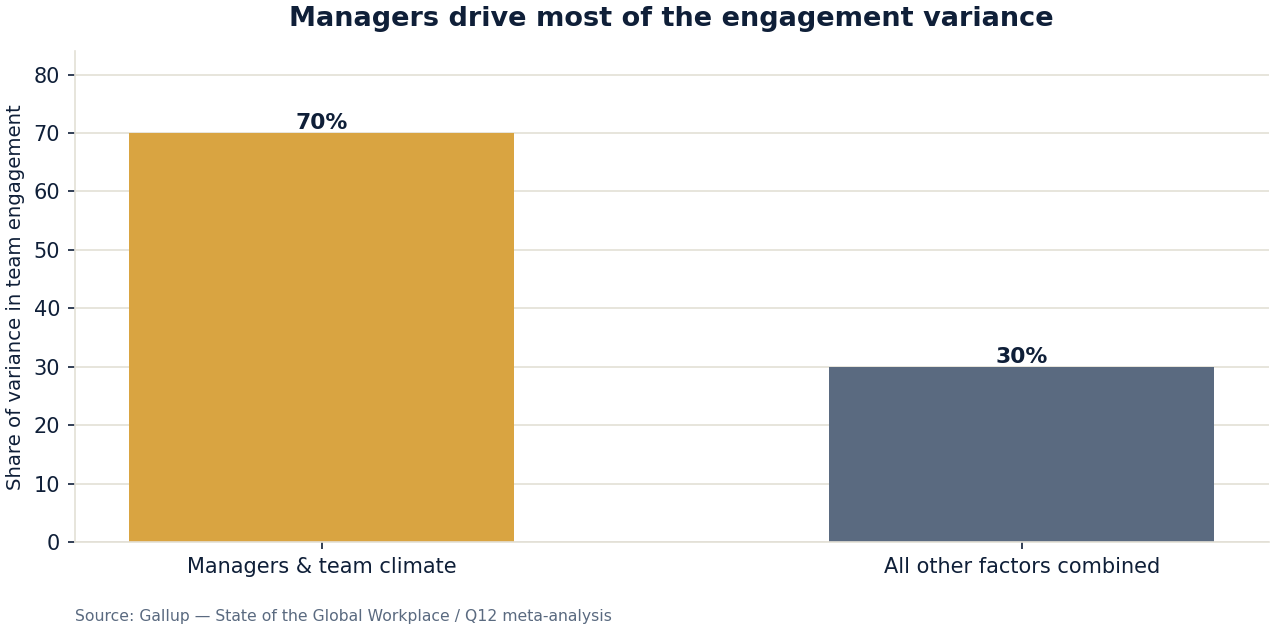
The chart above is the argument for training this capability deliberately rather than hoping for temperament. When Gallup attributes 70% of the variance in team engagement to the manager, it attributes the gap between paralysis and focus in turbulent periods to individual leader behavior — and engagement is not cosmetic under pressure. Gallup's top-versus-bottom quartile comparisons tie engaged teams to double-digit advantages in productivity and customer ratings and to materially lower turnover. The reassuring half of the research is that ambiguity reflexes are demonstrably buildable, which is the design premise of everything below.
Decision frameworks for incomplete information
Two frameworks cover most ambiguous conditions, and both are trainable in a single module. The first is the reversible-irreversible split: classify decisions by how expensive it is to unwind them. Reversible calls get speed and local ownership — decide fast, at the lowest capable level, review cheaply. Irreversible calls get deliberate slowdown, wide input, and pre-committed kill criteria. Most organizational paralysis comes from running reversible decisions with irreversible caution, and most organizational disasters come from the reverse.
The second is the 70% rule paired with pre-mortems: if you are waiting for 90% confidence, the window has already closed, so act at roughly 70% with explicit review triggers. Pair it with Gary Klein's pre-mortem — "it is eighteen months from now and this decision failed; why?" — which surfaces the risks that confidence hides. Together the two frameworks produce a decision map the team can apply without the leader in the room, which is the actual test of a trained capability.
| Decision class | Speed | Input required | Guardrail |
|---|---|---|---|
| Reversible ("two-way door") | Days, at the lowest capable level | One owner, light consultation | 30-day review; cheap to unwind |
| Irreversible ("one-way door") | Weeks, deliberately slowed | Wide input plus a pre-mortem | Written kill criteria; staged commitment |
| Recurring and routine | Instant, by protocol | None — automated | Quarterly protocol review |
The table gives cohorts a shared vocabulary for the split, borrowed in spirit from Jeff Bezos's one-way versus two-way door framing. The Leading Through Ambiguity program builds exactly these frameworks plus a stakeholder-communication module, packaged as facilitator-ready sessions with workbook exercises and assessments — $89.50, unlimited cohorts.
The communication cadence that holds teams together
Ambiguity communication is a calendar discipline, not a charisma contest. The churn behind the fog is structural: the World Economic Forum's Future of Jobs research expects roughly four in ten core job skills to change within five years, which means teams will live in semi-permanent transition and need rhythm more than reassurance. Three mechanics do the work:
- Fixed update rhythm — same slot, same format: what we know, what we don't, what changes for you, next update date. Predictability itself is the intervention; teams calibrate anxiety to the calendar.
- Question-first forums — open Q&A with anonymous submission; unasked questions become corridor narratives within days, and corridor narratives are always worse than reality.
- One-page narrative — every significant change gets a written page (context, decision, implications, timeline) before any town hall; reading beats rumor and survives the retelling.
These mechanics slot into any broader manager curriculum — see the complete leadership program guide for placement, and the remote leadership playbook for the distributed-team variants, where written cadence matters double.
The safety practices that keep signal flowing
Harvard's Amy Edmondson has spent three decades documenting the same finding: teams that feel safe admit errors earlier, ask for help sooner and learn faster — and leaders manufacture that safety through observable behaviors, not posters. Three practices carry most of the load. Leader vulnerability first: "here is what I got wrong last month" is the permission slip for everyone else's honesty. Normalize the flag: a concern raised in week one is publicly thanked even when it proves false, because punishing false alarms ends all alarms. Post-mortems without blame: a systems lens — "what made this mistake easy?" — instead of a person lens that ends the conversation. Note the compounding: safety practices feed bad-news speed, which feeds decision quality, which feeds trust — the same loop that breaks teams, running in reverse.
Running the simulation day
The simulation is where the toolkit becomes reflex, and it is easier to run than most teams expect. Build a two-hour scenario around a real adjacent situation — a reorg rumor, a regulator inquiry, a key customer wobble — and script four information injections at fixed times: one reassuring, one contradictory, one that invalidates an earlier decision, and one that arrives via "leak" rather than channel. Cohorts of 12-20 play the leadership team; facilitators play the board, the press, and the anxious employee who corners people at the coffee machine.
Debrief against the toolkit, not against the outcome: which injections triggered silence; how long reversible decisions took versus irreversible ones; whether the communication cadence held or collapsed into ad-hoc assurance; and whether bad news surfaced through the designed channel or through the corridor. The gap between the designed response and the actual one is the team's development agenda, written in its own evidence. Quarterly 45-minute re-runs keep the reflexes current, and organizations that run these simulations report that the real events afterward feel like a second rehearsal rather than a first performance.
Training design and measurement that survive the next crisis
Crisis skills fade without rehearsal, so the durable design runs four modules over eight weeks — decision frameworks, stakeholder communication, safety practices, and the simulation day — then converts to a quarterly 45-minute drill. Measurement follows the standard Kirkpatrick wiring: psychological-safety pulse items and decision-cycle time (how long reversible decisions take) at baseline and 90 days, with engagement and regretted-attrition trends as the lagging proof. Set the expectation with executives that the 90-day read is behavioral, not financial; the financial read arrives as the engagement differential compounds.
Frequently asked questions
What does leading through ambiguity actually mean?
Making good-enough decisions and keeping teams functional when information is incomplete: classifying decisions by reversibility, communicating on a fixed honest cadence, and maintaining psychological safety so bad news travels fast. It is a trainable capability, not a temperament.
How do leaders make decisions without complete information?
Two disciplines: the reversible-irreversible split — speed and local ownership for reversible calls, input and kill criteria for irreversible ones — and the 70% rule with pre-mortems. The point is acting at sufficient confidence with explicit review triggers, not waiting for certainty that arrives too late.
How do you communicate when you don't have answers?
On a fixed rhythm with a fixed format — known, unknown, what changes for you, next update — plus anonymous question channels. Predictability and honesty stabilize teams more than answers do, because silence reads as concealment.
Why is psychological safety central to uncertainty?
Because uncertainty raises the interpersonal cost of speaking up exactly when leaders most need signal. Teams without safety go quiet, decisions lose their error correction, and the crisis compounds — which is why safety practices are trained, not assumed.
How is this different from change management training?
Change management runs on planned transition mechanics: stakeholders, sequencing, adoption curves. Ambiguity leadership covers the fog before the plan exists — decision frameworks, cadence, safety. Mature curricula run both; this module covers the fog.
Where can I get a ready-to-deliver uncertainty leadership program?
The Leading Through Ambiguity kit includes the four-module arc with a live simulation day, workbook and assessments for $89.50 one-time, with unlimited internal delivery.
Your next step
Equip the managers who own the fog: the Leading Through Ambiguity program ships the frameworks, the cadence mechanics and the simulation day as a facilitator-ready kit. Extend it with the remote and hybrid team leadership playbook for distributed-team variants, and ground new managers in the fundamentals with first-time manager training for the first 90 days. Explore the full PersonaPulse library for the rest of the leadership series.