Gallup's quartile comparisons put the business stakes of leadership behavior in plain numbers: top-quartile teams deliver 23% higher profitability, 18% higher productivity and 43% lower turnover than bottom-quartile teams. Workshops are where much of that behavior change is supposed to start — and every experienced facilitator has lived the same horror: an activity that ran for twenty-five minutes, got laughs, and taught nothing, followed by the quiet realization that the room now trusts the facilitator less, not more. Leadership workshop activities work when the debrief carries the learning; the activity is only the delivery mechanism. This list gives trainers and L&D teams twelve activities that reliably produce insight, each with its teaching point, mechanics and the debrief questions that matter, mapped onto the modules of a full leadership development program.
What separates an activity that teaches from one that entertains
A PNAS meta-analysis of 225 studies found that students in lecture-only courses were 1.5 times more likely to fail than peers in active-learning classrooms — a result that transformed education and applies with force to corporate workshops. But adult leadership training adds a twist the education literature understates: the activity itself is not the active ingredient. The debrief is. Three criteria separate activities that teach from activities that merely entertain:
- A named teaching point. If you cannot state in one sentence what the exercise demonstrates, participants cannot either. Every activity below has one printed on its facilitator card.
- Real material. Invented scenarios produce polite discussion; participants' live situations produce emotional stakes, and emotion is what makes learning stick.
- A 1:2 activity-to-debrief ratio. Twenty minutes of exercise earns forty minutes of structured discussion. If time runs short, cut activities — never debriefs.
The payoff for this discipline is not facilitator vanity. 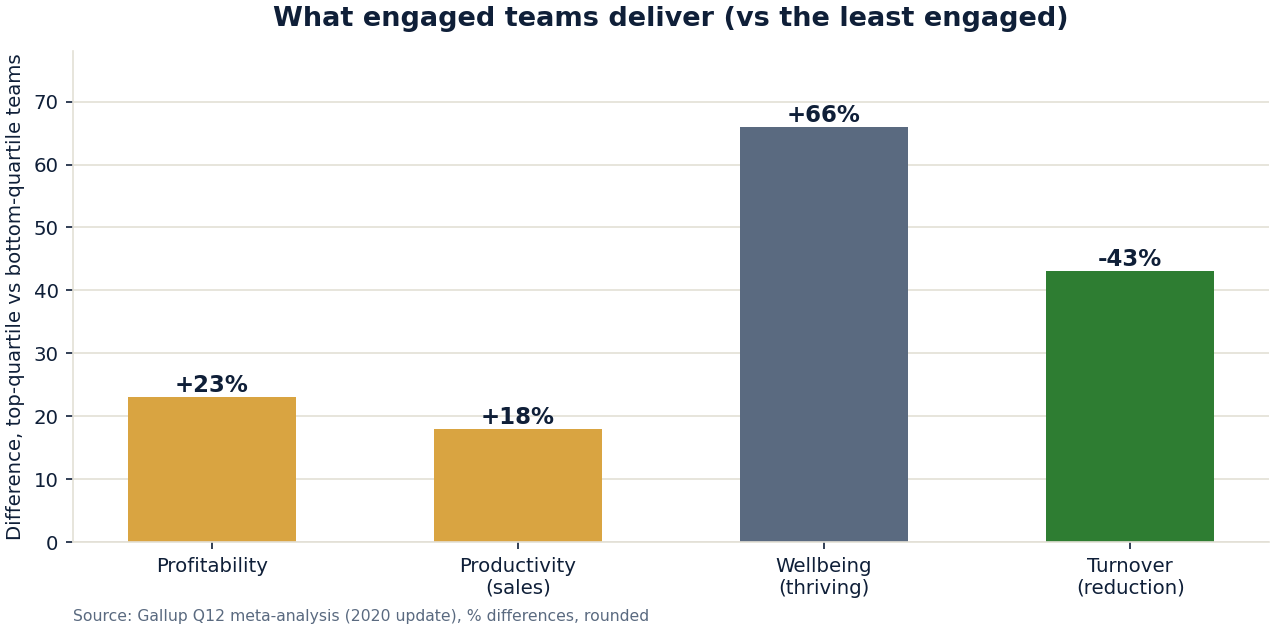 The chart above shows what leadership behavior differences are worth in business terms, and workshops remain the highest-leverage place to shift those behaviors at scale — provided every hour converts play into insight rather than entertainment.
Feedback, coaching and delegation activities
1. The compliment sandwich autopsy. Participants analyze, in trios, a scripted "feedback" conversation that uses the classic praise-criticism-praise structure. Teaching point: clarity beats cushioning. Debrief: "What actually got communicated? What will the receiver do differently tomorrow — and would they have done it without decoding?"
2. The 30-second redirect. Pairs; one describes a real work situation, the other must deliver situation-behavior-impact feedback in under thirty seconds, across three rounds of escalating difficulty (defensive, tearful, senior). Teaching point: structure survives pressure only if it is overlearned. Debrief: "Which round felt most real? What did you drop from the structure under pressure?"
3. Question golf. Coaching practice with a constraint: the "coach" may only ask questions, scored like golf — each statement costs a stroke, and the lowest score to help the "player" reach their own next step wins. Teaching point: the coaching skills habit of withholding the fix. Debrief: "Where did you itch to advise? What did the player produce that you would never have prescribed?"
4. The expert hostage. The facilitator plays a departmental expert who "knows everything" and receives a delegation conversation from a participant, resisting subtly ("you explain it faster yourself"). Teaching point: the delegation ladder conversation — not the intention — is what transfers authority. Debrief: "At which line did authority actually change hands?"
5. The blackout drill. Teams list a manager's recurring tasks; the facilitator "removes" the manager for two weeks, and teams redesign which tasks move to which delegation level. Teaching point: capacity is revealed by enforced absence, not by preference surveys. Debrief: "Which task scared you to move, and what checkpoint would make it safe?"
Style, team and trust activities
6. Style bingo, debrief edition. Each participant observes three real interactions before the workshop and predicts the leadership style used; the room maps predictions against the other party's experience. Teaching point: intent is not impact — the situational diagnostic beats self-image. Debrief: "Which mismatch surprised you?"
7. The misread memo. Everyone writes one instruction and passes it right; receivers execute it literally. Teaching point: direction quality under a directive style versus assumed context. Debrief: "What did the writer assume that the reader did not have?"
8. The failed project eulogy. Teams write a eulogy for a failed initiative — what killed it, what we ignored, what we celebrate anyway. Teaching point: psychological safety and blame-free learning. Debrief: "Which killer appeared in our own last project? Who could have raised it — and what would have happened to them?"
9. Airtime census. One participant counts airtime distribution during a live team task; the census is revealed afterward. Teaching point: meeting equity — the observable core of inclusive leadership. Debrief: "Who spoke least, and what did the room lose?"
Change, ambiguity and the closing contract
10. The rumour telephone. A crafted "organizational announcement" passes through four people, each retelling from memory. Teaching point: why fixed cadence and written narratives beat town-hall memory. Debrief: "What did the story gain and lose at each hop?"
11. The 70% decision line. Teams receive a scenario with staged information drops; they may act when they choose, but the window closes. Teaching point: the reversible-irreversible split from our ambiguity toolkit. Debrief: "What confidence level did you demand, and what did waiting cost?"
12. The one-behavior contract. Each participant writes one behavior they will run within 48 hours, with a named observer who reports at the next session. This single page converts a good workshop into a measurable Level-3 outcome — skip it and the other eleven activities were entertainment with props.
The half-day timing map and facilitation notes
For facilitators assembling the twelve into a session, the tested half-day sequence runs:
| Block | Activity | Minutes |
|---|---|---|
| Opening contract and one-behavior intention | — | 15 |
| Airtime census with equity debrief | #9 | 35 |
| 30-second redirect in trios | #2 | 40 |
| Break | — | 10 |
| Expert hostage: the delegation centerpiece | #4 | 45 |
| 70% decision line in teams | #11 | 40 |
| One-behavior contract with named observers | #12 | 20 |
Total: 3.5 hours with the 1:2 activity-to-debrief ratio intact. Materials are deliberately modest: printed scenario cards, a timer, sticky notes, one flip chart per team. The only component worth investing in is the debrief question bank — printed for the facilitator, not projected, because reading questions aloud from a slide flattens the conversation. If the session must compress, cut activity 11, never the contract: the contract is the difference between a workshop the cohort remembers fondly and a workshop the cohort's teams can point to.
Three rules apply across all twelve: rotate the vulnerable role so nobody plays "the difficult employee" twice in a row; keep real material wherever possible because emotional stakes do the retention work; and for virtual delivery, move the mechanics to breakout rooms and shared documents unchanged — the hybrid leadership playbook covers the facilitation layer. The full kit — scripts, materials lists, timing plans and debrief banks for every module type — ships inside Leadership Development Mastery for $89.50; the free starter pack includes Module 1 with its activities so you can test the format before licensing.
Frequently asked questions
What makes a leadership workshop activity effective?
A clear teaching point, low setup cost, emotional engagement through real material, and — decisively — a structured debrief that extracts the insight. An activity-to-debrief time ratio of 1:2 is the reliable standard.
How many activities fit in a half-day workshop?
Two to three, with full debriefs and a closing one-behavior contract. Six quick exercises with shallow debriefs produce entertainment; the learning lives in the discussion.
How do you handle participants who refuse role-play?
Offer observer-with-rubric as a legitimate first role and let them script rather than improvise. Refusers who watch two rounds with a scoring rubric almost always volunteer for the third.
Can these activities work virtually?
Yes — all twelve have breakout-room equivalents, and the debrief questions survive unchanged. Mechanics such as counts, timers and passing memos simply move to shared documents.
Where do I get debrief scripts and materials lists?
The Leadership Development Mastery kit includes facilitator scripts with debrief question banks for every module, plus the free activity starter pack for evaluation.
Your next step
Build your next session on a tested spine: Leadership Development Mastery ships all twelve activities with scripts, timing plans and workbooks for unlimited delivery. Start with the free workshop activity pack to sample the format, then place each module inside your curriculum with our leadership development program guide. Browse the full PersonaPulse library to assemble a complete manager curriculum.
Free Leadership Workshop Activity Pack — 12 Facilitator-Ready Exercises with Debrief Scripts
Get the free downloads for this topic — module 1, training plan, workbook sample, assessments and the table of contents.