ATD's State of the Industry benchmarks average direct learning expenditure at roughly $1,280 per employee per year, with the by-size spread running from about $970 at small organizations to $1,470 at the largest. Against that envelope, a single bespoke leadership module designed in-house consumes 90-130 designer hours before a single learner sits down. The build-versus-buy question in corporate training is usually answered by ideology ("nothing fits us like custom") or by sticker shock ("how can ready-made cost that little?"), and both are expensive ways to decide. This article builds the real cost model on both sides — designer hours, facilitation, measurement, the hidden rework tax — and shows the arithmetic that makes licensing a ready-to-deliver kit the rational default for most organizations, with in-house design reserved for genuinely proprietary content.
The visible costs of building in-house
Take one competent leadership module — say, feedback skills — designed properly. The hours arrive from four directions:
- Research and validation: 15-25 hours (evidence base, current practice, internal context).
- Design and build — deck, facilitator script, workbook, assessment: 40-60 hours for a professional learning designer.
- Review cycles — SME review, stakeholder feedback, rework: 15-25 hours; rework is always underestimated, so plan two full cycles.
- Pilot and revision — delivery, observation, fixes: 15-20 hours.
Conservative total: 90-130 hours per module. A credible multi-module leadership curriculum (8-10 modules) therefore consumes 700-1,200 designer hours before a single cohort runs — a five-figure project at realistic blended rates, before facilitation, materials and measurement are counted.
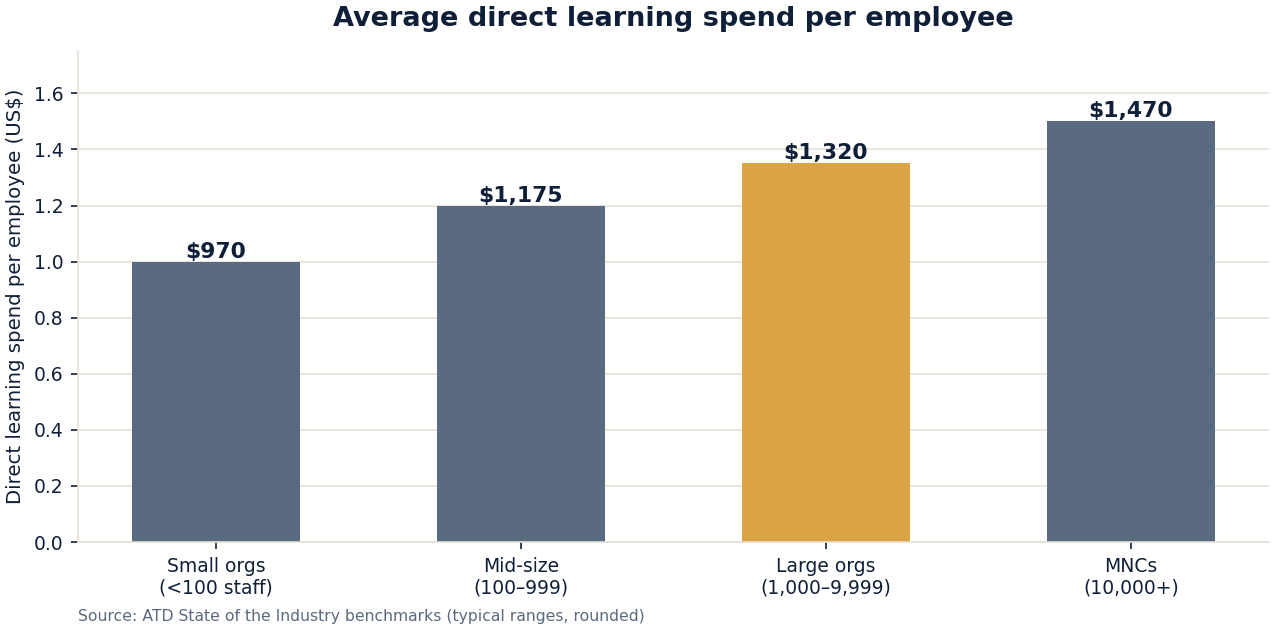
The benchmark above frames what "affordable" means in context. ATD's figure of roughly $1,280 per employee covers everything — compliance, onboarding, technical, leadership — so a bespoke build concentrated on one leadership population burns a disproportionate slice of the annual envelope in its first quarter. The case gets harder when Gallup estimates that low engagement drains $8.8 trillion in lost productivity globally, roughly 9% of global GDP, because that is the problem the spend is supposed to touch. Budget owners who cannot show per-participant arithmetic lose the room to those who can.
The hidden rework tax
In-house builds carry two costs that never appear in the project plan. The first is the maintenance tax: content ages, and every reorg, rebrand or platform change triggers updates nobody budgeted. Ready-made vendors amortize maintenance across their entire customer base; in-house owners amortize it into their own team's calendar forever. The second is the key-person tax: the designer who built it leaves, the source files turn out to be half-documented, and the next edit costs double. Documentation is theoretically free and practically never done.
The honest comparison is not build cost versus license price. It is (build + maintenance + key-person risk) versus (license + light customization).
L&D teams that skip this line in the model routinely discover, eighteen months later, that they are paying a second half-build — and that finance treats it as evidence the first investment was wasted.
The ready-made alternative, itemized
A licensed program inverts the arithmetic. The Leadership Development Mastery kit ships for a one-time $89.50 with:
- Presentation decks for every module, structured for spaced delivery.
- Word-for-word facilitator guides — a new facilitator delivers credibly on day one; a senior one adapts freely.
- Participant workbooks with fill-in exercises that produce workplace artifacts (the Level-3 evidence engine).
- Assessment packs and training plans — evaluation scaffolding included rather than designed separately.
- Unlimited internal delivery — run ten cohorts or a hundred; the license does not care.
| Cost line | In-house build | Licensed kit |
|---|---|---|
| Design hours | 90-130 per module | Included (vendor-amortized) |
| Customization | Weeks of SME review cycles | Hours: your logo, your cases |
| Maintenance | Perpetual and unbudgeted | Included with the vendor |
| Content cost per participant | Five figures per curriculum | About $6 at a 15-person cohort |
At a 15-person cohort, content cost runs about $6 per participant. Even adding facilitation time, the total sits two orders of magnitude below the bespoke route — and the customization that matters (your cases, your vocabulary, your real scenarios) is added by the facilitator in minutes, not by a design team in weeks.
The facilitation cost layer
Content is one line; delivery is the other. Three models, costed honestly. Internal facilitation is the cheapest per run but requires a credible facilitator with released time — and with a licensed kit's word-for-word scripts, a capable HRBP or senior manager delivers credibly without a train-the-trainer program. External facilitation is polished and neutral, which is valuable for sensitive cohorts, at market rates that dwarf content costs; reserve it for the two or three sessions where neutrality matters most. The train-the-trainer hybrid — license the kit, run one externally facilitated first cohort as the quality bar, then hand the scripts to internal facilitators — is the pattern most mid-size organizations converge on.
Note what disappears in the licensed model: the design-review cycle. In-house builds spend a shocking share of their calendar in stakeholder reviews ("can the legal slide say this?"); mature kits have already survived those conversations across dozens of customers. That is why the hybrid keeps total cost within a rounding error of the license price even after facilitation is counted.
When building in-house is genuinely right
Intellectual honesty requires the exceptions:
- Proprietary methodology that IS the product — consulting firms selling their own framework.
- Heavily regulated content where every line requires legal sign-off (some compliance, safety-critical operations).
- True competitive differentiation — content so specific to your operation that no market equivalent exists.
Notice what is not on the list: leadership skills. Feedback, delegation, coaching, change leadership — the transferable core — is commodity in the best sense: excellent versions exist, are field-tested, and cost less than lunch per participant. Reserve your design hours for the 10% that is genuinely yours; the 70-20-10 logic applies to budgets as well as to learning mixes.
The hybrid most organizations end up choosing
License the spine, customize the skin: ready-made modules for the transferable core, plus one or two in-house "case modules" built on your real projects. The hybrid gets a full curriculum live in weeks, keeps designer hours under 50, and leaves the maintenance tax with the vendor. It is also the fastest route to a measurable first cohort — which is what the next budget conversation will actually ask about — and the numbers land cleanly with finance when you bring the per-participant arithmetic together with the executive-alignment playbook in our L&D budget buy-in guide.
Frequently asked questions
How much does corporate leadership training cost?
Three tiers: licensed ready-to-deliver kits (from ~$89.50 one-time for full multi-module programs with unlimited delivery), external facilitation or off-the-shelf workshops (hundreds to low thousands per participant), and bespoke in-house design (90-130 designer hours per module plus permanent maintenance). Most organizations optimize with the licensed-spine-plus-custom-cases hybrid.
Why is ready-made training so cheap compared to custom?
Amortization: the vendor's design hours are spread across every customer, while your build's hours are spread across only you. An $89.50 kit represents hundreds of design hours already validated in delivery — which is also why mature kits outperform fresh bespoke drafts on polish.
What does in-house design really cost per module?
Plan 90-130 hours across research, build, two review cycles and pilot revision — then add the maintenance tax, because every future reorg or rebrand triggers updates. Key-person risk (the designer leaves, documentation is incomplete) is real and rarely budgeted.
Is custom training better than off-the-shelf?
For proprietary methodologies and regulated content, often yes. For transferable leadership skills the advantage usually runs the other way: mature licensed programs are field-tested and consistently polished, while first-draft custom content learns the same lessons at your expense.
Can we brand and modify licensed programs?
Yes — kits like Leadership Development Mastery are designed for it: your logo, your cases, facilitator adaptations throughout. Unlimited internal delivery means the license cost stays fixed while usage grows.
How do we justify the spend to finance?
With the measurement stack, not the sticker: per-participant content cost (about $6 at cohort scale), the agreed Kirkpatrick behavior and business metrics, and the comparison against the five-figure bespoke alternative.
Your next step
Run the numbers on your own population: the Leadership Development Mastery kit gives you the full multi-module spine for $89.50 with unlimited delivery, so the per-participant math does the persuading for you. Frame the decision with our leadership development program guide, and take the Kirkpatrick ROI guide into the budget meeting. Browse the complete PersonaPulse library to compare every program before you commit.