Gallup's long-running research puts a hard number on why this topic keeps HR leaders awake at night: managers account for around 70% of the variance in team engagement. Build better leaders and you move engagement, retention and productivity in one motion. Yet DDI's Global Leadership Forecast found that only 12% of organizations believe they have a strong leadership bench, and most leadership training still fails to survive contact with Monday morning.
This guide is the complete blueprint for HR directors, L&D managers and trainers who need a program that survives budget scrutiny: what a modern leadership development program contains, how to structure cohorts, how to measure behavior change (not just satisfaction scores), and how to decide between building content in-house and licensing a ready-to-deliver curriculum.
Why the business case is not soft
The payoff numbers are among the strongest in people analytics. Gallup compares top-quartile and bottom-quartile engagement teams and finds roughly 23% higher profitability, 18% higher productivity and 43% lower turnover in the top quartile — and the manager is the single biggest variable explaining that spread. On the investment side, ATD's State of the Industry benchmarking puts average direct learning spend near $1,280 per employee per year, and ATD's research on comprehensive training finds high-investment companies posting dramatically higher income per employee than low-investment peers. LinkedIn's Workplace Learning Report adds the retention angle: 94% of employees say they would stay longer at a company that invests in their learning. Leadership development is not a perk at the margin of the P&L; it is the control panel for the numbers executives already track.
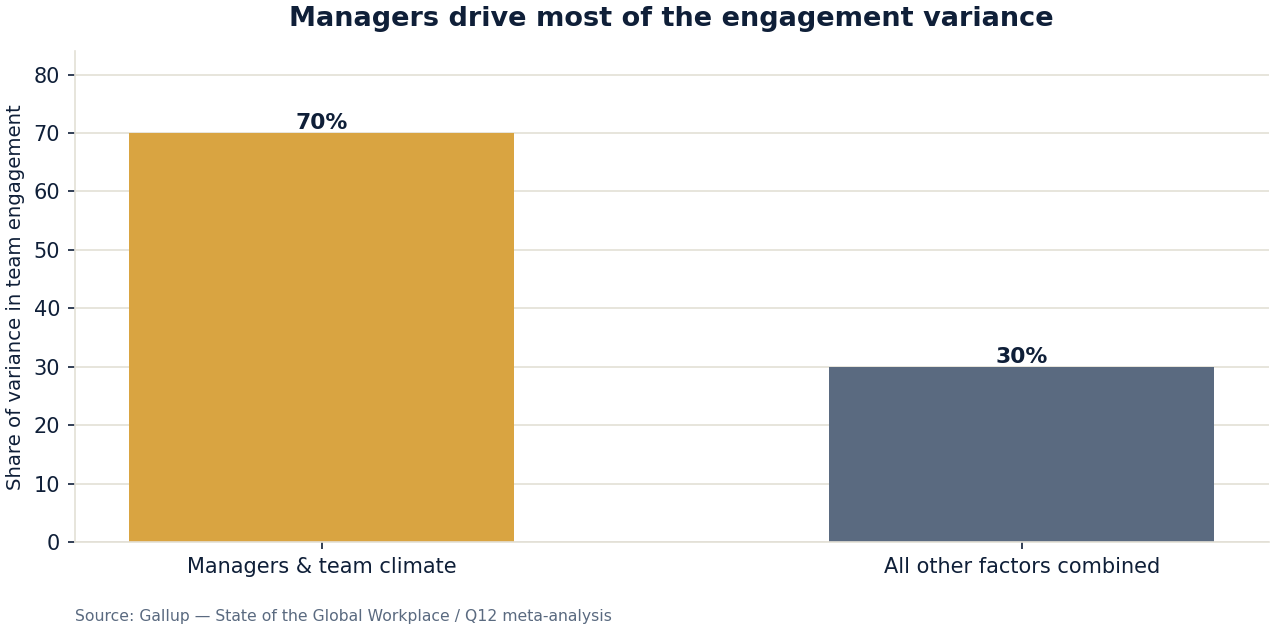
Two design implications follow directly. First, because the manager explains most of the engagement spread, manager capability — not generic employee wellness — is where development dollars compound fastest. Second, because engagement moves profitability and turnover in predictable directions, you can pre-agree the KPI chain before launch instead of reverse-engineering a story after the fact.
What a leadership development program actually is
A leadership development program is a structured journey — usually 3 to 12 months — that moves managers from knowing leadership concepts to demonstrating leadership behaviors. That distinction matters more than it looks. Knowing that delegation is good is easy; handing over a client relationship you personally built is not. A credible program therefore blends four ingredients:
- A competency model — 4 to 8 behaviors the business actually needs (feedback, delegation, coaching, strategic thinking, change leadership).
- Spaced learning events — workshops every 3-4 weeks instead of one heroic two-day event.
- Application between sessions — real workplace assignments, peer coaching and manager check-ins.
- Measurement — behavior baselines, 180/360 feedback and business KPIs agreed before launch.
The spacing is not stylistic preference. Ebbinghaus's forgetting-curve research, replicated for more than a century, shows learners shed most new information within days unless they retrieve and reuse it; spaced application between sessions is the only reliable antidote. A program that ends at the certificate is a program that ends at the forgetting.
Gallup's State of the Global Workplace estimates low engagement drains $8.8 trillion from the global economy every year — and the manager is the single biggest lever organizations control.
Step 1 — Anchor the program to business outcomes
Executives do not fund "leadership training"; they fund lower regrettable attrition, faster project delivery and stronger succession coverage. Before designing a single slide, agree on two or three measurable outcomes with the sponsor. Useful examples: raise engagement scores by 5 points, cut regrettable attrition in one population by 15%, or have at least two ready-now successors for each critical role. Every later design decision — content, format, duration — then gets justified against those outcomes, which is exactly the story you will tell in the budget review.
Ground the targets in cost data so the numbers resist challenge. SHRM's replacement-cost research pegs the cost of replacing a salaried employee at the equivalent of six to nine months of salary — higher for leadership roles once search fees and lost productivity are counted. If the program's participants manage 500 people and regrettable attrition runs 15%, even a two-point improvement pays for a serious curriculum several times over.
Step 2 — Choose the right competency set (and cut the rest)
The most common design failure is covering everything. A focused program for mid-level leaders usually needs six competencies at most:
- Coaching and feedback — structured conversations that change behavior.
- Delegation and empowerment — freeing leader time while growing the team.
- Leading change — communicating, sequencing and sustaining change.
- Decision-making under ambiguity — frameworks plus judgement.
- Team development — psychological safety, motivation, accountability.
- Strategic thinking — connecting daily work to business direction.
Resist copying a big-tech competency model wholesale; derive the list from evidence rather than taste. A structured training needs assessment — stakeholder interviews, manager pulse surveys, a skills matrix — will surface the two or three urgent gaps in your population, and those become the spine. If you want an objective baseline for cohort selection, a leadership assessment administered before day one also produces the pre/post contrast your measurement story will need later.
For a ready-made starting point, the Leadership Development Mastery program packages exactly this kind of competency arc into facilitator-ready modules — presentation decks, word-for-word facilitator guides, participant workbooks and assessment packs — so your design effort goes into context, not slide production.
Step 3 — Design the 70-20-10 learning mix
Research popularized by the Center for Creative Leadership describes how leaders actually grow: roughly 70% from challenging on-the-job experience, 20% from people, 10% from formal instruction. Formal workshops still matter — they install shared language and frameworks — but a program that is 100% workshops will leak. A practical 12-week cycle looks like this:
- Week 0 — baseline 180° feedback and self-assessment.
- Week 1 — workshop on the competency (frameworks, demonstrations, practice).
- Weeks 2-3 — workplace assignment (e.g. run a delegation conversation with one direct report), peer-coaching call, workbook reflection.
- Week 4 — next workshop opens with a 10-minute "what worked / what bombed" debrief.
Four cycles of that shape cover a four-competency program in a single quarter, with behavior evidence accumulating between sessions rather than after the fact. Our guide to the Kirkpatrick model shows how to wire measurement into that cycle from day one.
Step 4 — Cohort design that executives respect
Mixed-level cohorts feel inclusive but blunt the content: first-time managers need different theatre than directors. Two designs work reliably:
- Cohort by level — e.g. "new manager track" and "senior leader track", each 12-20 people.
- Cohort by function, level mixed — better for cross-silo relationships, with differentiated breakouts.
Cap cohort size at 20; above that, psychological safety in role-plays collapses. Two sponsor-facing details further raise the odds. First, make the participant's line manager a formal stakeholder — nomination, kickoff briefing, and manager-owned workplace assignments — because programs whose managers reinforce participants complete at far higher rates. Second, put a senior executive on stage at kickoff and close; DDI's forecast research consistently associates visible senior sponsorship with stronger program outcomes. If you are building the new-manager track first, see our dedicated piece on first-time manager training.
Step 5 — Measurement: behavior first, ROI second
Minimum viable measurement stack:
- Level 1-2 — session ratings and knowledge checks (necessary but weak).
- Level 3 — 60-90 day behavior change survey sent to each participant's manager and direct reports.
- Level 4 — the two or three business KPIs agreed in Step 1, tracked quarterly.
Programs that measure only satisfaction consistently underperform in renewal conversations; programs that can show a manager-level behavior shift at 90 days defend their own budget. If you have the appetite for multi-rater evidence, a structured 360-degree feedback cycle before and after the program is the strongest behavior instrument available — just budget the debrief facilitation, because undebriefed 360s do more harm than good.
Build vs buy: the honest math
Building a full multi-module leadership curriculum in-house costs a learning designer 200-400 hours per module once research, design, validation and rework are counted. Licensing changes the equation:
| Factor | Build in-house | License a ready-made kit |
|---|---|---|
| Design effort | 200-400 hours per module | Days to customize |
| Upfront cost | Designer salary or agency fees | One-time license (~$89.50 per program) |
| Evidence base | Depends on the designer's research | Frameworks validated across many client deliveries |
| Facilitator enablement | You write every guide | Word-for-word facilitator script included |
| Ongoing risk | Versioning and key-person dependency | Vendor maintains updates |
| Best for | Highly proprietary content | The standard 80-90% of leadership content |
The Leadership Development Mastery kit ships the entire arc — slides, facilitator scripts, workbooks, assessments, training plans — for a one-time $89.50, unlimited internal delivery, fully brandable. Most teams license the spine and inject company-specific cases, which gets a credible program live in weeks rather than quarters. Our cost comparison of in-house vs ready-made training walks through the arithmetic line by line.
Frequently asked questions
How long should a leadership development program be?
Twelve weeks is the sweet spot for mid-level leaders: long enough for spaced practice and behavior measurement, short enough to hold momentum and executive attention. Senior pipeline programs run 6-12 months, while first-time-manager tracks can compress to 8 weeks with tighter scope.
What is the ideal cohort size?
Fifteen to twenty participants. Below ten, role-plays lose diversity; above twenty-five, quieter participants hide, facilitators cannot coach individually, and completion rates drop noticeably.
How do we get managers to release participants for sessions?
Make the participant's line manager a program stakeholder: manager nomination, manager kickoff briefing, and manager-owned workplace assignments. When managers co-own the assignments, calendar conflicts largely disappear.
Can we run leadership development remotely?
Yes — with adjustments. Split sessions into 90-minute blocks, replace flipcharts with shared digital canvases, and increase peer-coaching touchpoints. Our playbook on remote and hybrid team leadership covers the facilitation mechanics.
What budget should we plan per participant?
ATD's State of the Industry benchmark puts average direct learning spend near $1,280 per employee per year across all learning. A focused leadership cohort commonly lands between $500 and $2,500 per participant depending on facilitation, licensing and measurement — dramatically less when a licensed kit replaces bespoke design.
Which comes first: content or measurement?
Measurement. Define the behavior evidence you will accept before choosing content, and the content decision nearly makes itself. Teams that start with content end up measuring satisfaction, because that is the only thing the content can prove.
Your next step
If your roadmap needs this program live this quarter, the fastest defensible route is licensing the spine. Leadership Development Mastery gives you the full facilitator kit for $89.50 — and the free starter pack lets you inspect Module 1, the training plan and the assessment quality before a single dollar is spent. For deeper design context, read our complete guide to running a training needs assessment before finalizing competencies, and our walkthrough of the Kirkpatrick model for the measurement layer. Or browse the full PersonaPulse library to compare every ready-to-deliver program.
Free Leadership Development Starter Pack — Module 1, Training Plan, Workbook & Assessments
Get the free downloads for this topic — module 1, training plan, workbook sample, assessments and the table of contents.