Benchmark data summarized by Kirkpatrick Partners suggests that while roughly 92% of organizations collect post-session reaction sheets and about 72% test learning, only around 45% measure behavior change and fewer than 30% measure business results — a measurement gap that starts at the humble development plan. Ask HR leaders about development plans and you hear the same confession: the organization has a beautiful template, completed once a year, filed, and never consulted again. The failure is not the template — it is the design. Plans die when they list aspirations instead of scheduling behaviors, and they stay dead when nobody instruments the difference. This guide gives HR teams a structure that survives contact with real calendars: assessment inputs, a 70-20-10 activity mix, quarterly reviews with consequences, and a worked example you can adapt.
Why most development plans die — and what the gap costs
The talent stakes are unambiguous. LinkedIn's Workplace Learning Report found 94% of employees would stay longer at a company that invests in their development, and Gallup finds employees who have meaningful weekly conversations with their manager are around three times as engaged as those who do not. The development plan is where both levers are supposed to live — the investment promise and the conversation cadence — which is why an abandoned template quietly drains retention.
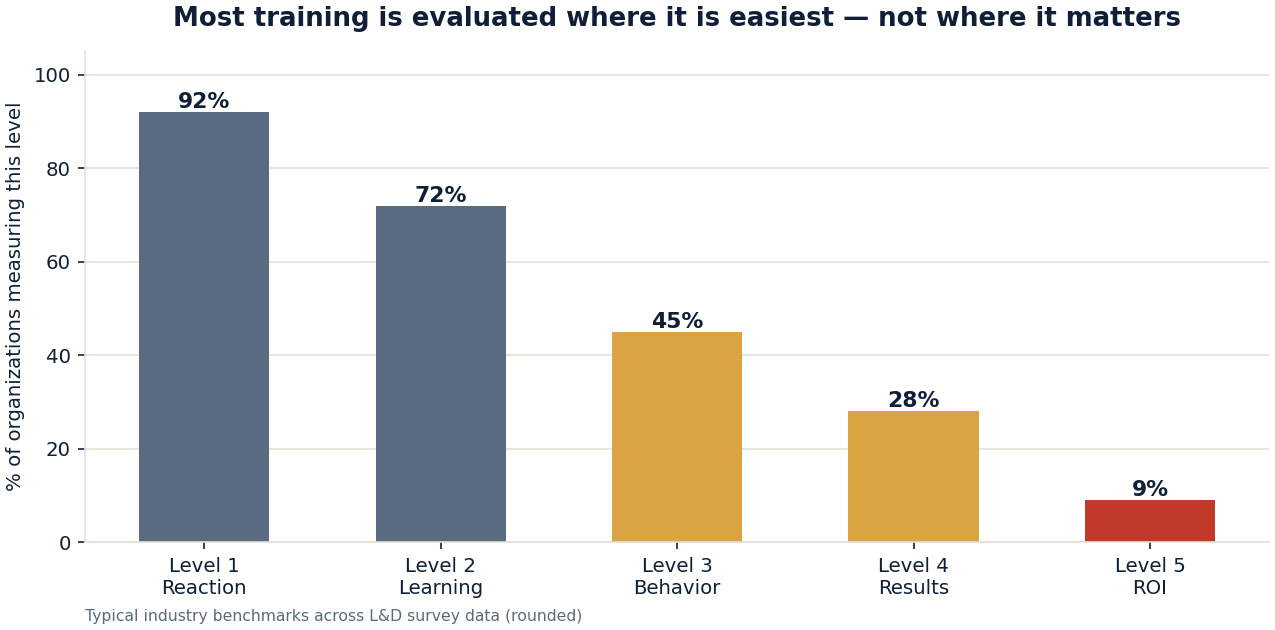
The chart explains why plans die quietly rather than failing loudly: a development plan is a Level 3 (behavior) and Level 4 (results) instrument, and those are precisely the levels most organizations never wire up. A plan nobody measures is indistinguishable from a plan nobody means, and everyone involved senses it. The 70-20-10 mix popularized by the Center for Creative Leadership supplies the design fix — most development comes from stretch assignments, some from people, some from formal learning — and the template below hard-codes that mix so the plan becomes a schedule rather than a wish list.
The anatomy of a plan that survives
Seven fields, no more:
- The one-sentence leadership goal. Specific and behavioral: "lead the integration of the two support teams without regretted attrition" — not "become a better communicator".
- Assessment inputs. What we already know: 360-degree feedback, stakeholder interviews, the skills-matrix gap. Plans without inputs are guesses with formatting; our training needs assessment guide shows how to collect them systematically.
- Three target behaviors. The observable version of the goal, each written so a stakeholder could rate it — the Level-3 habit from our Kirkpatrick guide.
- The 70-20-10 activity mix. A stretch assignment (the 70), sponsor, mentor or coach touchpoints (the 20), formal learning (the 10) — see the complete program guide for why the mix matters.
- Support cast. Named people with named commitments: the manager, a sponsor, a peer partner.
- Review cadence. Quarterly, 45 minutes, fixed agenda: evidence of behaviors, obstacles, next quarter's assignment.
- Kill criteria. What would tell us this plan — or this goal — is wrong. Plans with exit doors get revisited; plans without them get abandoned silently.
The 6-month structure — and the 12-month variant
| Phase | Months | Focus | Evidence produced |
|---|---|---|---|
| Foundation | 0 | Assessment inputs consolidated; goal and behaviors agreed three-way | Baseline stakeholder ratings |
| Build | 1-3 | Stretch assignment begins; formal module on the weakest behavior; plan as standing 1:1 item | First workplace artifacts |
| Review one | 3 | Evidence against behaviors; adjust assignment difficulty | Documented re-rating |
| Visibility | 4-6 | Presenting to senior forum; leading a cross-functional piece | Stakeholder feedback |
| Review two | 6 | Decision point: extend, promote, redirect | Full stakeholder re-rating |
The 12-month variant adds a second, larger stretch assignment and a mentoring pairing, with reviews at months 3, 6, 9 and 12. For senior populations the formal-learning share shrinks and the assignment weight grows, consistent with the 70-20-10 evidence. Anything longer than twelve months decays into irrelevance as the business changes; anything shorter than six cannot show behavior evidence at all.
The worked example (steal this)
Goal: "Run the regional consolidation without losing either team lead." Behaviors: (1) runs delegation conversations that leave named owners; (2) communicates change on a fixed cadence with written narratives; (3) surfaces team concerns within one week. Mix: 70 — leads the consolidation workstream (real, current, board-visible); 20 — biweekly coaching one-to-ones with the HRBP; 10 — the change-communication and ambiguity toolkit modules. Support: sponsor is the COO; peer partner is another program participant. Reviews: quarter-end, evidence-first agenda. Kill criteria: if the consolidation scope doubles, renegotiate the goal — do not silently absorb it.
The plan fits on one page. If yours needs two, you have written a strategy document, and strategy documents do not survive quarterly review agendas either. Note that every behavior is rateable by a named stakeholder — that single test is what turns the plan into measurement instead of sentiment.
The HR audit checklist for development plans
Twice a year, HR should sample-audit live plans against eight questions. One: does the goal name an observable outcome? Two: are there exactly three target behaviors, each rateable by a stakeholder? Three: does the 70-layer contain a real, current stretch assignment — not a course? Four: are the support cast named humans with named commitments? Five: do the reviews exist in calendars, with the plan as a standing agenda item? Six: has evidence been produced at the last review — artifacts, not impressions? Seven: were the kill criteria ever seriously discussed? Eight: does the plan ladder toward a pipeline need the organization has (see our succession guide)?
Plans failing four or more questions get a one-hour rebuild conversation, not a compliance email — the point of the audit is quality, not paperwork rates. Track one meta-metric: the share of plans that produced their month-6 stakeholder re-rating on schedule. That number, trending upward, is the difference between a development system and a form-filling exercise, and it is the number to show the board when the development budget conversation returns.
Why plans fail — and from template to system
Three failure patterns account for most dead plans. Aspirations without behaviors — the fix is that every line must pass the stakeholder-rating test. No calendar consequences — the fix is that the plan lives as a recurring agenda item in existing one-to-ones, not as a document. HR-owned instead of manager-owned — the fix is that the manager's commitments are named fields; HR audits, managers execute.
Individual plans compound into a succession system when their goals ladder toward pipeline roles — the logic our succession planning guide develops in depth. The template itself ships as a fillable workbook inside the Advanced Leadership Mastery program ($89.50, unlimited use), alongside the modules that back each behavior block — the fastest way to move from one good plan to a system of them.
Frequently asked questions
What should a leadership development plan include?
Seven fields: one behavioral goal, assessment inputs, three target behaviors, a 70-20-10 activity mix with a real stretch assignment, a named support cast, quarterly reviews with a fixed evidence-first agenda, and kill criteria. One page, calendar-embedded, manager-owned.
How long should a leadership development plan run?
Six months for a focused goal, twelve for a pipeline-track plan with a second assignment. Longer horizons decay into irrelevance as the business changes; shorter ones cannot show behavior evidence.
Who owns the plan — HR, the manager or the individual?
The manager owns execution (it runs inside their one-to-ones), the individual owns the evidence and the assignment, and HR owns the audit and the cadence. Plans HR owns alone die in HR; plans managers own live in the calendar.
How is a development plan different from a performance plan?
Performance plans close current-role gaps; development plans build next-role capability through stretch assignments and formal learning. Confusing the two produces training that fixes today at the expense of tomorrow.
How do you measure whether a development plan worked?
Stakeholder re-rating of the three target behaviors at month six, evidence artifacts from the stretch assignment, and the next-step decision made on schedule. The Kirkpatrick wiring applies at plan scale.
Where can I get a fillable template?
The free Advanced Leadership starter pack includes the plan template with a worked example; the full Advanced Leadership Mastery kit ships it as a workbook integrated with the supporting modules.
Your next step
Turn the template into a system: Advanced Leadership Mastery ships the fillable plan workbook with the modules that back every behavior block, for $89.50 unlimited use. Connect individual plans to the organizational picture with our succession planning guide, and prove the impact using the Kirkpatrick evaluation guide. Explore the full PersonaPulse library to see every leadership program in the store.
Free Leadership Development Plan Template — 6/12-Month Structure + Worked Example
Get the free downloads for this topic — module 1, training plan, workbook sample, assessments and the table of contents.