The International Coaching Federation's Global Coaching Client Study reported a median return of seven times the initial coaching investment, and 86% of companies said they at least recouped their investment. Yet the same ROI math that justifies coaching for pivotal leaders makes it unaffordable as a whole-population strategy — and coaching is also simply the wrong tool for some gaps. Ask five vendors to fix a leadership problem and you will get three different prescriptions: a coaching engagement, a mentoring scheme, a training program. All three can work; each solves a different problem. This comparison gives HR leaders, trainers and coaches a decision framework grounded in the research on how leaders actually develop.
The one-line distinction
- Training transfers knowledge and installs shared frameworks. An expert designs it; participants learn the same thing at the same pace.
- Mentoring transfers wisdom and context. A more senior person shares experience, opens networks and models judgment over time.
- Coaching unlocks performance and ownership. A coach — manager-as-coach or professional — asks structured questions so the coachee finds their own answers and commits to action.
The Center for Creative Leadership's 70-20-10 research explains why all three exist: leaders grow roughly 70% through challenging experience, 20% through other people, 10% through formal instruction. Training owns the 10%; mentoring and coaching own most of the 20%; none of them substitutes for real assignments. That is also why a coaching-only or training-only strategy always under-delivers — each mode touches only a slice of how development actually happens.
What the evidence says about each mode
Coaching has the strongest per-person ROI numbers. Besides the ICF's 7x median ROI, the Manchester Review's study of 100 executives found an average return of 5.7 times the investment, and MetrixGlobal's oft-cited evaluation of a coaching program at a large utility calculated returns exceeding 500%. Mentoring's flagship evidence comes from Sun Microsystems, where formal mentoring produced retention rates of 72% for mentees and 69% for mentors, versus 49% for non-participants — a roughly 23-point retention spread that outperforms most engagement initiatives. Training's evidence is less glamorous but structural: it is the only mode that reaches an entire management population with the same frameworks at low cost per head, which is why it remains the default spine of corporate academies.
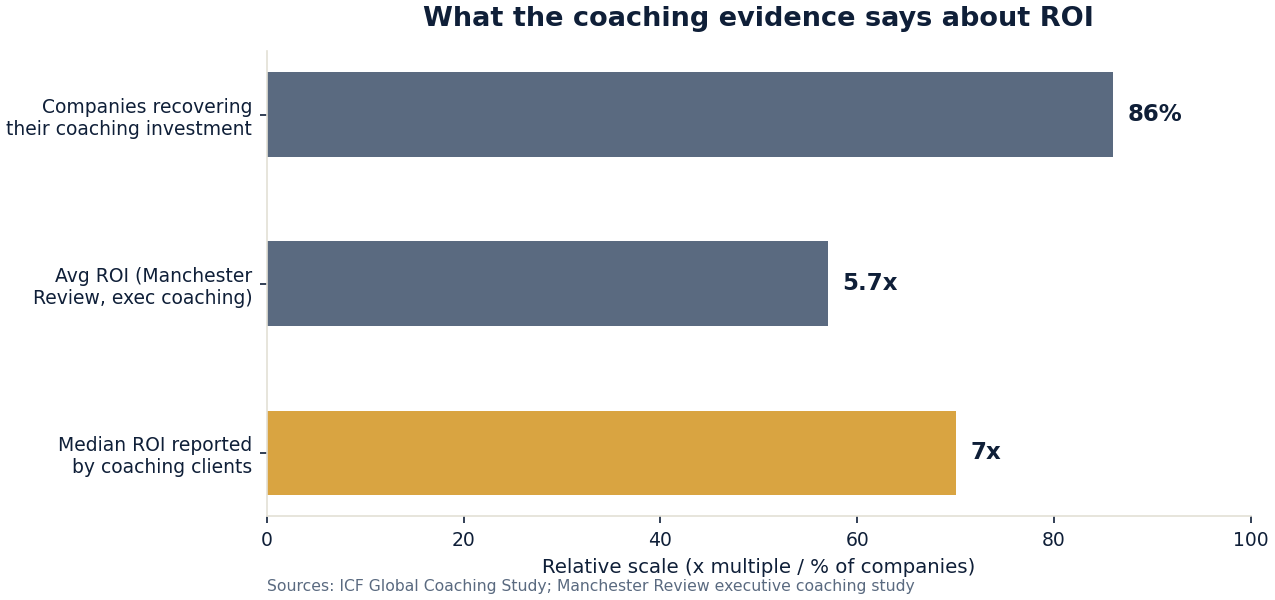
Treat the coaching numbers carefully. They are medians from engaged buyers who contracted for specific goals — not a promise for every engagement. The same studies consistently show ROI collapsing when goals are vague, sponsorship is absent, or the wrong mode was chosen in the first place.
Comparison table: the honest differences
| Dimension | Training | Mentoring | Coaching |
|---|---|---|---|
| Primary goal | Shared knowledge & frameworks | Context, networks, judgment | Behavior change & ownership |
| Agenda owned by | Designer / facilitator | Mentor | Coachee |
| Best for | Standards, vocabulary, skill baselines | Career navigation, culture transmission | Performance gaps, transitions, habits |
| Scale | High (one-to-many) | Medium (one-to-few) | Low (one-to-one) |
| Cost per person | Lowest | Low (internal time) | Highest |
| Time to impact | Weeks | Months | Weeks-to-months |
| Evidence risk | Transfer fades without application | Quality varies by pairing | Depends on coach skill & chemistry |
| Failure signature | Nodding agreement that fades by Thursday | Pleasant chats with no skill gain | Expensive questions about a knowledge gap |
When to choose each mode
Choose training when the organization needs a common operating system: every manager giving feedback with the same structure, planning delegations with the same ladder, running one-to-ones with the same cadence. Training is also the cheapest way to reach a whole management population — ATD's benchmarking puts average direct learning spend around $1,280 per employee per year across everything, and licensed ready-to-deliver programs like Leadership Development Mastery push the per-head cost of a full curriculum far below that.
Choose mentoring when the gap is contextual: high-potential employees who need exposure, sponsorship and organizational navigation that no course can supply. Effective schemes are deliberately time-boxed (9-12 months), formally launched with agreements, and monitored with light-touch reviews — informal schemes quietly die within a quarter.
Choose coaching when the barrier is behavioral or motivational: a technically excellent leader whose stakeholder relationships are fraying, or a strong performer stepping into a bigger role. The ICF's numbers justify coaching for pivotal roles — not for everyone. DDI's Global Leadership Forecast found only 12% of organizations confident in their leadership bench, and coaching is best reserved for the leaders whose trajectory determines the bench's shape.
Why the modes fail when used for the wrong job
The failure patterns are predictable. Training used to fix a behavioral gap produces nodding agreement that evaporates by Thursday — knowledge was never the constraint. Mentoring used to fix a skills gap produces pleasant coffee chats — the mentor likes the mentee but cannot teach feedback structures. Coaching used to fix a knowledge gap produces expensive questions — the coachee genuinely does not know the framework and cannot "find it within themselves".
The rule of thumb: if the person doesn't know, train; if the person knows but doesn't see, mentor; if the person sees but doesn't do, coach.
The combined model that actually works
High-performing L&D functions layer the modes deliberately. A proven sequence for a management population:
- Train the baseline — a cohort workshop series installs shared language and frameworks (weeks 1-12).
- Mentor the context — pair participants with senior leaders for monthly navigation conversations (runs alongside).
- Coach the gap — manager-as-coach one-to-ones or targeted professional coaching where behavioral blockage shows in the data.
The manager-as-coach layer deserves special attention: training every manager in coaching-conversation skills multiplies your coaching capacity without external spend. Our guide to coaching skills for managers covers the four conversation moves that make that work, and a structured 360-degree feedback cycle is the cleanest way to locate where the coaching gaps actually are.
What the decision costs when you get it wrong
A mis-prescribed coaching engagement for one population (say, 20 leaders at typical market rates) can consume $150,000-400,000 — enough to run a licensed training track for the same population many times over — while solving the wrong problem. Coaching ROI collapses toward zero not because coaching fails but because the constraint was never coachable; meanwhile the population that needed the training baseline still lacks it.
The disciplined sequence is cheap to run in the other order: diagnose the gap with a skills matrix and stakeholder interviews, choose the mode, and only then choose the vendor. Write the mode decision down with the evidence that drove it. The diagnosis conversation takes one afternoon; the mis-prescription takes twelve months to discover and a further year to unwind — and a documented diagnosis is the difference between "the program didn't work" and "the mode didn't fit, here is what we changed to".
Frequently asked questions
Is coaching better than training for leadership development?
Neither is "better" — they solve different problems. Coaching produces deep behavior change for individuals; training installs shared frameworks across a population. Most organizations need both: training for the baseline, coaching for the stubborn gaps the training reveals.
Can a manager be both boss and coach?
Yes, with boundaries. Manager-as-coach works for development conversations (growing capability, unlocking ownership) but not for performance management or disciplinary issues — the agenda conflict is real. Skilled managers name the mode explicitly: "this is a coaching conversation, not a review".
How long should a mentoring relationship last?
Nine to twelve months with an explicit closing review. Open-ended mentoring drifts into unfocused friendship; time-boxing keeps both parties accountable to goals, and successful pairs can always restart with a new agreement.
What ratio of mentees to mentors is healthy?
Aim for no more than two or three mentees per mentor. Beyond that, quality degrades and cancellations start; a waiting list is better than a diluted program.
How do we measure whether coaching is working?
Contract for it upfront: specific behavior goals agreed with the coachee's stakeholders, a mid-point stakeholder pulse, and an end-of-engagement re-rating. Vague goals like "become a better leader" make ROI unprovable by design.
Where does ready-made training fit in this mix?
As the spine. A licensed curriculum such as Leadership Development Mastery — $89.50 one-time, unlimited cohorts — delivers the shared-framework layer at a fraction of bespoke design cost, freeing budget for the mentoring and coaching layers that only humans can deliver.
Your next step
If you are allocating a development budget across the three modes, start by licensing the training spine — Leadership Development Mastery covers the shared-framework layer for $89.50 one-time — then reserve coaching spend for the pivotal leaders your data flags. Deepen the decision with our guide to coaching skills for managers and our complete leadership development program blueprint, or browse the full PersonaPulse library for every ready-to-deliver program.