US organizations spend roughly $16 billion a year on leadership development, McKinsey has estimated, yet DDI's Global Leadership Forecast finds only about one organization in eight reports a strong leadership bench. The disconnect starts at the front door of the pipeline: promotions and development investments are too often decided by interview impressions and visibility rather than measured capability. Gallup's data makes the cost clear — companies fail to choose the candidate with the right talent for a manager role 82% of the time, and managers account for roughly 70% of the variance in team engagement. A leadership assessment test replaces those impressions with evidence of readiness. This guide explains the main types of leadership assessment tools, shows sample leadership assessment questions, and walks through scoring methods that turn results into development plans instead of dusty reports.
What a leadership assessment test measures
A leadership assessment test evaluates the competencies that separate effective leaders from effective individual contributors: strategic thinking, decision quality under ambiguity, influencing without authority, coaching and developing others, change leadership, and emotional intelligence in conflict. Because leadership is contextual, strong assessments present realistic situations — a resourcing conflict, a resistant stakeholder, an underperforming senior hire — and score how candidates reason and respond.
It is equally worth being clear about what these tests do not do. No instrument can certify that someone will be a great leader; assessments estimate probability by measuring behaviors and capabilities that research links to leadership outcomes. That is why the strongest practice triangulates: one self-report view, one observed-behavior view, one cognitive or judgment view. Any single-source verdict — especially a personality test alone — should never decide a promotion.
Types of leadership assessment tools
The main categories, each with a different job to do:
| Tool | Format | Best for | Effort to run |
|---|---|---|---|
| 360-degree feedback | Multi-rater survey from manager, peers, direct reports | Incumbent leaders; development focus | Low-medium |
| Leadership personality inventories | Self-report questionnaire | Coaching conversations, style awareness | Low |
| Situational judgment tests (leadership SJT) | Scenario-based decisions | Promotion readiness, high-volume pipelines | Medium |
| Cognitive and business acumen tests | Timed reasoning or case questions | Strategic roles, succession slates | Medium |
| Assessment centers | Simulations: role plays, presentations, group exercises | Senior selections; succession decisions | High |
| Structured behavioral interviews | Competency-scored STAR interviews | Final rounds; calibration-friendly | Medium |
For most organizations, a workable stack is a 360 for current leaders, an SJT or business case for promotion candidates, and an assessment center for executive succession. Each element is covered separately in our guides to 360-degree feedback for leaders and assessment center design.
Sample leadership assessment questions and what they reveal
Concrete items make the differences obvious:
- Situational judgment item. "Two of your direct reports disagree sharply about a client deliverable, and the client meeting is tomorrow. What do you do first?" Strong responses sequence diagnosis, alignment and escalation appropriately — the scoring rubric maps each option to a competency.
- 360 survey item. "When projects fall behind, this leader addresses the cause rather than assigning blame." Raters answer on a behavioral frequency scale, which turns vague impressions into comparable data.
- Behavioral interview prompt. "Tell me about a time you had to deliver an unpopular decision. How did you communicate it, and what happened?" Scored against a STAR rubric for decision quality and empathy.
- Self-assessment scale item. "I adjust my communication style to my audience," rated from never to consistently. Useful for surfacing self-awareness gaps — especially where self-ratings diverge sharply from 360 results.
Notice the pattern: every effective item describes behavior in a situation, not opinion in the abstract. That is what separates a real leadership assessment question from a personality quiz.
How to score a leadership assessment test
Scoring discipline is where programs succeed or quietly die. Use behaviorally anchored rating scales: each score point on a rubric is described in observable terms, so two assessors watching the same simulation can converge. Set benchmarks in advance — either norm-referenced (against a comparison group) or criterion-referenced (against the target role's requirements) — and decide the weighting before results arrive, not after.
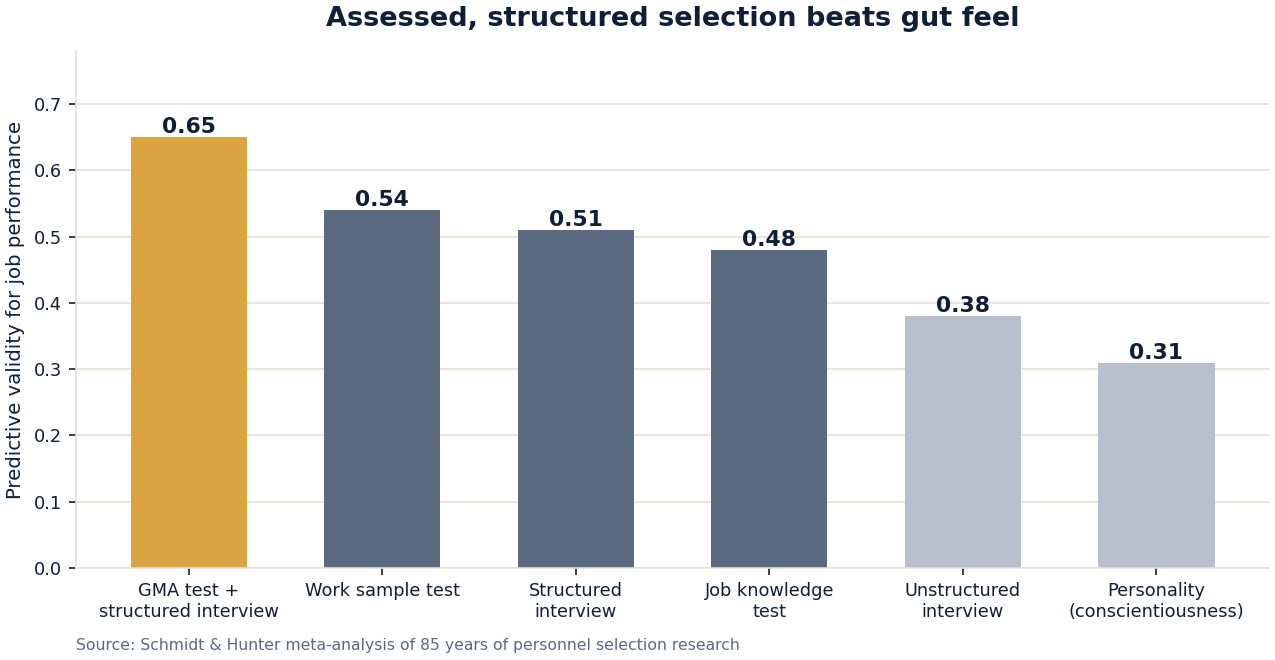
The research message applies to leadership selection directly: structured, job-relevant measurement beats charm. Three further rules keep scoring defensible. Train and calibrate assessors with sample responses before the first real candidate. Combine multiple raters and multiple methods, because measurement error averages out while single-rater bias compounds. And record not just scores but evidence — the behavioral notes behind a 3.4 rating are what make the number actionable later. If your competency language is not yet defined, start with our competency assessment framework guide before scoring anything.
From assessment results to a leadership development plan
An assessment that ends with a score has failed half its purpose. The output should be a development conversation within two weeks and a written leadership development plan inside a month: two or three priority competencies, concrete on-the-job assignments, a coaching or mentoring component, and a reassessment date 6-12 months out. Closing the loop this way is also what makes reassessment meaningful — the second administration measures movement, not just a new snapshot.
The retention logic is strong too: LinkedIn's Workplace Learning Report found 94% of employees say they would stay longer at a company that invests in their learning, and nothing signals investment like a personalized plan built from your own assessment data. Delivery format matters here as well. Building simulations, rubrics and workbooks from scratch for every cohort exhausts even well-staffed L&D teams; complete leadership program packages now ship with ready-made assessments, facilitator guides and participant workbooks aligned to each module, so the assessment-to-development pipeline runs on the same competency map from diagnosis to classroom to follow-up. For senior audiences, pair the test data with visibility work — our executive presence training guide covers the observable behaviors boards actually read.
Frequently asked questions
What is a leadership assessment test used for?
Organizations use leadership assessments to select promotable candidates, diagnose development needs in current leaders, and build succession slates with comparable data. The same instruments also anchor coaching engagements by establishing a measurable starting point. In every case the goal is evidence-based decisions about who is ready for which role.
What questions are on a leadership assessment test?
Expect scenario-based judgment items, behavioral interview prompts, self-report style inventories and, in assessment centers, simulated leadership tasks such as role plays or presentations. Questions describe realistic leadership situations — conflict, change, resourcing — and score responses against competency rubrics. Strong tests measure behavior in context rather than abstract opinions.
Can you prepare for a leadership assessment?
You can prepare honestly: review the target role's competencies, practice structuring answers to behavioral questions with real examples, and rehearse thinking aloud in case exercises. What does not work is gaming personality inventories — inconsistency checks catch it, and inflated profiles hurt the candidate most. Focused practice on judgment and communication is legitimate and effective.
What is a good score on a leadership assessment?
There is no universal number; benchmarks depend on the instrument and the role's requirements. Many organizations set criterion-referenced cut scores — for example, demonstrated proficiency in each core competency rather than a single total. Compare against the target role and a relevant norm group, never against an arbitrary percentage.
How long does a leadership assessment take?
A 360-degree feedback cycle typically spans two to three weeks of rater collection; an online SJT or personality inventory takes 20-40 minutes; a full assessment center runs a half-day to two days. The deeper the decision's stakes, the more time is justified. Match the tool to the decision, not the other way around.
Are leadership personality tests accurate?
Validated inventories are reliable and useful for describing style and preferences, but personality alone is a weak predictor of leadership outcomes. That is why best practice pairs them with observed-behavior measures like simulations and 360 feedback. Treat personality results as conversation starters, not verdicts.
Your next step
Assessment tells you who is ready; a program builds the rest. The Advanced Leadership Mastery program includes ready-made leadership assessments, scoring rubrics and participant workbooks with its facilitator guides, so an assessment cycle can flow straight into targeted development. Deepen the measurement side with our 360-degree feedback for leaders guide, and turn results into action with the leadership development plan template. Explore the full PersonaPulse library for every assessment-equipped leadership package.