Every L&D budget conversation eventually hits the same wall: "but did it work?" The Kirkpatrick model remains the most widely used answer framework — four levels of training evaluation, from happy sheets to business results. Yet measurement discipline thins out fast: industry surveys consistently find around 92% of organizations measuring Reaction, 72% measuring Learning, 45% measuring Behavior, 28% measuring Results — and only 9% calculating ROI. Decades of transfer research suggest as little as 10-30% of classroom learning ever shows up as changed behavior on the job, and programs without evaluation design have no way to know. This guide makes Levels 3 and 4 operational for leadership programs specifically.
The four levels in ninety seconds
- Reaction — did participants find it relevant and engaging? (post-session survey)
- Learning — did they acquire the knowledge, skills and confidence? (pre/post checks)
- Behavior — are they applying it on the job? (60-90 day stakeholder surveys)
- Results — did targeted business metrics move? (KPI tracking agreed before launch)
A workable evaluation plan assigns each level an instrument and a date:
| Level | Question answered | Instrument | When |
|---|---|---|---|
| 1. Reaction | Was it relevant and engaging? | Five-item relevance survey | Within 48 hours of each session |
| 2. Learning | Did they acquire the skill? | In-session assessments and role-plays | During each workshop |
| 3. Behavior | Are they applying it on the job? | Stakeholder re-rating plus artifacts | Day 0 baseline, Day 90 re-rate |
| 4. Results | Did the business metric move? | Pre-agreed KPI tracking | Quarterly, 3-6 month lag |
| 5. ROI (Phillips) | Did it pay for itself? | Benefit-cost conversion with isolation | At program close |
The levels are sequential for a reason: you cannot credibly claim Level 4 without Level 3 evidence, because business results move for many reasons and behavior change is your program's fingerprint on the outcome. The sequence also maps neatly onto budget psychology — Levels 1-2 prove the program was sound, Level 3 proves it changed people, and Level 4 proves it changed the business.
Where organizations actually stall
The measurement funnel above is real and remarkably stable across surveys: nearly everyone collects happy sheets, almost nobody computes ROI. The drop-off between Learning (72%) and Behavior (45%) is the crux, because Level 3 is where training budgets are actually defended — and it is exactly the level that cannot be measured after the fact. Behavior data must be baselined before the program runs, which is why evaluation design is a launch decision, not a wrap-up task.
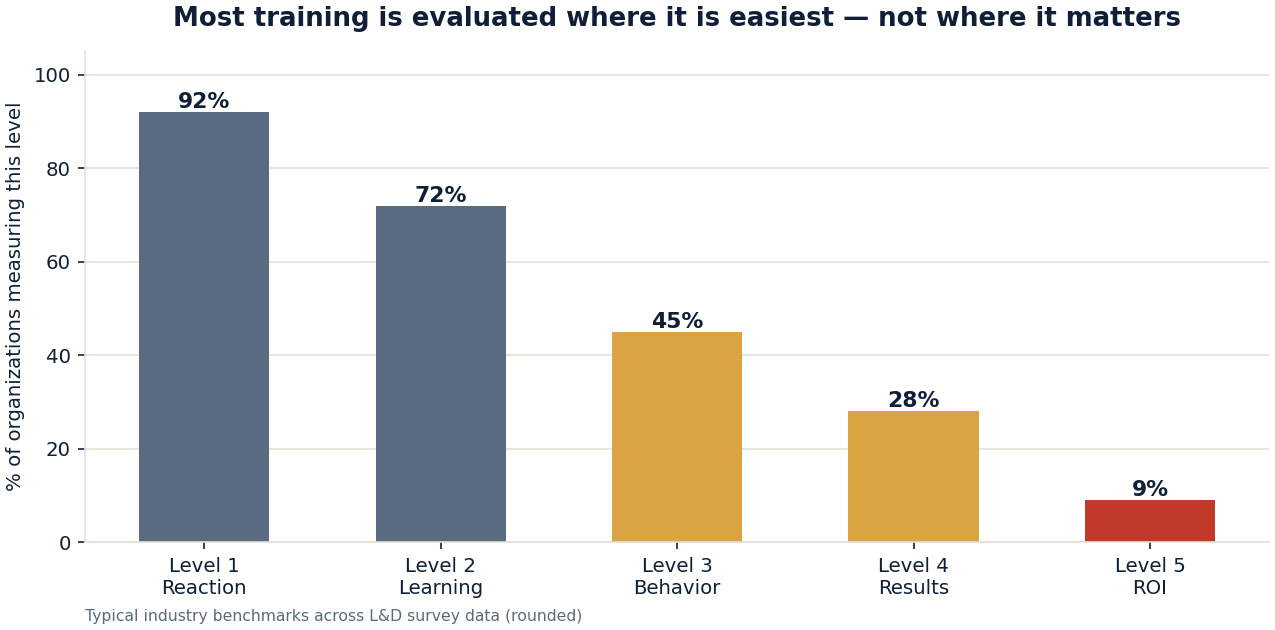
If your organization sits in the 72%-but-not-45% band, the fastest upgrade is mechanical rather than analytical: add a Day-0 behavior baseline and a Day-90 re-rating to the next cohort's launch pack. No dashboards required — a spreadsheet and named stakeholders will do.
Level 1-2: necessary, weak, cheap to do well
Reaction surveys deserve two minutes of design: replace "did you enjoy it" with relevance items — "I can apply this within two weeks" predicts transfer far better than star ratings. Learning measurement for skills programs should be behavioral evidence inside the session: the assessed role-play, the completed delegation plan, the drafted one-to-one agenda. Retention pressure starts immediately after any session — Ebbinghaus's forgetting-curve research shows most uncued new knowledge fades within days — so the Level-2 evidence you capture in-session is often the freshest you will ever get. Ready-made programs help here: the Leadership Development Mastery kit ships an assessment pack per module, so Level 2 evidence exists by construction rather than by afterthought.
Level 3: the level that decides renewals
Behavior measurement is a calendar decision, not a survey decision. Wire it in at launch:
- Day 0 — baseline: the participant's manager and three direct reports rate the target behaviors (e.g. "gives specific feedback", "delegates with clear checkpoints").
- Day 90 — same stakeholders re-rate the same items. A mean shift of even half a point on a 5-point scale across a cohort is a defensible behavior claim.
- Assignment evidence — each workshop produces a workplace artefact (delegation plan, coaching notes). The 90-day review asks what happened to it.
Our first-90-days curriculum guide shows these hooks already embedded in a new-manager program; the same pattern generalizes to any leadership cohort. For a deeper treatment of the model's mechanics — including the updated New World Kirkpatrick emphasis on transfer climate — see our guide to the four levels of training evaluation.
Level 4: pick two metrics and defend the lag
Results-level claims need metrics that plausibly respond to manager behavior within 3-6 months:
- Regrettable attrition in the participating population — SHRM's replacement-cost research puts losing a salaried employee at roughly six to nine months of salary, which makes even small attrition moves valuable.
- Team engagement scores for participants' teams — Gallup attributes roughly 70% of engagement variance to the manager, and its top-versus-bottom-quartile research ties engagement to 23% higher profitability and 43% lower turnover.
- Internal mobility / readiness — successors named and ready per critical role.
State the causal chain explicitly — better delegation lowers overload, overload drives attrition — and pre-agree it with finance. When the metric moves, the story is already accepted; when it does not, you negotiated the lag in advance instead of defending it in panic.
Budget benchmark to anchor the ROI math: ATD's State of the Industry reports average direct learning spend of roughly $1,280 per employee per year — a focused leadership cohort typically costs less than that, which makes Level 3-4 evidence the difference between "cheap" and "provable".
The Phillips upgrade: ROI as a ratio
Jack Phillips' extension adds a fifth step: convert benefits to money, subtract costs, divide by costs — ROI = (net benefits ÷ costs) × 100. For leadership programs this works when the benefit chain is short and defensible; attrition reduction times replacement cost is the classic, and Phillips' methodology adds isolation techniques (trend lines, control groups, stakeholder estimates) to keep the claim honest. Keep the ratio for the executive summary, but lead with Level 3 behavior evidence; ratios built on soft chains get audited and demolished. Our dedicated guide to Phillips ROI measurement walks the full calculation with worked examples.
Common failure modes — and the three instruments that prevent them
- Measuring everything at Level 1 — fix: cap reaction surveys at five items.
- Level 3 surveys that ambush stakeholders — fix: tell raters at Day 0 they will be re-asked at Day 90; response rates double.
- Level 4 metrics chosen after launch — fix: sponsor signs the two-metric list before the first workshop.
- No control view — fix: track a matched non-participant population on the same KPIs; even a rough comparison strengthens the claim.
- Measuring the pilot, then stopping — fix: wire the instruments into every cohort's launch pack so the discipline survives busy quarters.
Kirkpatrick discipline is really a paperwork discipline — three short instruments, all creatable in an afternoon. First, the relevance-weighted reaction survey (five items): applicability within two weeks, facilitator usefulness, materials usefulness, confidence to apply, and one open "what would make this more useful". Anything longer suppresses honest completion. Second, the behavior re-rating sheet (eight items max): the specific behaviors your curriculum trains, rated 1-5 by the participant's manager and three direct reports, administered at Day 0 and Day 90 with identical wording — and pre-announced at baseline, because ambush surveys get ignored. Third, the artifact ledger: one row per participant per module — the delegation plan, the coaching notes, the meeting redesign — with a "what happened to it" column filled at the 90-day review.
Artifacts are the most persuasive evidence in any readout because they are real objects, not perceptions. Organizations that skip the instruments usually re-invent them badly mid-program under deadline pressure; building them into the launch pack — which is precisely how licensed curricula structure their evaluation templates — lets the discipline survive busy quarters.
Frequently asked questions
What are the four levels of the Kirkpatrick model?
Reaction, Learning, Behavior and Results — a sequence for evaluating training from immediate perception through knowledge gain, on-the-job application, to business impact. The 2026-relevant discipline is front-loading: decide what Levels 3-4 will measure before the program runs.
Is the Kirkpatrick model still valid?
Yes — it remains the shared language of the industry. Critics rightly note it under-weights context and transfer climate; the practical answer is to pair it with assign-and-apply design (real workplace tasks between sessions) rather than abandoning the framework.
How long after training should behavior be measured?
Sixty to ninety days. Inside thirty days, novelty inflates scores; beyond four months, attribution decays. For multi-month programs, pulse at each module boundary instead.
What response rate do Level 3 surveys need?
Above 60% from each stakeholder group for a defensible read. Pre-announcing the survey and keeping it under ten items are the two levers that reliably get you there.
Can small organizations use Kirkpatrick without a data team?
Yes. Two metrics, one spreadsheet, one baseline survey template per stakeholder. The model scales down far better than people expect — what dies is not the framework but the ambition to measure everything.
Where can I get evaluation templates ready to use?
The free Training Evaluation Toolkit includes reaction, learning, behavior and results templates — and the full Leadership Development Mastery kit ($89.50, unlimited delivery) embeds per-module assessments so Levels 1-2 are covered by construction.
Your next step
If you need to defend a leadership training budget this year, build the measurement plan first and the content second — Leadership Development Mastery ships with per-module assessments and evaluation templates to start from. Go deeper with our guide to the four levels of training evaluation and our worked Phillips ROI methodology walkthrough, or browse the full PersonaPulse library to see every program that comes measurement-ready.
Free Training Evaluation Toolkit — Reaction, Learning, Behavior & Results Templates
Get the free downloads for this topic — module 1, training plan, workbook sample, assessments and the table of contents.