More than 65 years after University of Wisconsin professor Donald Kirkpatrick published his dissertation chapter on evaluating training, the Kirkpatrick model is still the framework L&D teams name first — and the one executives test your credibility against. The statistics explain both its staying power and the embarrassment: ATD survey data finds 92% of organizations measure whether learners enjoyed a program, 72% measure what they learned, but only 45% measure whether behavior changed on the job, 28% measure business results, and roughly 9% calculate financial ROI. That cliff-edge drop-off is the Kirkpatrick gap. This guide explains the four levels of training evaluation, shows how to operationalize each one with instruments you can build or buy, and positions the model honestly — including where its critics have a point.
What is the Kirkpatrick model?
The Kirkpatrick model is a four-level framework for evaluating training: did participants react favorably (Level 1), did they learn (Level 2), did they apply it on the job (Level 3), and did it produce business results (Level 4). Kirkpatrick introduced the levels in 1959 through a series of journal articles, and his son James and daughter-in-law Wendy later updated the approach as the "New World Kirkpatrick" — most importantly by reversing the planning sequence so programs start by defining Level 4 outcomes.
The model endures because it matches how managers intuitively ask about training: did they like it, did they learn, will they use it, did it matter? Its simplicity is also its risk — the levels are easy to name and much harder to instrument. The sections below make each level concrete.
The four levels of training evaluation at a glance
| Level | Question it answers | Example measures | Common data sources |
|---|---|---|---|
| 1. Reaction | Did participants find it relevant and engaging? | Post-session survey scores, relevance ratings | End-of-session forms |
| 2. Learning | Did knowledge, skill or confidence change? | Pre/post tests, skill demonstrations, rubric scores | Assessments before and after |
| 3. Behavior | Are participants applying it on the job? | 60-90 day observation rubrics, 360 pulse, manager check-ins | Manager reports, work products |
| 4. Results | Did it move business outcomes? | KPI deltas tied to the target: quality, retention, sales, safety | Business dashboards, HRIS |
| 5. ROI (optional) | Did monetary benefits exceed costs? | Benefit-cost ratio, ROI percentage | Phillips ROI methodology |
Level 5 is not Kirkpatrick's own addition — Jack Phillips extended the model with a formal ROI step — but executives increasingly treat it as the real finish line. Our companion guide to proving training ROI with the Kirkpatrick model covers it alongside Phillips' methodology in detail.
The Kirkpatrick gap: what organizations actually measure
Industry surveys keep confirming the same pattern: most organizations stop measuring after the smile sheet, and the percentage falls off a cliff as you climb the levels. The numbers below come from ATD survey research on which Kirkpatrick levels organizations actually measure.
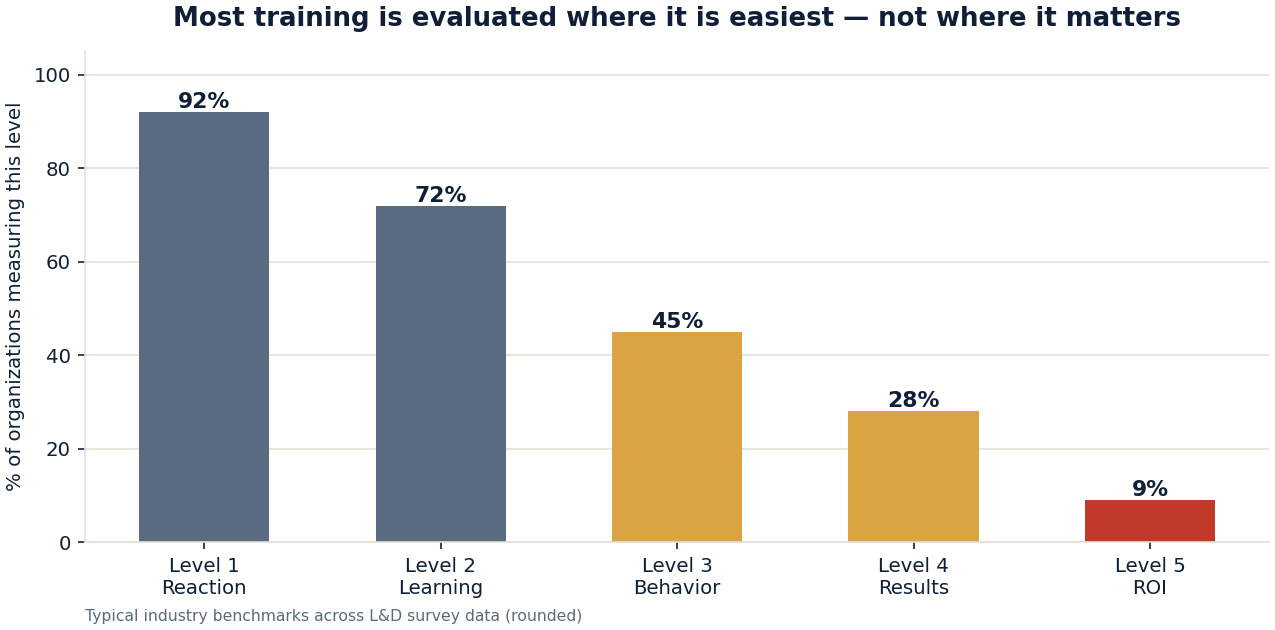
Three reasons drive the gap. Levels 1 and 2 are cheap and inside L&D's control, while Level 3 requires managers' cooperation and Level 4 requires access to business data and an attribution story. Measurement at the top also demands planning before delivery — baselines, target KPIs, comparison groups — which is impossible to retrofit after a program ends. And many teams quietly fear what a Level 4 question invites: a finance partner asking how much of the result the training actually caused. None of these reasons change the fact that executives fund Level 4 outcomes; they only explain why most functions stay stuck below the cliff. A Kirkpatrick training evaluation effort lives or dies at exactly those upper levels, so the practical sections below focus there.
Applying each level in practice
Level 1 — Reaction, done usefully. Replace "did you enjoy it" with relevance and confidence items: "I can apply this to my work within 30 days," rated on a defined scale, plus one open question about what would make it more applicable. Watch response rates and item variance; a program where every session scores 4.9/5 is telling you the instrument is dead, not that the training is perfect.
Level 2 — Learning, measured twice. Pre/post knowledge checks or skill demonstrations are the workhorse, and the difference between them is your learning gain. Complete program packages that ship with ready-made pre and post assessments and scoring rubrics remove the most common excuse for skipping this level — the instruments arrive aligned with the content. Keep every item tied to an objective you actually taught.
Level 3 — Behavior, 60-90 days later. Choose two or three observable behaviors from the program, define them in a short observation rubric, and agree with line managers in advance that they will rate and coach against it. Short 360 pulses or work-product reviews also work where direct observation is impractical. Level 3 is where training evaluation earns executive respect, because it is the first level that describes the workplace, not the classroom.
Level 4 — Results, by design. Pick one or two KPIs the program can plausibly influence, capture the baseline before delivery, and agree the attribution logic with the finance or operations partner who owns the metric. A realistic goal is a credible contribution story — "retention improved 3 points in pilot teams versus 1 point in comparison teams" — not laboratory-grade causality. If the budget conversation needs strengthening before you start, our guide to winning executive buy-in for L&D budget is the practical playbook.
Criticisms of the Kirkpatrick model — and realistic fixes
The model has genuine limitations, and pretending otherwise weakens your evaluation story. The common critiques: the levels imply a strict causal chain that research does not always support — positive reaction, for instance, barely predicts learning or application; the model says little about how to measure, which spawned a template industry of smile sheets that measure nothing but satisfaction; and it treats results as the summit without weighting broader outcomes such as retention, adaptability or culture.
The pragmatic fixes keep the framework and lose the theater. Start with Level 4 and work backward when designing, exactly as the New World version recommends. Replace single pre/post snapshots with comparison groups where feasible — even a rolling-cohort design gives you one. Pair the Kirkpatrick ladder with Phillips' ROI methodology when money questions arrive, as our guide to the Phillips ROI measurement approach explains. And treat the levels as a checklist of questions to answer, not a religious hierarchy — a well-evidenced Level 3 story often persuades executives more than a shaky Level 4 claim.
Frequently asked questions
What are the four levels of the Kirkpatrick model?
The four levels are Reaction (did participants find the training engaging and relevant), Learning (did knowledge or skill change), Behavior (are they applying it on the job) and Results (did business outcomes move). Many practitioners add Phillips' Level 5 for financial ROI. In practice the levels are measured with surveys, pre/post assessments, manager observations and business KPIs respectively.
What is the difference between Kirkpatrick Level 3 and Level 4?
Level 3 measures whether participants changed their behavior at work; Level 4 measures whether business results improved. A leader may visibly coach weekly (Level 3) while team attrition barely moves (Level 4) — which is itself a valuable diagnostic finding. Level 3 is behavior evidence; Level 4 links it to organizational metrics.
Is the Kirkpatrick model still relevant?
Yes — it remains the shared vocabulary for training evaluation and the framework executives understand fastest. Its limits are real, so modern practice uses it alongside comparison groups, Phillips ROI and predefined outcome targets. Practically, it is still the default structure most L&D evaluation reports follow.
How do you measure Kirkpatrick Level 3 behavior change?
Define two or three target behaviors from the program, then measure them 60-90 days later through manager observation rubrics, short 360 pulses or review of real work products. Agree the measurement approach with line managers before delivery. Comparing results against a baseline or a non-trained group makes the evidence far stronger.
What is the fifth level of training evaluation?
Level 5 is financial ROI, added by Jack Phillips: convert program benefits to money, subtract fully loaded costs, and express the result as a percentage of cost. It is demanding work, but it answers the question CFOs actually ask. Our companion article on proving training ROI walks the calculation step by step.
How long after training should you evaluate behavior change?
Sixty to ninety days is the standard window — long enough for new habits to form, short enough that other changes have not drowned the signal. For strategic programs, a second check at six months catches durability. Schedule the evaluation before the program runs, or it will quietly disappear from the calendar.
Your next step
Evaluation is far easier when the program arrives with its instruments. The Leadership Development Mastery program includes ready-made pre and post assessments, evaluation forms and scoring rubrics with every package, so Levels 1 and 2 are covered on day one and Level 3 has a defined behavior checklist to build on. Continue with our companion piece on proving training ROI with the Kirkpatrick model, then the Phillips ROI measurement guide for the money question. The full PersonaPulse library shows every package with its assessment contents listed.