The first decade of inclusion training produced a familiar result: vocabulary improved, teams did not. The research explains why — awareness content changes what people say, while inclusion is built from observable behaviors that team members experience, or don't, in meetings, assignments and feedback. The business case is strong enough to take seriously: McKinsey's Diversity Wins series found top-quartile gender-diverse executive teams were 25% more likely to achieve above-average profitability — 36% for ethnic diversity — and Deloitte's research found teams whose leaders score high on inclusion report 80% better team performance. The bridge from that potential to Tuesday-morning reality is inclusive leadership training aimed at behavior, not vocabulary. This guide is the design.
The six behaviors inclusive leaders actually do
Deloitte's six-trait model — commitment, courage, cognizance of bias, curiosity, cultural intelligence, collaboration — is a useful map, but training needs verbs. The observable version:
| Behavior | Observable marker | How to measure it |
|---|---|---|
| Runs equitable meetings | Rotating airtime; deliberate invitation of quieter voices | Airtime tally on sampled meetings |
| Assigns opportunities transparently | Stretch tasks posted and rotated, not granted by hallway proximity | Share of stretch tasks posted vs private |
| Interrupts bias in real time | Names the pattern without humiliating anyone | Observer scorecards in live meetings |
| Solicits dissent structurally | Pre-read comment fields, assigned challenger, "what would make this fail" rounds | Dissent items logged per decision |
| Gives calibration-safe feedback | Same evidence standard for everyone, checked against pattern over time | Rating-pattern audit |
| Owns the repair | Addresses the miss, repairs it, says what changed | Repair actions logged |
Each behavior is observable, coachable and measurable — which is exactly what makes Level-3 evaluation possible where awareness training produced none. The meeting mechanics borrow directly from our remote and hybrid playbook, because hybrid meetings amplify every inequity they inherit.
Why awareness-only workshops stall
Awareness content triggers defensiveness before it triggers change: participants hear "you are the problem," protect identity, and file the vocabulary. Behavior-first design inverts the order. It starts with meeting mechanics and assignment rules, which feel like management craft rather than accusation; early wins create the psychological safety; then the deeper bias cognition lands with the research base already in the room. The sequencing matters as much as the content — permission precedes challenge, and mechanics precede mindset. Harvard Business Review's well-known review of diversity programs reaches the same conclusion from the other direction: mandatory, one-shot, blame-flavored sessions produce minimal durable change, while designs that build skills, engagement and accountability move outcomes.
Inclusion is experienced at the team level in about six recurring situations — meetings, assignments, feedback, disagreements, recognition and repairs. Train the six situations and the culture follows.
This is also why the training fails when it is a single session bolted onto a compliance calendar: the behaviors need spaced rehearsal with real artifacts, exactly like every other leadership skill in the complete leadership program architecture.
The training architecture: four modules across eight weeks
A behavior-first program runs four modules across eight weeks, each producing one artifact:
- Equitable meeting mechanics (week 1) — the rotation and invitation toolkit; participants rebuild one recurring meeting immediately. Artifact: the rebuilt meeting agenda.
- Transparent opportunity allocation (week 3) — teams audit last quarter's stretch-task distribution against a posted-assignments standard; the audit is usually the loudest learning moment. Artifact: the assignment board.
- Bias interruption rehearsal (week 5) — scripted scenarios with escalation and de-escalation paths, role-played with peer observers scoring against the rubric. Artifact: scored practice rounds.
- Feedback calibration (week 7) — evidence-anchored feedback practice with pattern-checking on one's own ratings history. Artifact: a calibration checklist in use.
The Inclusive Leadership program packages this arc with facilitator script, scenarios, workbook and assessment — $89.50 one-time for unlimited cohorts — and slots into the wider leadership curriculum as the inclusion track.
The interruption scripts: language for the hard moments
Behavior training must supply actual words, because the moment a leader decides to interrupt a bias pattern is the moment improvisation fails. Four scripts cover most situations. The pattern-name script: "I want to slow us down — I think we're evaluating this idea more harshly than the last one; let's test both against the same criteria." The credit-restore script: "Before we move on — Maya proposed this direction ten minutes ago; let's credit that and build on her version." The airtime script: "We've heard from four people with similar profiles — Dev, I'd like your read on this." The assignment script: "This stretch project is open — posted Friday, criteria attached, expressions of interest by Wednesday."
Each script is rehearsed with escalation paths — what to do when the pattern repeats anyway — and a repair path for when the leader themselves gets it wrong. "I interrupted you twice in that meeting; I noticed, and I will do better" is itself the modeled behavior. Leaders who own their misses earn more behavioral change than leaders who never miss, because the team learns the standard applies to everyone, including the person holding the rubric.
The engagement payoff: why the behaviors compound
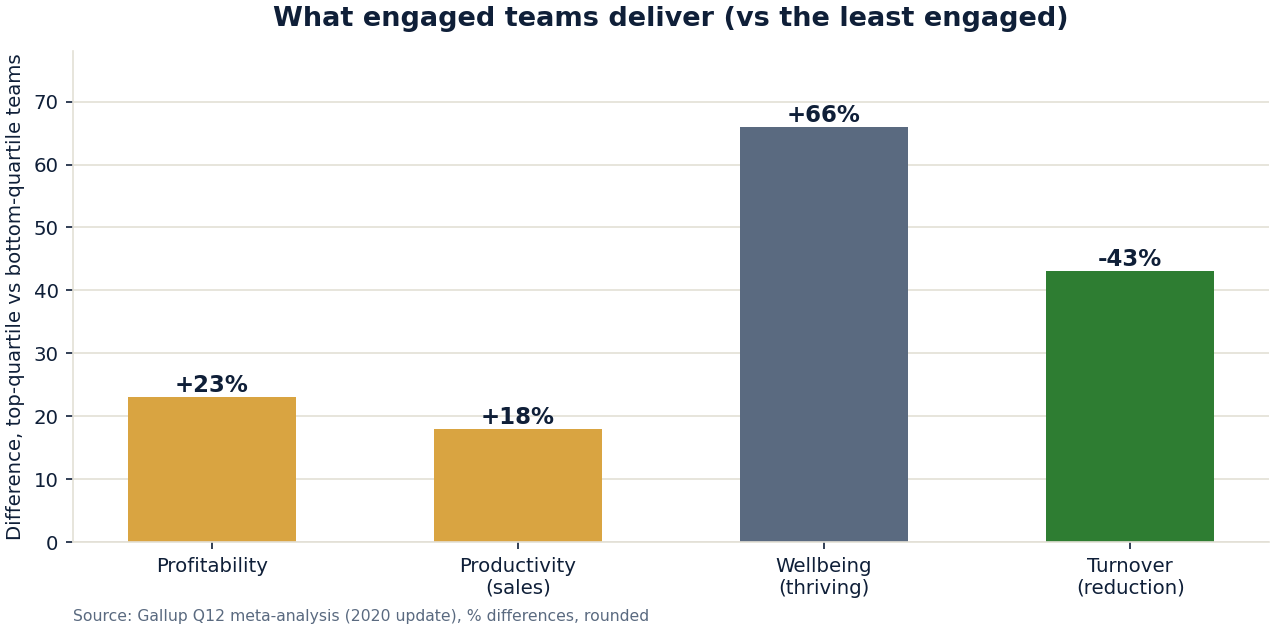
Inclusive leadership is not a values garnish on top of engagement — it is a driver of it. Gallup's Q12 meta-analysis compares top-quartile to bottom-quartile engagement and finds the gap worth +23% profitability, +18% productivity, +66% wellbeing and -43% turnover, and the six behaviors above are precisely how engagement gets manufactured in meetings and assignments.
The inclusion-specific numbers point the same direction. Deloitte's research found teams with inclusive leaders are 17% more likely to be high-performing, 20% more likely to make high-quality decisions, and 29% more likely to behave collaboratively. BetterUp's belonging research ties strong belonging to a 56% jump in job performance and roughly half the turnover risk, and BCG found companies with above-average management diversity reported 19 percentage points more revenue from new products and services. The pattern across sources is consistent: the behaviors are the mechanism, and the business outcomes are the dividend.
Measuring behavior, not sentiment
Three instruments, all baseline-versus-90-days:
- Meeting equity sample — an airtime-and-invitation tally on two sampled meetings per participant.
- Assignment transparency — share of stretch tasks posted versus privately granted.
- Team pulse — "my manager makes sure everyone's perspective is heard before decisions" and "opportunities are allocated fairly here."
That trio is honest Level-3 evidence — stronger than any attitude survey — and plugs into the Kirkpatrick wiring used across our program guides. Publish cohort-level results back to participants at the 90-day mark: teams that see their own airtime and assignment numbers improve the behaviors faster, because inclusion becomes a shared scoreboard rather than a private virtue. Where a broader competency system exists, map the six behaviors into your competency assessment framework so inclusion scores live beside every other leadership capability instead of in a separate report nobody opens.
Frequently asked questions
What is inclusive leadership?
A leadership capability defined by observable behaviors — equitable meeting practices, transparent opportunity allocation, real-time bias interruption, structural dissent, calibrated feedback and repair — that make diverse teams actually perform. Deloitte's six-trait model maps onto the same verbs.
Does inclusive leadership training work?
Awareness-only formats show weak behavioral evidence; behavior-first designs with meeting mechanics, audits and rehearsal produce measurable team-level shifts within 60-90 days. The design determines the outcome.
How do you measure inclusion at the team level?
Three practical instruments: airtime and invitation sampling in meetings, transparency audits of assignment allocation, and team pulse items on voice and fairness — baseline against a 60-90 day re-measure.
Isn't this just unconscious bias training by another name?
No — and the difference is the mechanism. Bias training targets cognition; inclusive-leadership training targets recurring observable situations: meetings, assignments, feedback. The latter survives contact with Tuesday because it changes the default mechanics.
Can inclusive leadership be trained in one session?
One session can install the meeting toolkit; the assignment and feedback behaviors need spaced modules with real artifacts. Eight weeks, four modules, one artifact per module is the proven minimum.
Where can I get ready-to-deliver inclusive leadership materials?
The Inclusive Leadership kit includes the four-module arc with facilitator script, scenarios and assessment for $89.50 one-time with unlimited cohorts. Compare it with the wider PersonaPulse library before commissioning a custom build.
Your next step
If your inclusion ambitions currently live in a values statement, the fastest upgrade is a behavior program with a scoreboard. The Inclusive Leadership program ships the four-module arc ready to deliver, and the 360-degree feedback implementation guide shows how to wire the observer measurement. Browse the full PersonaPulse library to assemble the complete leadership track around it.