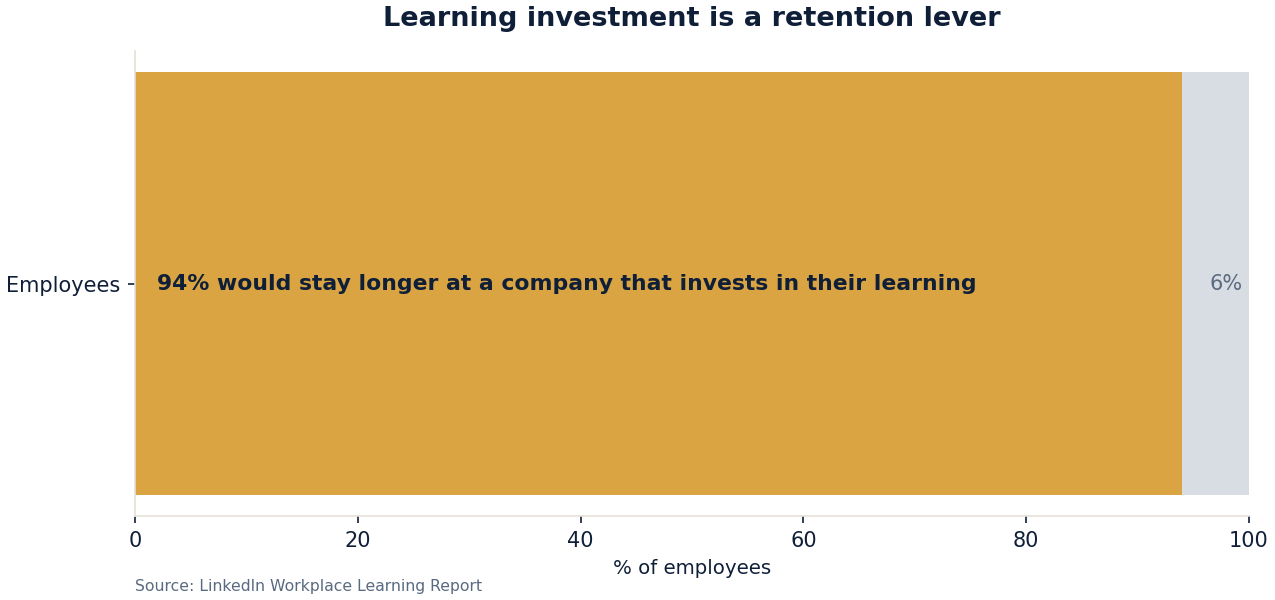
94% of employees say they would stay longer at a company that invests in their learning, according to LinkedIn's Workplace Learning Report — a figure that reframes the L&D budget conversation from cost center to retention lever. Yet funding conversations still stall on the same question: "what's the ROI?" The stalemate is unnecessary, because executives do not actually demand spreadsheet-perfect ratios; they demand evidence discipline — a defined problem, a costed intervention, a promised measurement and a small first step. This guide is the proposal structure that wins funding for training budgets, built for HR and L&D leaders who are tired of losing it.
Why "what's the ROI?" is usually the wrong question — and the honest answer
Training ROI is calculable when the benefit chain is short: attrition reduction times replacement cost is the classic, and the Phillips five-level methodology exists for cases where isolation of effects is genuinely defensible. But demanding a Level-5 ratio for every program is a category error — it punishes exactly the programs (leadership, inclusion, change capability) whose value compounds through behavior. The honest executive answer has three parts: what we will measure (behavior plus two business metrics, per our Kirkpatrick guide), what the causal chain is, and what the pilot will tell us by when. Leaders who give that answer get funded; leaders who promise fake ratios get audited — and poison the well for everyone who follows.
For the measurement deep-dive, our Phillips ROI measurement guide covers when a full five-level case is worth building and when it is theater.
The retention economics executives already believe
The strongest budget arguments are not training arguments at all; they are the retention and engagement numbers executives already track. LinkedIn's finding that ~94% of employees would stay longer at a company that invests in their learning makes L&D a retention instrument by the workforce's own account. Gallup attributes ~70% of the variance in team engagement to the manager, prices disengagement at roughly $8.8 trillion globally (about 9% of global GDP), and estimates replacing an employee at one-half to two times annual salary — with SHRM's research adding recruiting and productivity drag. ATD benchmarks average direct learning spend at ~$1,280 per employee per year, which gives you the denominator for every per-participant argument you will make.
The translation move is to attach those numbers to your specific population. "Our manager population's regretted attrition is 18%; replacement costs run 0.5-2x salary; a program costing under $200 per participant needs to save two exits a year to break even" is a conversation executives recognize as their own. "We want to build a world-class learning culture" is not.
The one-page proposal that works
Six blocks, one page:
| Block | What goes in it | The mistake that kills it |
|---|---|---|
| 1. The business problem | Operational terms: attrition %, exit-interview themes, bench coverage | "We need leadership training" as the opening line |
| 2. The intervention | Scoped small: one cohort, one population, one quarter | Proposing the three-year academy up front |
| 3. The cost | Total and per-participant; licensing makes content nearly invisible | Hiding facilitation time; padding the content line |
| 4. The measurement promise | Two business metrics plus behavior re-rating at 90 days, baselines agreed | Promising ROI ratios nobody can isolate |
| 5. The decision requested | Exactly one: approve the pilot, with a named decision date | Asking for endorsement instead of a decision |
| 6. The kill criteria | What result would stop the rollout | No exit doors — proposals without them read as faith |
Block 3 deserves one elaboration. Licensing economics have quietly rewritten the cost math: a full multi-module program such as Leadership Development Mastery licenses for $89.50 with unlimited internal delivery, which makes the content line nearly invisible next to facilitation time — the full comparison of in-house build versus ready-made licensing is in our cost model guide. When the CFO sees a program cost of a few hundred dollars per participant all-in, the funding conversation shifts from "can we afford it" to "can we afford to schedule it".
Block 6 is counterintuitive and decisive. Executives fund pilots with promised evidence and defined exits; they decline programs that need faith up front. Writing your own kill criteria costs you nothing — a failed pilot was going to die anyway — and buys credibility no case study can.
The pilot design that survives scrutiny
- Cohort of 12-20 from one population — enough for a measurable signal, small enough to schedule.
- A matched comparison — the same population, not yet trained, on the same metrics. The comparison converts anecdotes into evidence and is the single strongest feature of a fundable pilot.
- A visible sponsor — the executive whose metric hurts owns the pilot kickoff and receives the 90-day read personally. Sponsorship is the budget's life insurance.
- A 90-day readout with three numbers — behavior delta from the Level-3 survey, the two business metrics versus comparison, and the operational decision: scale, adjust, or stop.
Pilot audiences matter: choose a population where the executive sponsor already feels the pain, not the most convenient department. And baseline everything before the first session — metrics reconstructed after the fact read as advocacy, not evidence.
The 90-day readout: what goes on the slide
The readout meeting is where the pilot pays, and one slide carries it. Top line: the decision requested — scale, adjust, or stop, with the scale-up cost attached. Then the three evidence blocks. Behavior: the stakeholder re-rating delta (mean shift on the target behaviors, cohort versus baseline) — the causal link the rest of the story stands on. Business: the two agreed metrics for the cohort versus the comparison population, presented as deltas with honest confidence language ("n=18, direction consistent with the behavior data"). Operations: completion rates, artifact counts, and the one thing you would change in the next cohort — the operational honesty that makes the rest credible.
Two presentation rules. Lead with the comparison, not the absolute: "attrition 11% versus 17% in the comparison population" lands; "engagement improved" does not. And bring one participant story told in the stakeholder's own words — thirty seconds, specific, tied to a behavior the slide already quantifies. Executives vote with both halves of the brain; the readout slide that respects both is the one that gets the scale-up signature on the spot.
The language that opens wallets — and the sequencing to reverse
Opens: "attrition in this population", "bench coverage", "engagement delta versus comparison group", "per-participant cost", "90-day readout". Closes: "world-class learning culture", "transformative journey", "best-in-class content", and any ratio you cannot defend to finance. Match the vocabulary of the budget meeting, not the conference keynote — the new-manager data roundup is a ready-made source of defensible numbers for exactly this register.
The sequencing most L&D teams get backwards is funding before measurement. Reverse it: evaluate the format with a pilot cohort of Leadership Development Mastery (content cost: $89.50), design the measurement before the first session, and let the 90-day readout argue for the scale-up. The full-year budget conversation then starts from evidence instead of hope — and you will never again open a funding meeting by being asked to prove a negative.
Frequently asked questions
How do you prove ROI for leadership training?
You usually cannot — and should not pretend to. You prove behavior change at 90 days (stakeholder re-rating), movement on two pre-agreed business metrics versus a comparison population, and a short, defensible causal chain. Present that as evidence discipline; fake ROI ratios get audited and poison the well.
What should an L&D budget proposal include?
One page: the operational business problem, a small scoped pilot, total and per-participant costs, the two-metric measurement promise with baselines, one named decision requested, and kill criteria. Proposals with exit doors get approved; proposals without them read as faith.
How big should a pilot cohort be?
Twelve to twenty from a single population, with a matched not-yet-trained comparison on the same metrics. Small enough to schedule, large enough for a signal, and structured enough to produce the 90-day readout.
Which metrics convince executives most?
The two they already report: engagement scores and regrettable attrition in the trained population, against the comparison group. Behavior re-ratings carry the causal story; the business metrics carry the budget story.
How do we respond to "can't we just do this internally for free?"
With the real math: 90-130 designer hours per module plus permanent maintenance, against $89.50 licensing with the design already field-tested — see our cost comparison. "Free internal" is usually the most expensive option in the meeting.
Where does the pilot content come from?
License the spine: Leadership Development Mastery delivers the full program for $89.50 with unlimited cohorts, so the pilot's only real costs are facilitation and time.
Your next step
Scope the pilot this quarter: one cohort of 12-20, the two-metric promise, the comparison group, the 90-day readout on the calendar. License the content with Leadership Development Mastery at $89.50, source your supporting numbers from the first-time manager statistics roundup, and browse the PersonaPulse library for the programs to scale into once the readout lands.