Organizations promote their best individual contributors into management and then wonder why the transition misfires. The research is unforgiving: CEB (now Gartner) found that 60% of new managers underperform in their first two years, and the Center for Creative Leadership estimates that around 40% of new leaders fail within 18 months. A widely cited CareerBuilder survey makes the cause painfully plain — 58% of managers said they received no management training at all when they stepped into the role. First-time manager training exists to break that pattern, and the first ninety days decide whether it does.
This article gives HR and L&D teams a deployable 30-60-90 curriculum: what to teach, in what order, with which exercises — plus the measurement hooks that prove it worked.
Why the first 90 days carry so much weight
A new manager's habits form fast. The peer who used to join them for coffee is now someone they may need to coach — or discipline. Without structure, most new managers default to two failed strategies: doing everything themselves (the player-coach trap) or copying their own previous boss, for better or worse. Gallup's research adds scale to the problem: organizations fail to choose the right manager 82% of the time, and Gallup has long argued that only about one in ten people has the innate talent to manage — so the population entering these 90 days is usually managing for the first time without natural management instincts, and that is normal, not a hiring failure.
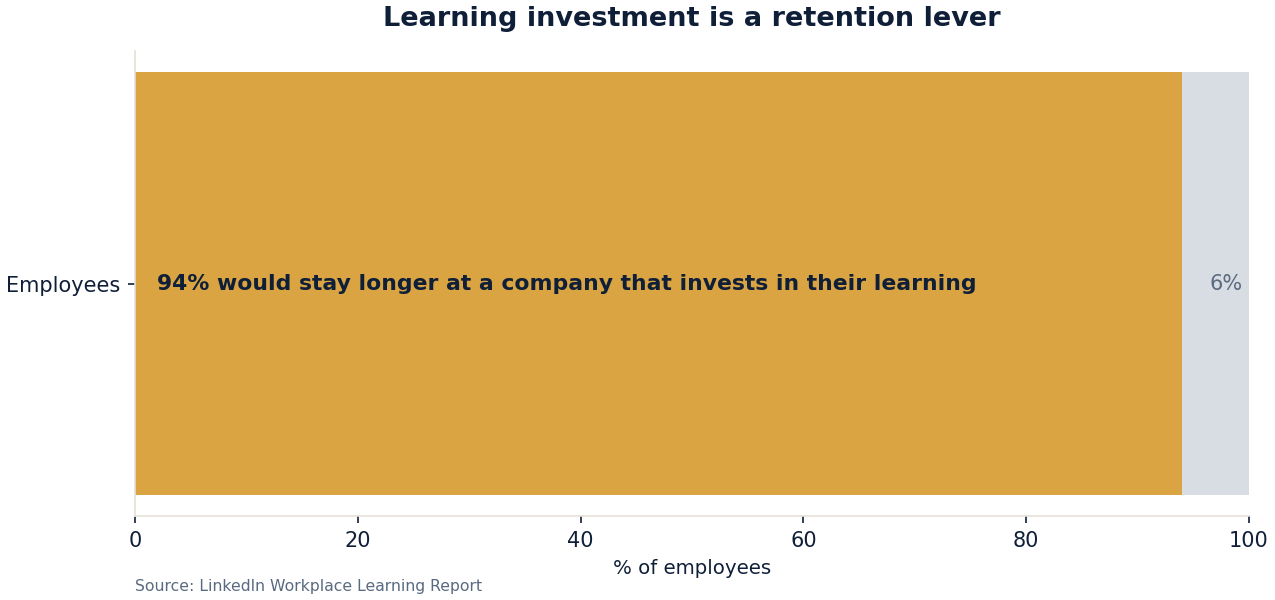
The stakes are bigger than one career. Managers account for roughly 70% of the variance in team engagement (Gallup), so an unsupported new manager quietly leaves an entire team's engagement to chance. There is also a retention dividend to getting this right: LinkedIn's Workplace Learning Report found 94% of employees would stay longer at a company that invests in their learning, and the management transition is the moment employees feel that investment most acutely.
Finally, timing is economics. SHRM's replacement-cost research puts the cost of losing a salaried employee at roughly six to nine months of salary, before counting the damaged engagement of the team left behind. Reaching every new manager with a structured 90-day arc costs a fraction of one avoided regrettable exit — and first-time managers are the largest leadership population any organization builds, which makes every design improvement multiply.
The 30-60-90 curriculum at a glance
| Phase | Focus | Core sessions | Artifacts produced |
|---|---|---|---|
| Days 1-30 | Identity and basics | Transition map, manager time, first one-to-ones | Team charter, calendar audit |
| Days 31-60 | Core conversations | Feedback, delegation, coaching practice | Delegation plan, feedback log |
| Days 61-90 | Team mechanics | Meetings, conflict, recognition, escalation | Meeting redesign, 90-day review |
- Days 1-30 — Identity and basics. The shift from contributor to leader, time management for managers, and the first one-to-one conversations.
- Days 31-60 — Core conversations. Feedback, delegation and coaching skills, practiced in role-play before they are practiced on real people.
- Days 61-90 — Team mechanics. Running meetings that matter, handling conflict early, and a public 90-day review with their own manager.
Days 1-30: rewrite the job description in the manager's head
The module that pays for the whole program is the identity shift. New managers must stop measuring themselves by personal output — a metric that now actively misleads them. The session that lands this is surprisingly simple: participants map where their hours actually go against what the role now requires, then set two "stop doing" commitments.
Practical components for this block:
- The transition map — eleven specific shifts from individual contributor to manager (reward sources, relationships, time horizon, definition of "good day").
- Manager time basics — calendar audit, one-to-one cadence, protecting deep work.
- First conversations toolkit — a scripted first-one-to-one agenda that surfaces working styles, motivations and worries.
- Expectation-setting exercise — participants draft a "what my team can expect from me / what I expect from my team" charter and pressure-test it in pairs.
The one-to-one cadence deserves special emphasis in this block. Gallup finds employees who have regular meetings with their manager are close to three times as likely to be engaged as those who do not — so a biweekly one-to-one habit installed in week three is arguably the highest-yield behavior in the entire curriculum. The First-Time Manager Essentials program opens with exactly this arc, including the fill-in workbook pages that turn the charter from a workshop artefact into a habit.
Days 31-60: feedback, delegation and coaching under supervision
Middle block, hardest skills. Each gets a dedicated session with role-play — because reading about feedback does nothing when a defensive employee is sitting across the desk.
- Feedback that changes behavior — situation-behavior-impact structure, practice rounds with peers, and the follow-up conversation most managers skip.
- Delegation without abandonment — the delegation ladder (what to delegate, to whom, with what checkpoint), plus a live delegation-planning worksheet. Our deep dive on delegation skills for managers expands this into a standalone guide.
- Manager-as-coach basics — question-first conversations; the difference between coaching, mentoring and directing is unpacked in our comparison of coaching vs mentoring vs training.
Rehearsal is non-negotiable here. New managers will meet the real defensive reaction within weeks of the workshop, and the difference between a script they have said out loud twice and a framework they have only read is the difference between behavior and embarrassment. Facilitators should script the pushback lines — "you said you'd trust me", "last time you took it back after two days" — directly into the role-plays so the hardest moments arrive in the practice room first.
Days 61-90: team mechanics and the public review
The final block moves from one-to-one skills to team-level operations: meeting hygiene (a decision log beats a brilliant monologue), early conflict resolution, recognition habits, and escalation judgement — knowing what to own, what to solve and what to pass upward.
It ends with the 90-day review: the participant presents to their own manager what changed in their team's operations, supported by the workbook evidence. This review is not a formality; it is the Level-3 behavior data point your L&D measurement plan has been waiting for. It also doubles as a retention signal — the transition rituals that make new managers feel invested-in are precisely the experiences LinkedIn's research links to longer tenure.
What HR should measure (beyond attendance)
- Baseline pulse at day 0 and day 90: team clarity, workload confidence and "my manager gives useful feedback" items.
- One-to-one cadence — a simple operational KPI; consistent biweekly one-to-ones within 60 days are a leading indicator of everything else.
- Manager-of-manager rating at 90 days against the three commitments from the charter.
Add a light team-level check where you can: engagement or pulse scores for participants' teams, compared with a matched group of teams whose managers have not yet been through the program. Even a rough contrast gives the Level-4 story a foothold before the annual engagement survey lands. For the evaluation architecture behind these hooks, our guide to the Kirkpatrick model lays out the full instrument set.
Build, borrow or license?
For a single intake, adapting existing corporate content may be feasible. For repeated intakes — which first-time manager training always becomes — a licensed curriculum is the economics-friendly route. First-Time Manager Essentials ships the whole 90-day arc (decks, facilitator script, workbook, assessments, training plan) for $89.50, one-time, unlimited cohorts. The free starter pack includes Module 1 and the training plan so you can evaluate fit before buying.
For the wider context — competency models, cohort design and executive sponsorship — start with the complete guide to building a leadership development program.
Frequently asked questions
How long should first-time manager training be?
Spread it across the actual first 90 days: three half-day workshops plus structured assignments between them. A single two-day event before the manager has faced a real situation produces knowledge without behavior change.
Should we train managers before or after they start managing?
Ideally both sides of the transition: a one-day "preparing to lead" session while still an individual contributor, then the 30-60-90 arc after appointment. Pre-transition training installs vocabulary; post-transition training builds reflexes.
What is the biggest mistake in first-time manager programs?
Skipping the identity-shift module and jumping straight to tools. When managers still measure themselves by personal output, every later technique — delegation, feedback, coaching — quietly gets used to do more personal work rather than to grow the team.
How many new managers per cohort?
Twelve to sixteen. Feedback practice needs enough partners for varied role-plays, but small enough that every participant performs at least twice per session.
Can new managers from different departments share a cohort?
Yes, and it usually strengthens the program: departmental mix lowers the social risk of honest role-plays and builds the cross-functional network new managers lean on later.
What does first-time manager training typically cost?
A licensed ready-to-deliver kit like First-Time Manager Essentials runs $89.50 one-time with unlimited internal cohorts; bespoke in-house design for the same arc typically consumes 100-200 designer hours before delivery. See our cost breakdown for the full arithmetic.
Your next step
If you are standing up a first-time manager track this quarter, First-Time Manager Essentials gives you the complete 30-60-90 curriculum — decks, facilitator script, workbook and assessments — for $89.50 one-time, with a free starter pack to preview first. For the broader frame, read our guide to building a leadership development program and our roundup of first-time manager statistics for the numbers that justify the budget. The full PersonaPulse library lists every ready-to-deliver program in the store.
Free First-Time Manager Training Pack — Module 1, 30-60-90 Plan, Workbook & Assessments
Get the free downloads for this topic — module 1, training plan, workbook sample, assessments and the table of contents.