When the Center for Talent Innovation studied thousands of senior executives, it put a number on the vague feeling every HR leader recognizes: executive presence accounts for about 26% of what it takes to get promoted into senior leadership. Not intelligence, not results — the perception of gravitas, communication and polish. Results get leaders considered; presence gets them chosen. The good news buried in the same research is that presence is not innate charisma — it is a trainable cluster of observable behaviors, and the training design matters enormously. This guide separates the trainable components from the mythology and shows L&D teams what a credible executive presence program must contain to avoid becoming expensive theatre.
Why presence is climbing the L&D agenda
The timing is not accidental. The WEF Future of Jobs survey projects that 44% of workers' core skills will be disrupted by 2027, with roughly half the workforce needing reskilling — and among the skills climbing fastest in demand it lists leadership and social influence. As technical skill sets churn faster, the durable differentiators become exactly what presence training develops: composure under pressure, concise communication, credibility in the room. LinkedIn's Workplace Learning Report points the same direction — employees overwhelmingly report staying longer at companies that visibly invest in their development, which makes a credible presence program a retention instrument as much as a pipeline one.
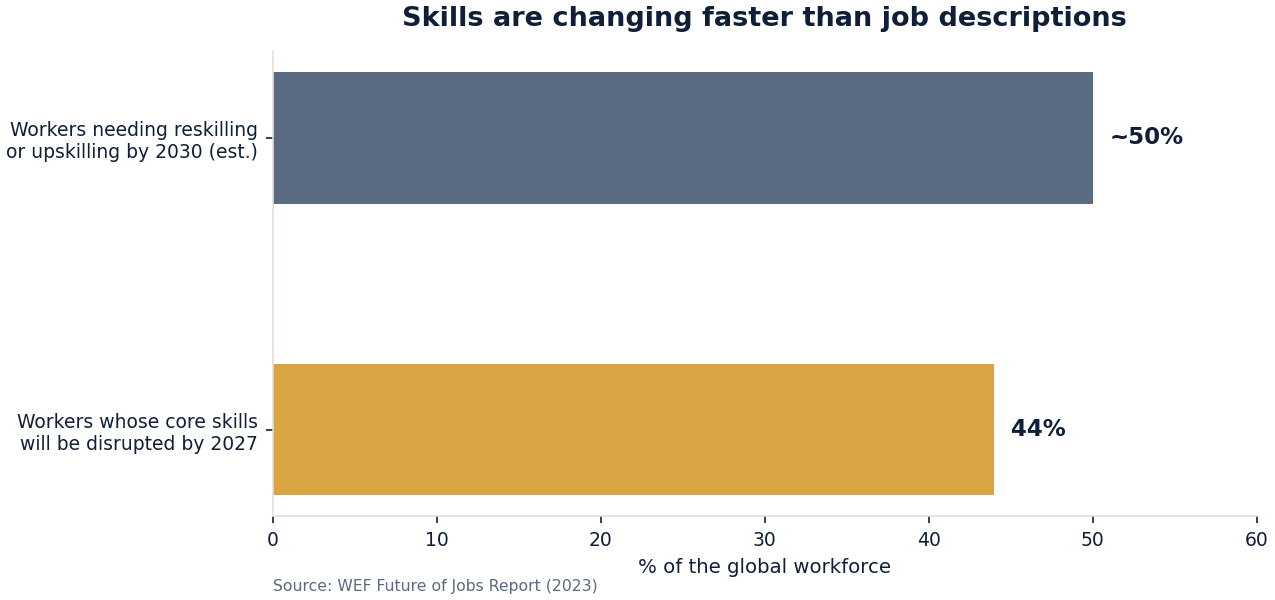
For talent pipelines the logic is blunt: organizations keep funding technical development for people whose technical ceiling is fine, while the promotion decision turns on a skill cluster nobody trains. A presence program aimed at observable behavior closes that specific gap.
The three pillars — and what each is really made of
The CTI research decomposes executive presence into three pillars, and the weightings matter for curriculum design: gravitas dominates, communication follows, appearance trails. Each pillar hides concrete, coachable behaviors rather than personality traits.
| Pillar | Weight in presence | Trainable components | How to train it |
|---|---|---|---|
| Gravitas | ~67% | Composure under fire, decisiveness in ambiguity, grace in crisis | Pressure simulations with interruption and recovery — not lectures |
| Communication | ~28% | Structured concise delivery, audience calibration, command of the room | The 30-second answer drill, meeting mechanics, video review |
| Appearance | ~5% | Signal coherence — packaging matches message and target role | A signal audit, not a style makeover |
Gravitas deserves most of the training hours, and it is the pillar most courses skip, because it requires the one thing lecture-format training cannot supply: stress rehearsal with structured feedback. Composure is a practiced reflex, not a personality purchase. The cohort that role-plays a hostile board question twice a week outperforms the cohort that reads about executive poise every time.
What separates real presence training from expensive theatre
A program that works, module by module:
- Baseline video diagnosis — every participant presents; the room and the camera expose the filler words, the retreating eyes, the hedging language ("I think maybe we could possibly..."). No self-report instrument finds these; video does.
- The 30-second answer drill — executives lose rooms by answering the first question with background. The drill is headline first, evidence second, stop — ten timed rounds.
- Pressure simulation with interruption — the presence test is not the prepared pitch; it is the hostile question mid-flight. Rehearsed interruption-and-recovery builds the composure pillar the research weights most.
- Meeting-command mechanics — claiming the first two minutes, positioning statements, the strategic silence. Small mechanics, visible scoreboard.
- Signal audit — one pass on whether packaging coheres with the target role, deliberately the shortest module in the arc.
The Leadership Presence and Executive Gravitas program is built around this rehearsal architecture rather than the lecture-plus-tips format that makes most presence courses forgettable — and the one-time license model means running cohort two costs a room, not a re-purchase.
The feedback layer: cameras, stakeholders and 360s
Executive presence has a brutal blind-spot profile: the behaviors that derail — hedging, over-explaining, physical retreat — are invisible to the person doing them. Two feedback sources fix what self-assessment cannot. Camera evidence is reviewed in structured self-critique rounds, and progress across modules is measurable frame by frame. Stakeholder pulse — three senior observers rate presence behaviors before the program and again at 60 days, and the delta becomes Level-3 evidence in the Kirkpatrick measurement case.
Presence training without video is like voice training without sound: the participant leaves with advice about behaviors they cannot yet perceive.
Where the organization already runs 360-degree feedback for leaders, add a presence item set to the existing instrument rather than inventing a parallel survey — observers suffer survey fatigue, and the delta you need is small and behavioral: fewer hedging phrases, cleaner headlines, steadier delivery under challenge. ICF's long-running global coaching study reported median return on coaching investment of roughly 700%, and the finding is ultimately about structured feedback loops; presence training borrows the same loop in compressed form.
Virtual presence: the second stage
Executive presence is now judged on two stages — the room and the camera — and most programs train only the first. Microsoft's Work Trend Index has tracked meeting load for typical knowledge workers at well over double pre-2020 levels, which means the camera stage is where many promotion-relevant impressions now form. On video the rules change in specific, trainable ways: the 30-second answer becomes a 15-second answer, because latency punishes long preambles; the camera angle replaces posture as the authority signal; and commanding the room becomes commanding the agenda document and the talk-track.
Two mechanics transfer almost one-to-one: the strategic pause — even more powerful when the camera freezes it — and headline-first structure. Programs should rehearse presence on both stages: one pressure round in the room or a full-fidelity simulation, one on video with recording review. Leaders who present well in person but read flat on video are common, and fixable in two focused sessions once the gap is visible. The facilitation mechanics for distributed cohorts sit inside our remote and hybrid leadership playbook.
Who needs it most — and the decay problem
One scheduling note before population design: presence skills decay fastest of all leadership capabilities when unused, because they are performance-adjacent — the 30-second answer slackens within weeks without practice rounds. Cohorts that install a five-minute pre-meeting ritual (headline the update before walking in) keep the skill alive between modules; cohorts that rely on the workshop alone regain the hedging habits by month two. Build the ritual into the workbook, not into the facilitator's memory.
The people who benefit most are rarely the loudest candidates for it: technically brilliant leaders whose results have outrun their visibility — disproportionately women and minority leaders — and country experts stepping into global roles. Designing cohorts around those populations multiplies pipeline impact, and the design questions are covered in our women in leadership program guide. Catalyst's sponsorship research points the same direction: visibility behaviors respond quickly to deliberate practice, and the advancement effects compound.
Frequently asked questions
Can executive presence really be trained?
Yes — the research treats presence as a perception of observable behaviors, and observable behaviors are trainable. Video-based rehearsal with structured feedback produces measurable gains within weeks. What lecture alone cannot train is composure under pressure, which requires simulated pressure.
How long does executive presence training take?
A credible arc runs 4-6 weeks with a video baseline, two rehearsal modules and a 60-day stakeholder re-rate. One-day workshops create awareness; they cannot install the headline-first and pressure-recovery reflexes the promotion decision actually rewards.
Is executive presence biased against certain groups?
The underlying behaviors — composure, clarity, command of the room — are group-neutral; bias enters when assessors confuse presence with conformity to their own style. Behavior-anchored rubrics and diverse observer panels counter that, and the training often disproportionately benefits leaders whose expertise has outrun their visibility.
What is the fastest presence improvement for a shy leader?
The 30-second answer drill plus meeting-command mechanics. Shy leaders typically lose rooms in the first thirty seconds and never recover; fixing the opening and the pause changes perceived presence faster than any personality work.
How is executive presence measured?
Behavior-anchored stakeholder ratings before and after, video self-critique progression, and in high-stakes cases assessor panels against a rubric. Satisfaction scores prove nothing at this level.
Where can I get a full executive presence training kit?
The Leadership Presence and Executive Gravitas program includes the video-diagnosis flow, pressure-round scripts, workbook and assessment pack for $89.50 one-time with unlimited internal delivery. Browse the PersonaPulse library to compare adjacent programs.
Your next step
For a program that ships the rehearsal architecture — video diagnosis, pressure rounds, stakeholder measurement — ready to facilitate, see the Leadership Presence and Executive Gravitas page. Pair it with the 360-degree feedback implementation guide for the measurement layer, and compare it with the rest of the PersonaPulse library as you assemble the leadership track.