The World Economic Forum estimates that 44% of workers' core skills will be disrupted by 2027, and that six in ten employees will need retraining before then just to keep pace. Most HR teams already sense the gap is coming — what they lack is a way to see it at the level of a role, a team, or a single employee. That is exactly what a well-designed employee skills assessment delivers: a ranked, evidence-based picture of where capability stands today against where the business needs it tomorrow. This guide walks through how to build a skills assessment framework your front-line managers will actually use — not once a year under duress, but as part of how they run their teams.
Why a skills assessment framework beats another spreadsheet
A skills assessment is a structured measurement of what people can do now against what their roles require. The difference between an assessment and a skills assessment framework is consistency: a framework defines which skills get measured, how they are scored, who scores them, and how often, so results stay comparable across teams and over time. Without that structure, every manager invents a private scale, and you end up with spreadsheets you can neither aggregate nor trust.
The stakes justify the effort. Gallup attributes roughly 70% of the variance in team engagement to the manager, and capability conversations are among the highest-leverage conversations a manager can hold. LinkedIn's Workplace Learning Report has repeatedly found that around 94% of employees say they would stay longer at a company that invests in their learning. And SHRM estimates that replacing a salaried employee costs the equivalent of six to nine months of salary — a bill that often lands precisely because an emerging skill gap went unnoticed for a year.
The five building blocks of a skills assessment framework
Every durable framework, whether it covers fifty people or five thousand, stands on the same five blocks:
- Business outcomes first. Start from the two or three capabilities the strategy depends on this year, not from a generic list of soft skills.
- Role-level skill profiles. Translate each role into eight to twelve skills, split between technical and behavioral, with a required proficiency level for each.
- A shared proficiency scale. One scoring language across the organization — see the table below — so a level 3 means the same thing in sales and in engineering.
- Evidence rules. Define what counts as proof of proficiency: observed behavior, delivered work, certification, or structured assessment scores.
- A cadence and an owner. Reassess on a fixed rhythm (twice a year is the norm), with a named owner who publishes results and chases the follow-up.
Skip any block and the framework quietly dies. Most organizations skip the last one, which is why so many skills matrices are frozen in time at the quarter they were launched.
How to build a skills matrix your team will maintain
The skills matrix is the workhorse of the framework: skills as rows, people (or roles) as columns, scores in the cells. Keep it under a dozen skills per role — past that, it stops being a tool and becomes an encyclopedia no one updates. Use a simple numeric scale rather than colors alone, because numbers aggregate: you can average across a team, a site, or a region and watch movement quarter over quarter.
Calibration matters more than software. Before the first full cycle, gather managers for a one-hour session, score two sample profiles together, and argue about the edges until the ratings converge. That single hour does more for data quality than any feature in an HRIS. The scale below is a reliable starting point:
| Level | Label | What it looks like in practice |
|---|---|---|
| 0 | No exposure | Has not used the skill in a work context |
| 1 | Aware | Understands the concept but cannot apply it unaided |
| 2 | Assisted | Applies the skill with guidance or review |
| 3 | Independent | Applies the skill reliably without support |
| 4 | Coach | Applies it under pressure and can teach others |
One column header per skill, one row per person, and the matrix is live. If your role profiles need more depth than a matrix can carry — behavioral indicators, promotion gates, leadership levels — the natural next step is a fuller competency assessment framework, which we cover separately.
Running gap analysis and turning scores into decisions
Gap analysis is simple arithmetic with serious consequences: for each person and role, subtract the current score from the required level. A gap of one level is a coaching conversation; a gap of two or more is a development priority; a team-wide gap on the same skill is a training investment, not an individual problem. Aggregate the gaps into a heat map and three decisions fall out naturally: who gets development now, which programs to buy or build, and which roles need external hiring because the gap is too wide to close internally.
Prioritize by business impact, not by how loudly the gap screams. A two-level gap in a skill the strategy depends on this year outranks a one-level gap in something rarely used. Feed the top gaps straight into development plans using the 70-20-10 logic — most on-the-job assignments, some coaching and mentoring, a little formal training — and keep the heat map visible so progress is measurable at the next cycle.
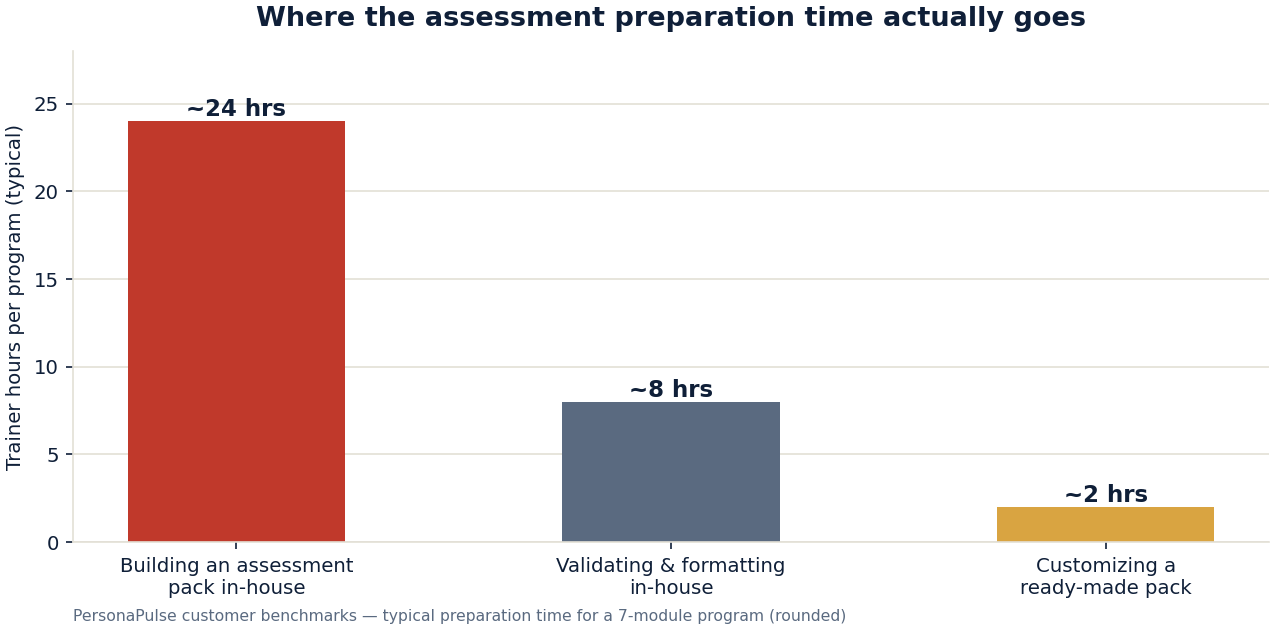
There is also a pragmatic shortcut worth naming. Building an assessment in-house typically consumes around 24 hours of prep, and validating it adds roughly 8 more, while customizing a ready-made, pre-validated assessment pack takes about 2 hours:
Whether you build or buy, insist on scoring sheets that managers can complete in under thirty minutes per person per cycle — our overview of corporate assessment tools compares the build-versus-buy options in detail. PersonaPulse's training packages ship with ready-made skills assessments and workbooks precisely for this reason: the measurement instrument is the part worth borrowing, and the conversation it triggers is the part only your managers can have.
Getting managers to actually use it
The framework will be adopted or abandoned at the manager level, so design for the manager's calendar:
- Pre-fill every self-assessment so managers review rather than start from a blank page.
- Cap the effort at twenty to thirty minutes per person per cycle.
- Anchor the conversation in the existing 1:1 rhythm instead of inventing a new meeting.
- Run the one-hour calibration session before the first cycle and repeat it whenever new managers join.
- Publish an aggregate view — never an individual leaderboard — so teams see the payoff of honesty.
The alternative is well documented: Gallup finds only about 21% of employees strongly agree their performance is managed in a way that motivates them to do outstanding work. Assessment without follow-through is one of the main reasons that number stays low. When managers see gaps from the previous cycle actually close, participation and honesty climb on their own.
From results to development plans and budget
Results only matter if they route somewhere. Route individual gaps into development plans, team gaps into the training budget, and repeated organization-wide gaps into hiring and succession conversations. If you are still upstream of this work, our training needs assessment guide shows how to identify which gaps deserve investment in the first place. Then let the scores make the budget case for you: a heat map that moved two levels in a year is the most persuasive slide an L&D team can put in front of a CFO.
Frequently asked questions
What is an employee skills assessment?
An employee skills assessment measures a person's current proficiency in defined skills against the level their role requires. It typically produces a per-person profile, a team heat map, and a ranked list of gaps. The best versions combine self-rating, manager rating, and at least one objective source of evidence.
How often should we run skills assessments?
Twice a year is the sweet spot for most organizations: often enough to catch drift, far enough apart for real development to happen between cycles. High-turnover or fast-changing functions may go quarterly. Whatever you choose, keep the cadence fixed — irregular assessments destroy trend data.
What is the difference between a skills matrix and a competency framework?
A skills matrix is a lightweight grid of skills, people, and scores, usually maintained by a team lead. A competency framework is a fuller architecture: definitions, behavioral indicators per proficiency level, and links to hiring, development, and promotion. Most organizations start with the matrix and graduate to the framework.
How do you score a skills assessment fairly?
Use one shared proficiency scale, define observable evidence for each level, and calibrate managers before every cycle. Triangulate at least two perspectives — self and manager at minimum — and treat big mismatches between them as the most interesting data point, not a problem to average away.
Which skills should we assess first?
Start with the two or three capabilities the business strategy depends on this year, plus any skill where a gap creates safety, compliance, or customer risk. Resist the urge to assess everything at once. A focused matrix of eight to twelve skills gets completed; a fifty-skill checklist does not.
Are self-assessments reliable enough to use alone?
No. Research on self-assessment shows people systematically misjudge their own proficiency, often by wide margins in both directions. Self-ratings are still valuable — the gap between self-view and manager view is itself powerful feedback — but pair them with manager ratings or objective evidence before making decisions.
Your next step
PersonaPulse's First-Time Manager Essentials program — see the course page at First-Time Manager Essentials — includes ready-made assessments, workbooks, and facilitator guides, so your managers can run their first assessment cycle this month rather than next quarter. If you want to start free, the Free Skills Assessment Pack includes a skills matrix template, gap analysis worksheets, and scoring sheets. To compare it with the rest of the catalog, browse the PersonaPulse library, or read how skills work fits into a new leader's ramp in our guide to first-time manager training and the first 90 days.
Free Skills Assessment Pack — Skills Matrix, Gap Analysis & Scoring Sheets
Get the free downloads for this topic — module 1, training plan, workbook sample, assessments and the table of contents.