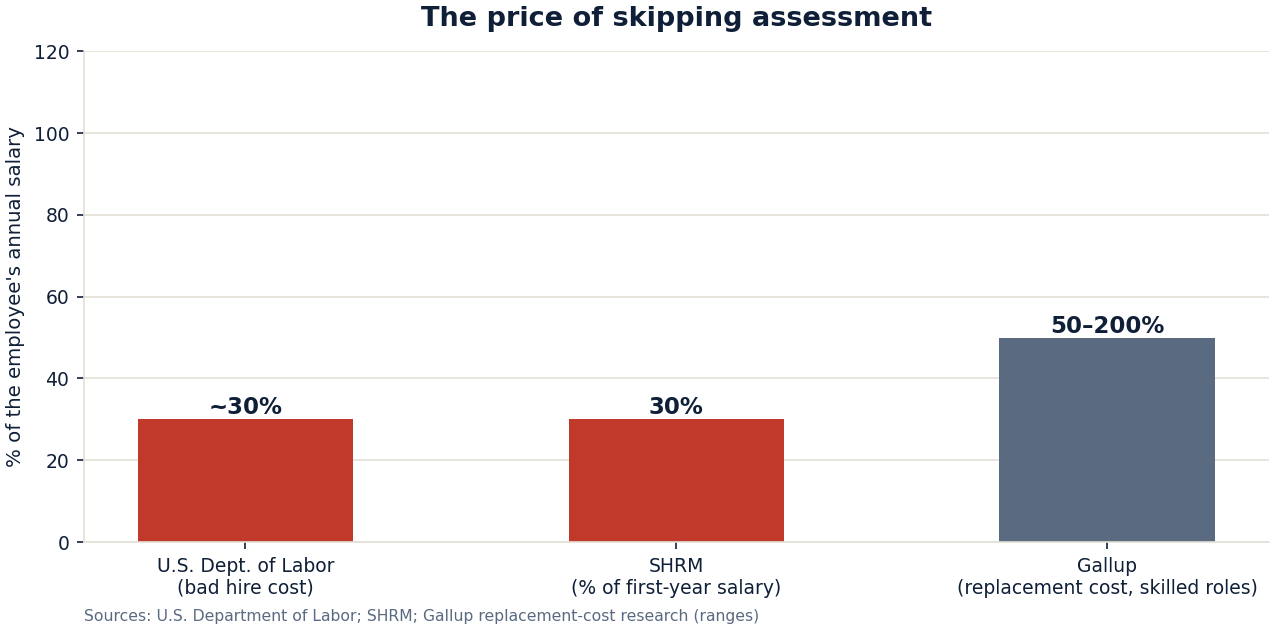
SHRM estimates that replacing a mis-hired employee costs close to 30% of that person's first-year earnings — before you count the manager hours, the team disruption and the second recruitment cycle. Most of those mis-hires and mis-promotions trace back to improvised evaluation: a different form in every department, scores that mean different things to different managers, no evidence trail behind the ratings. Standardized employee assessment templates are the unglamorous fix. McKinsey finds that 87% of companies already have skill gaps today or expect them within a few years, so the same forms that protect your hiring decisions also power your workforce planning. Here are the six staff assessment form types every L&D team needs, plus the scoring habits that keep them honest across departments.
Why standard templates beat blank pages
Blank pages produce folklore; templates produce data. A standard form forces the same dimensions, the same scale and the same evidence standard for every person assessed, which is what makes results comparable across teams and defensible when someone asks how a decision was made. It also removes the biggest practical barrier — the assessor who stares at a blank document, gives up and falls back on impressions.
Speed matters more than most L&D teams admit. Building an assessment template from scratch typically takes around 24 hours of design and another 8 of validation; customizing a validated, ready-made template takes about 2. Multiply that difference across six forms and several departments, and the case for starting from proven templates rather than blank pages makes itself. Defensibility is the third benefit: when ratings are anchored and documented, you can explain every decision — to employees, to leadership and, if it ever comes to it, to a lawyer.
The 6 employee assessment templates that matter
Six forms cover roughly ninety percent of what an L&D team does with assessment data:
| # | Template | What it captures | When to use |
|---|---|---|---|
| 1 | Skills matrix | Proficiency ratings by skill and person, with evidence | Quarterly skills reviews, workforce planning |
| 2 | 30-60-90 day onboarding assessment | Ramp progress against role expectations | Every new hire and internal move |
| 3 | Competency-based appraisal template | Behaviors rated against defined anchors | Annual or semiannual reviews |
| 4 | 360-degree feedback form | Peer, direct-report and manager input on behaviors | Development cycles, not pay decisions |
| 5 | Individual development plan (IDP) | Goals, actions, support needed, review dates | Immediately after any assessment |
| 6 | Succession readiness scorecard | Potential, readiness, flight risk, bench depth | Annual talent review |
The skills matrix is the anchor of the set: until you know what proficient looks like per skill, the other five forms are just formatting. The appraisal template is the one most often done badly — if it rates behaviors without anchored descriptions and evidence lines, it rates mood. And the 360 form should stay out of pay decisions; the moment compensation hangs on peer input, the candor that makes 360s valuable disappears. Each form should have a named owner, a fixed cadence and one version of the truth stored somewhere everyone can find.
Standardizing scoring across departments
The fastest way to wreck good templates is letting every department improvise its own scale. Standardize on a five-point scale with written anchors, cap competency lists at five or six, and require an evidence line under every rating — a score without an example is an opinion. Then train the raters, because the Gallup finding that only 21% of employees strongly agree their performance is managed in a way that motivates them is, in large part, a rater-training problem.
Calibration ties it together. Once or twice a cycle, have managers score the same anonymized example and reconcile differences out loud. It takes 45 minutes, and it is the single highest-leverage meeting in your assessment calendar. The competency assessment framework guide shows how to build the anchors your scale needs.
From assessment data to budget-ready business cases
Individually, assessment forms are paperwork. Aggregated, they are the strongest business case your L&D function can make. Roll scores up by team and skill, compare against business metrics, and you have a needs analysis that points spending at real gaps instead of requests from the loudest stakeholder. The Philips ROI methodology guide shows how to extend that data into return-on-investment calculations, and this guide to executive buy-in turns it into the language budget owners actually respond to.
The stakes are not hypothetical. The World Economic Forum expects 44% of workers' core skills to change by 2027, LinkedIn's Workplace Learning Report found that 94% of employees would stay longer at a company that invests in their learning, and Gallup ties high engagement to 23% higher profitability. Assessment data is what tells you where to invest first — and whether the investment moved anything.
Build your templates or buy them ready-made
Given the 24-hours-to-build versus 2-hours-to-customize gap, most L&D teams should customize rather than create. A practical middle path: adopt validated templates for the six forms above, then invest your saved design hours in calibration and follow-through — the parts that actually determine whether assessments change anything. If you want the full cost math on building versus licensing, the in-house versus ready-made comparison lays it out line by line. PersonaPulse training packages include ready-made assessments and workbooks for exactly this reason, so the forms arrive pre-validated and mapped to the training content they feed.
Frequently asked questions
What is an employee assessment template?
It is a pre-structured form for evaluating skills, behaviors or readiness — with defined dimensions, anchored rating scales and space for evidence. Using one ensures every person is assessed against the same standard, which makes results comparable and defensible.
What should a staff assessment form include?
Defined competencies with anchored five-point scales, an evidence line under each rating, a results-versus-goals section, a self-assessment field and no more than three development actions. Anything beyond that tends to go unread.
How often should assessments be run?
Light-touch quarterly, with a full cycle annually; onboarding assessments run at 30, 60 and 90 days by definition. The cadence matters less than consistency — every cycle skipped quietly converts the system back into impressions.
How many questions should an appraisal template have?
Five to seven competencies plus two or three goal sections is the workable ceiling for quality responses. Longer forms do not collect more truth; they collect more fatigue, and fatigue produces middle-of-the-scale ratings.
Can these templates be used for performance pay decisions?
Appraisal and skills data can inform pay, but keep 360-degree feedback strictly developmental — the moment peer input drives compensation, honest feedback dries up. Publish the rules so employees know which data affects what.
How do we get managers to actually complete them?
Make the form short, the scale anchored and the deadline public, then require calibration attendance. Managers complete assessments when the template takes 45 minutes instead of an afternoon and when their peers visibly do the same.
Your next step
PersonaPulse's Advanced Leadership Mastery program includes ready-made assessments, facilitator guides and participant workbooks, so the six forms above arrive pre-built and mapped to the development content they support. For deeper reading, start with the employee skills assessment framework to structure your skills matrix, and the 360-degree feedback implementation guide before launching form four. The complete PersonaPulse library lists all 169 ready-to-deliver programs.