Gallup's analysis of Inc. 500 chief executives found something counterintuitive: CEOs who scored highest on the Delegator theme ran companies with 33% greater revenue growth than their do-it-all peers. Delegation is not a soft preference — it is an arithmetic of scale. And yet it remains the skill managers most consistently avoid, because unlike feedback or planning, delegation feels like losing control of something that already works. This guide is for L&D teams and coaches designing delegation training that survives real workload pressure.
Why managers don't delegate: the four honest fears
Workshop facilitators hear the same four fears worldwide, and naming them is half the fix:
- "It's faster if I do it." True once, false at scale — every repeat task keeps the manager as the bottleneck.
- "They'll make mistakes." Also true — briefly. The error cost is the tuition for capability the team keeps forever.
- "My value is my expertise." The identity fear. This one is not solved by tools; it is solved in discussion (see the identity shift in our first-90-days guide).
- "I'll look replaceable." Inverted logic: leaders who develop talent become more senior, not less — succession-ready leaders get promoted and their teams get raided (in a good way).
McKinsey Global Institute's analysis of knowledge-worker time adds the pressure context: managers routinely lose around 28% of the workweek to email alone, plus a third or more in meetings. Delegation is the only mechanism that frees those hours without hiring. The cost of not fixing this compounds quietly: CEB (now Gartner) found 60% of new managers underperform in their first two years, and the player-coach trap — doing instead of enabling — is the most common symptom.
The five levels of delegated authority
Vague delegation ("handle the client thing") is the real failure mode — not laziness. The delegation ladder makes authority explicit:
| Level | Who decides | Checkpoint rhythm | Use when |
|---|---|---|---|
| 1. Do exactly as specified | Manager | Continuous | Compliance-critical or brand-new tasks |
| 2. Research, I decide | Manager | At milestones | High stakes, developing capability |
| 3. Recommend, I approve | Member, manager vetoes | Before execution | Standard operating decisions |
| 4. Decide and inform me | Member | After the fact | Proven capability, routine stakes |
| 5. Own it entirely | Member | Exceptions only | Deep trust, low risk, growth roles |
A functional delegation plan assigns a level to every recurring task. Most "delegation failures" are Level-4 assignments run at Level-1 checkpoints (micro-managed, trust destroyed) or Level-1 tasks run at Level-5 (abandoned, then rescued at midnight). The ladder prevents both, and it gives the conversation a vocabulary — "I'm handing this to you at a 3" — that removes the ambiguity where micromanagement breeds.
The ladder also pairs naturally with situational leadership logic: the right level depends on the team member's competence and commitment for that specific task, not on their seniority. Our guide to situational leadership in practice covers that diagnosis in depth.
The conversation structure that makes it stick
Effective delegation follows a five-part conversation — teachable in a single workshop module:
- Context: why this task matters and where it fits.
- Outcome: what "done well" looks like, stated as qualities and deadlines, not method.
- Level: which rung of the ladder applies, said out loud.
- Checkpoint: when and how progress gets reviewed — agreed, not imposed.
- Lessons loop: after completion, one question — "what would you do differently next time?"
Two of the five parts are skipped most often, and both skips are expensive. Skipping the outcome definition forces the delegate to guess at quality standards, which guarantees the manager will "have to" intervene later. Skipping the lessons loop converts every delegation into a one-off transaction instead of a capability lesson — the task leaves the manager's desk once but never permanently.
What delegation buys the business
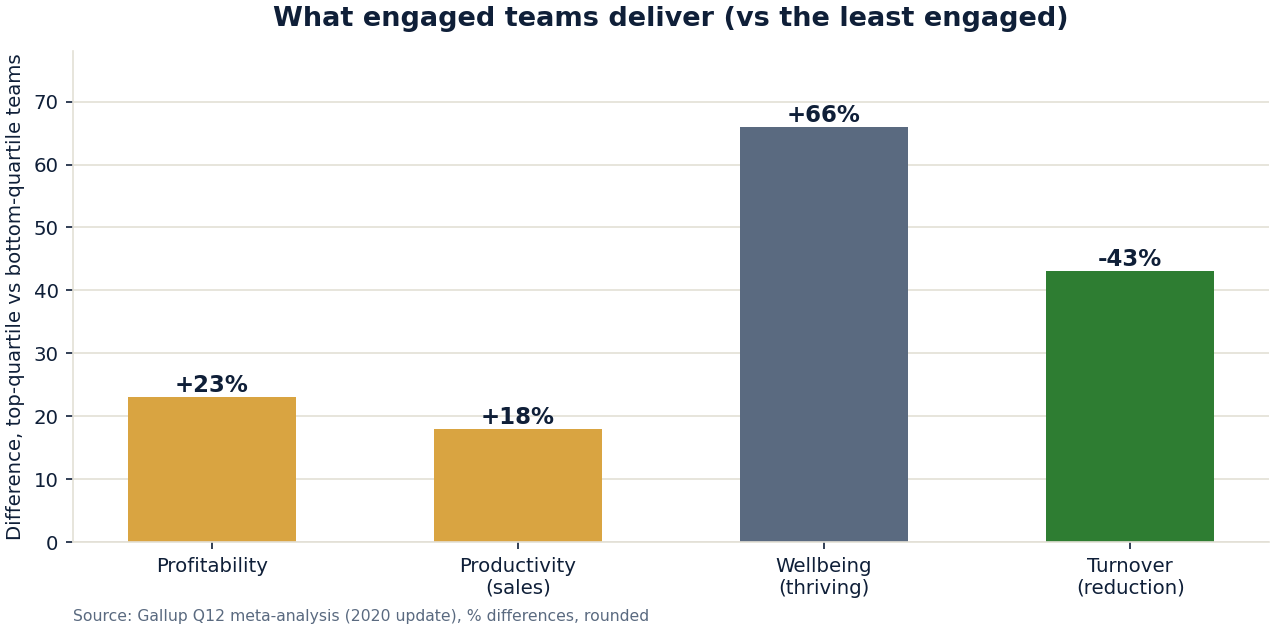
The Gallup Inc. 500 finding — 33% higher revenue growth for high-Delegator CEOs — is the headline, but the mechanism runs through engagement. Gallup attributes roughly 70% of the variance in team engagement to the manager, and its top-versus-bottom-quartile comparison shows engaged teams delivering 23% higher profitability, 18% higher productivity and 43% lower turnover, with thriving and wellbeing substantially higher as well. Delegation is one of the few manager behaviors that moves every one of those channels at once: it grows the team member's ownership, frees the manager for the work only they can do, and signals trust — the currency engagement is made of.
There is a succession argument too. DDI's Global Leadership Forecast found only 12% of organizations confident in their leadership bench — and an undelegated critical task is, by definition, a succession risk with no named second owner. LinkedIn's Workplace Learning Report adds the retention lens: 94% of employees would stay longer at a company that invests in their development, and nothing says "we are investing in you" like real ownership of a visible piece of work.
Designing the training: role-play or it never happened
Delegation training fails when it stops at the ladder diagram. The behavior changes in rehearsal: participants bring a real task they are currently hoarding, script the conversation with the five parts, and run it with a peer playing their direct report — including the pushback ("last time you took it back after two days"). Facilitators debrief against the ladder. One session, three rehearsals each, and the language is installed.
Structure the module in three moves. First, the diagnostic: participants audit their own task list and tag every recurring item with the level it currently runs at and the level it should run at — the gap column is the workshop's energy source. Second, the rehearsal: three rounds with escalating pushback, swapped partners each time. Third, the commitment: each participant leaves with one task re-leveled and a checkpoint date in their calendar before the 60-day follow-up.
The Delegation and Empowerment program packages exactly this arc — presentation deck, facilitator script with the pushback lines, workbook with the delegation-planning grid, and an assessment to certify the skill. For HR teams assembling a wider manager curriculum, it slots directly into the leadership development program blueprint.
Measuring delegation: three leading indicators
- Manager calendar audit — percentage of hours on tasks only that manager can do (target: rising).
- Delegation-ladder distribution — sampled from participants' plans: healthy spread across levels 2-5, not a spike at 1.
- Team capability map — number of tasks with a named second owner per critical process.
Sixty to ninety days after training, these three numbers tell a more honest story than any satisfaction survey — consistent with the Kirkpatrick measurement approach we recommend for every program. Expect an uneven adoption curve: roughly a third of any cohort delegates visibly within two weeks, a third needs the manager-of-manager nudge, and a fifth reabsorbs quietly until a workload crisis forces the issue. Plan for that distribution instead of designing for the fastest third — the workbook's 60-day checkpoint exists precisely so the slow third gets a structured, low-drama second chance at the ladder.
The coaching layer
Some managers delegate in the workshop and reabsorb everything within a month. That pattern responds to coaching, not more content: a short manager-as-coach engagement, or the participant's own leader using coaching questions in one-to-ones ("what are you holding this week that someone on your team should own?"). Our comparison of coaching, mentoring and training maps when each mode applies — and for most organizations the cheapest fix is training the layer above to coach, which multiplies delegation follow-through without external spend.
Frequently asked questions
What is the biggest barrier to delegation?
Identity, not skill. Managers who see their value as personal expertise experience delegation as self-erasure. Training must surface this fear explicitly and replace the definition of leader value — from "best doer" to "capability multiplier" — before techniques will stick.
Which tasks should a manager delegate first?
Recurring, well-defined, low-stakes tasks with a capable owner — reporting, scheduling, first-draft anything. Early wins build both parties' confidence before high-stakes work moves down the ladder.
How do you delegate to an already-overloaded team member?
Delegation is a rebalancing act, not an addition: pair every new assignment with an explicit removal ("this takes priority over X — I'll take X back or park it"). Silent stacking is how delegation destroys trust and burns people out.
What if the team member fails at a delegated task?
Pre-agreed checkpoints make failure a planned lesson, not a surprise. Review against the outcome definition (was the level right? was the checkpoint missed?), capture the lesson, and re-delegate. Rescuing the task and taking it back up the ladder is the true failure.
How long until delegation training shows results?
Behavior shifts within two to four weeks when assignments and checkpoints are used; calendar-level impact (manager hours freed) is visible in six to eight weeks. Track the three leading indicators above at day 60 and day 90.
Does delegation training work for senior leaders too?
Even more than for new managers — the stakes and the identity attachment are higher. Executive cohorts benefit from adding succession logic: every undelegated critical task is a succession risk with no named second owner.
Your next step
If you want a delegation workshop live this quarter, the Delegation and Empowerment kit includes the full program — deck, facilitator script, workbook and assessment — for $89.50 one-time with unlimited internal delivery. Pair it with our first-time manager 30-60-90 curriculum to embed delegation early, and the complete leadership development program blueprint to slot the module into a wider track. Browse the full PersonaPulse library for every ready-to-deliver program in the store.