PwC's Future of Customer Experience survey found that 32% of customers will walk away from a brand they love after a single bad experience. In most cases that moment is not a pricing or product failure — it is a skill failure at the front line, invisible until the revenue is already gone. A structured customer service assessment makes those gaps visible before customers feel them: which agents avoid de-escalation, which teams skip verification steps, and which supervisors coach on instinct instead of evidence. A customer service skills test also gives you a baseline, so improvement stops being a feeling and becomes a number you can defend in a budget review. This guide covers what to measure, how to run a service quality assessment in five steps, and how to convert the results into coaching that actually moves your scores.
Why a customer service assessment beats gut feel
Most service organizations manage by dashboard: CSAT, NPS, first-contact resolution, average handle time. Those are outcome measures — they tell you that something went wrong, not which skill failed or who needs help. A customer service assessment works upstream of the dashboard by measuring the behaviors that produce those outcomes, conversation by conversation.
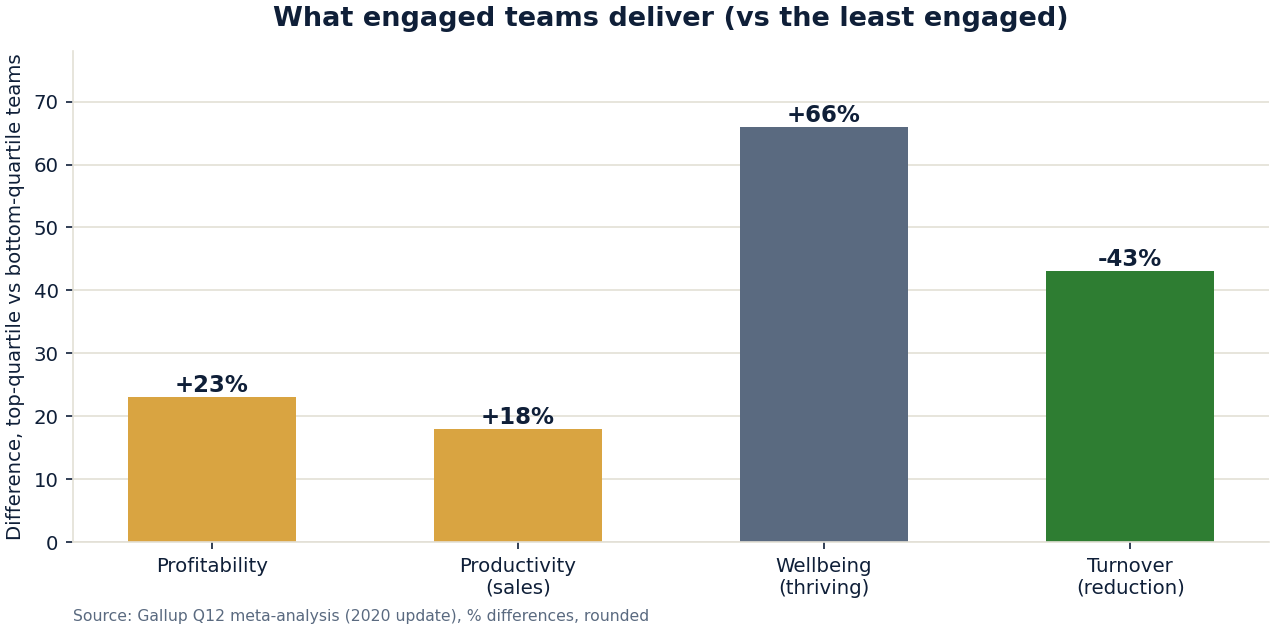
The commercial stakes are well documented. Salesforce's State of the Connected Customer report found that 88% of customers say the experience a company provides matters as much as its products or services. American Express research puts a number on the upside: customers report being willing to spend 17% more with companies that deliver excellent service. And Gallup's long-running meta-analysis links top-quartile employee engagement to 23% higher profitability and roughly 10% better customer loyalty ratings — engagement that is built or broken by frontline supervisors.
A rigorous assessment adds four things a dashboard cannot:
- A skill baseline per agent, team and channel, so training targets real gaps instead of loudest complaints.
- A hiring signal, if you run scenario-based testing with candidates as well as current staff.
- Calibrated coaching input, so every supervisor coaches the same behaviors in the same way.
- Evidence for budget, when you need to justify a customer experience training investment to leadership.
The skills a customer service skills test should measure
Effective assessments measure observable behavior, not personality. Keep the list to six or eight skills, weight them by role — a chat agent needs written precision, a field technician needs diagnosis and expectation-setting — and define what good looks like in one sentence per skill.
| Skill | What good looks like | How to assess it |
|---|---|---|
| Active listening | Restates the issue and confirms impact before proposing a fix | Recorded role-play scored against a behavior rubric |
| Product and policy knowledge | Answers without unnecessary escalation and cites current policy | Scenario-based knowledge check, refreshed quarterly |
| De-escalation | Names the customer's emotion, stays calm, offers concrete next steps | Angry-customer simulation with trained raters |
| Written communication | Clear, empathetic, error-free email and chat responses | Timed writing task scored with anchored examples |
| Ownership | Closes the loop without the customer having to chase | Case simulation plus follow-through observation |
| Compliance basics | Verifies identity and protects data on every contact | Observation checklist from live or recorded interactions |
Whatever you choose to measure, publish the rubric to agents before the assessment runs. The point is development, not entrapment — people should know what excellent looks like and get a fair chance to demonstrate it. Teams that skip this step find the assessment becomes an adversary exercise instead of a coaching input.
How to run a service quality assessment in five steps
- Define the rubric. Pick six to eight competencies, write one-sentence definitions and three anchored levels: below expectations, meets expectations, exceeds.
- Sample real work. Pull a stratified sample of recorded calls, chats and emails per agent — enough to see variety, not so much that scoring bogs down.
- Add scenario testing. Recorded role-plays and timed written tasks reveal what people do under pressure, which static QA sampling routinely misses.
- Calibrate your raters. Have two or three assessors score the same interactions, compare ratings and reconcile differences before scoring everyone else. Uncalibrated raters are the single biggest source of noise in any service quality assessment.
- Convert scores to coaching plans. Every agent leaves with two strengths to keep and two gaps to work on, each tied to specific training or practice assignments.
One planning note before you start: teams that build assessments from scratch typically spend around 24 hours on design plus another 8 on validation, while teams that customize a ready-made assessment spend about 2. Unless your service context is genuinely unusual, customizing a validated instrument is the better use of your week — and it removes the risk that your rubric quietly measures nothing.
Turning assessment scores into coaching that moves CSAT
An assessment that ends in a spreadsheet changes nothing. The output should be a coaching plan per agent, a training priority per team, and a reassessment date 60 to 90 days out so you can demonstrate movement. If you want the results to read as a business case, structure the follow-up using the Kirkpatrick model, which connects behavior change to the service metrics your leadership already watches.
Supervisors are the multiplier. Gallup has found that managers account for roughly 70% of the variance in team engagement, which means the same assessment program succeeds or fails depending on how well supervisors coach to it. This is where packaged programs earn their keep: every PersonaPulse training package ships with a facilitator guide, participant workbook and ready-made assessments, so supervisors are not inventing coaching materials on Sunday night.
Common mistakes when testing customer service skills
Even well-intentioned programs stumble in predictable ways:
- Testing product knowledge only. Knowledge is necessary but not sufficient; empathy and de-escalation drive loyalty more than policy recall does.
- Skipping rater calibration. Two assessors scoring the same call 40 points apart will destroy trust in the entire process.
- Running it once. A one-off assessment is a snapshot; improvement requires a baseline, an intervention and a re-measure.
- Ignoring written channels. Email and chat quality shape brand perception as much as phone calls do.
- Assessing without consequence. If scores never connect to coaching, agents learn within one cycle that the exercise is theater.
Frequently asked questions
What is a customer service assessment?
It is a structured evaluation of the skills frontline service people use every day — listening, de-escalation, product knowledge, written communication and compliance — measured against defined rubrics. It typically combines observation of real interactions with scenario-based testing. The output is a skill profile per person and per team, not just a satisfaction score.
How is a service quality assessment different from CSAT or mystery shopping?
CSAT measures a customer's perception of one interaction; mystery shopping measures one staged visit. A service quality assessment measures the underlying skills across a representative sample of real work, so it explains why your scores look the way they do and what to train.
Can we use a customer service skills test for hiring?
Yes, and it is one of the stronger predictors you can add. Pair a realistic job simulation with a structured interview — Schmidt and Hunter's meta-analysis puts structured interview validity around 0.51, well above unstructured conversations. For a fuller hiring framework, see this pre-employment assessment guide.
How often should we assess?
Twice a year is a sensible default for established teams, with a lighter quarterly pulse for new hires and anyone in an active coaching plan. Always reassess 60 to 90 days after a major training push so you can show movement.
Do we need special software to run one?
No. A rubric, a sample of recorded interactions, trained raters and a spreadsheet will carry a program a long way. Tools help with scaling and analytics, but calibration and rubric quality matter far more than software does.
How long does a full assessment cycle take?
Planning and rubric design take two to three days, scoring a team of 20 takes roughly a week of part-time assessor time, and coaching conversations wrap the following week. Most teams complete a full cycle in three to four weeks without pausing operations.
Your next step
If you would rather deploy than design, the Customer Experience Excellence program from PersonaPulse includes ready-made assessments, a facilitator guide and participant workbooks, so you can run a complete customer service assessment cycle in weeks rather than quarters. For related reading, start with the sales team assessment guide if you are extending assessments to revenue teams, or the employee skills assessment framework for a broader skills baseline. You can browse all 169 ready-to-deliver programs in the PersonaPulse library.