In their landmark synthesis of 85 years of personnel selection research, Schmidt and Hunter found that a combination of general mental ability and a structured interview predicts job performance better than almost any other signal — a predictive validity of 0.65, compared with 0.38 for the unstructured conversations most organizations still default to. That gap is exactly what modern corporate assessment tools exist to close. For L&D teams these tools matter twice over: they reveal which skills your people actually hold today, and they show whether the programs you deliver are moving those skills at all. Yet many teams still assemble assessments ad hoc — no scoring rubric, no reliability check, no link to business outcomes. This guide explains what corporate assessment tools are, which types of assessment tools for the workplace are worth the budget, and how to deploy employee assessment tools without drowning your team in admin.
What corporate assessment tools are (and what they are not)
A corporate assessment tool is any structured instrument that converts observed behavior, answers or work products into comparable data about a person's skills, competencies or potential. The category covers pre-hire tests, 360-degree feedback surveys, skills checks, situational judgment tests, competency rubrics and leadership inventories. What separates a real assessment tool from a quiz is measurement discipline: defined criteria, consistent scoring, and evidence that results predict something you care about — performance, readiness, retention.
It helps to see employee assessment tools as a lifecycle layer rather than a single product. A candidate assessment screens applicants; an onboarding diagnostic establishes a skills baseline; development assessments target coaching; succession assessments compare bench strength against future roles. When the same competency language runs through all four stages, you get something rare: comparable data from hire to promotion. When each HR process buys its own instrument, you get four silos that never reconcile.
Types of assessment tools for the workplace
There is no single best tool — mature L&D functions layer two or three, each answering a different question. The table below summarizes the main categories of assessment tools for the workplace.
| Tool type | What it measures | Best used for | Typical format |
|---|---|---|---|
| Skills and knowledge tests | Job-specific knowledge and hands-on skill | Screening, training needs analysis, post-training checks | Timed tests, work samples, simulations |
| Cognitive ability tests | Learning speed, problem solving, reasoning | Early-career and high-change roles | Multiple-choice aptitude batteries |
| Personality and behavioral inventories | Work styles, motives, traits | Team fit, coaching, development conversations | Self-report questionnaires |
| 360-degree feedback | Observed behavior from manager, peers, reports | Leader and manager development | Multi-rater survey |
| Situational judgment tests | Decision quality in realistic scenarios | Pre-hire screening, promotion readiness | Scenario-based items |
| Assessment center exercises | Competencies under observed pressure | Leadership pipelines, succession | Role plays, case studies, presentations |
Two practical notes before you shortlist vendors. First, behavioral inventories describe preferences, not ability — they are useful for coaching but should never screen people out on their own. Second, skills tests age fast: anything tied to a specific software version or regulation needs a review cycle, which is why many L&D teams now start from an editable employee assessment templates pack rather than authoring every instrument from scratch.
How to choose: validity, reliability and fairness
Vendor claims are easy; measurement quality is not. Judge every tool on five criteria.
- Predictive validity. Does the score correlate with job performance? Schmidt and Hunter's synthesis remains the reference point: structured interviews at 0.51 and work samples at 0.54, versus 0.38 for unstructured interviews. Tools without published validity evidence start with a strike against them.
- Reliability. The same person under the same conditions should produce roughly the same score. Ask vendors for internal consistency and test-retest statistics.
- Fairness and adverse impact. Check whether pass rates differ sharply by demographic group, and whether the vendor supplies validation evidence aligned with EEOC uniform guidelines.
- Administration burden. Factor in setup time, proctoring, scoring and reporting — not just license fees.
- Integration and data portability. Results should flow to your LMS or HRIS and stay exportable, or your competency data dies inside another silo.
The stakes are real. SHRM benchmarks average cost-per-hire at roughly $4,700, and Gallup finds that companies fail to select the candidate with the right talent for a manager role 82% of the time. An assessment layer that is valid, reliable and fair pays for itself the first time it prevents one wrong leadership hire.
Build vs buy: the hidden cost of doing it yourself
Given a blank slide deck and a survey license, most L&D teams badly overestimate how quickly they can produce a defensible assessment. Building a solid instrument means writing items, piloting them, running reliability checks and setting cut scores — realistic prep runs to about 24 hours per assessment, plus another 8 hours to validate results before the instrument is safe to use for real decisions. Customizing an existing, validated instrument takes closer to 2 hours: swap in your competency language, adjust the scoring rubric, align the branding.
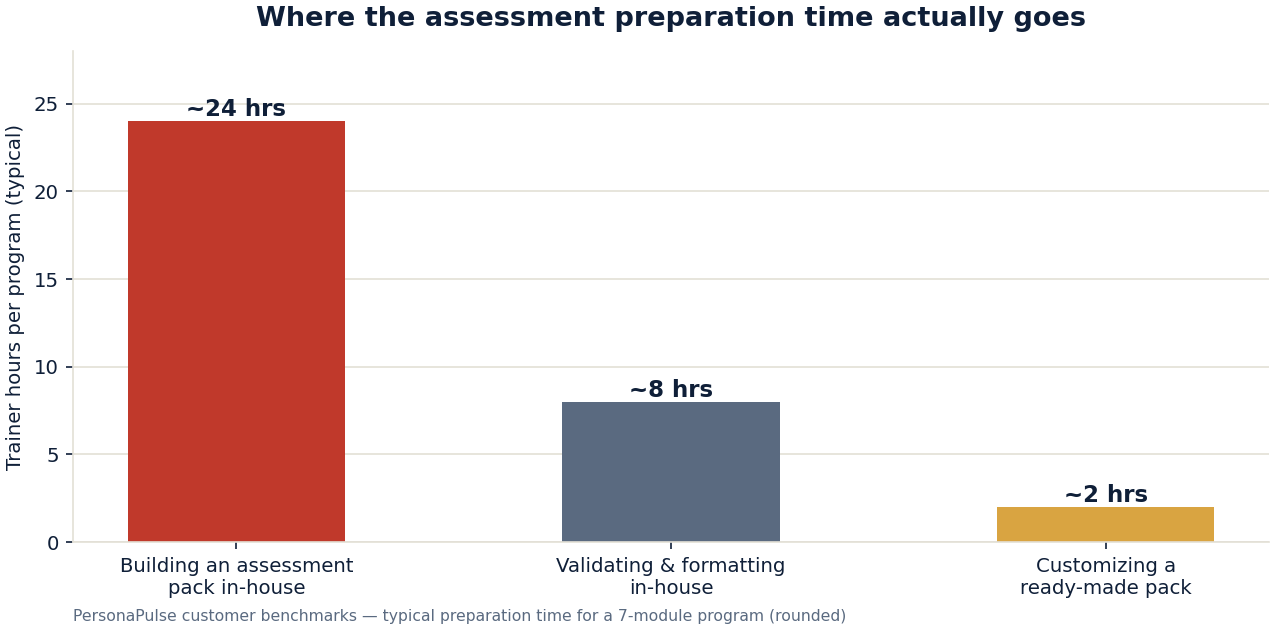
That difference compounds across a training calendar. If your team needs ten assessments a year — intake diagnostics, pre/post checks, competency reviews — the build-it-yourself route consumes hundreds of hours that never touch facilitation or follow-up. This is one reason many teams now buy complete program packages that ship with ready-made assessments, scoring rubrics and facilitator guides: the measurement instrument arrives aligned to the content, which also keeps Kirkpatrick-style pre/post comparisons clean. The full economics are covered in our comparison of in-house and ready-made leadership training costs.
Rolling out employee assessment tools without the classic failures
Most assessment rollouts fail for organizational reasons, not psychometric ones. Six practices prevent the usual damage:
- Anchor to a competency framework. Define the skills and behaviors you care about first, then pick tools that measure them; the reverse order produces impressive data nobody can act on. Our competency assessment framework guide shows the scaffolding.
- Pilot with one cohort. Run the tool with 20-30 people, check item quality and completion rates, then scale.
- Train scorers. A rubric applied by five managers five different ways produces noise; calibration sessions are cheap insurance.
- Tell people what happens next. Assessments die when participants never see results or a development action. Publish the follow-up process before launch.
- Respect the data. Assessment results are sensitive personal data: restrict access, agree retention periods, and keep development data separate from performance data.
- Close the loop into learning. Feed gaps straight into training needs analysis and program selection — the training needs assessment guide shows how assessment data becomes a budget case.
Handled this way, assessment stops being an HR compliance exercise and becomes the measurement backbone of the whole learning function.
Frequently asked questions
What is the best corporate assessment tool for small businesses?
Small organizations get the most value from low-administration tools: a short skills checklist for intake, a structured interview rubric for hiring, and one validated skills test per critical role. Heavy multi-rater platforms usually cost more in setup time than they return until you pass roughly 100 employees. Editable ready-made templates are usually the best first step.
How much do corporate assessment tools cost?
Pricing varies widely: off-the-shelf skills tests and template packs can run from tens to a few hundred dollars per use, enterprise assessment platforms typically charge per-employee annual licenses, and custom-built instruments cost the most once you count development hours. The honest comparison is total cost including admin time, not just license fees.
Are employee assessment tools legal to use in hiring?
Yes, when they are job-related and consistently applied. In the United States, assessments used for selection must comply with EEOC uniform guidelines, which in practice require evidence that the tool predicts job performance and does not create unjustified adverse impact. Keep validation records on file and monitor pass rates by group.
What is the difference between an assessment and a survey?
A survey collects opinions; an assessment measures ability or behavior against defined criteria with consistent scoring. Engagement pulses are surveys, while skills tests and rubric-scored simulations are assessments. 360-degree feedback sits in between — opinion data, but structured against competencies.
How often should workplace assessments be repeated?
For development purposes, an annual or biennial cycle is typical, with short skill checks attached to specific programs. Reassess 60-90 days after training when you want evidence of behavior change. More frequent testing risks fatigue and declining data quality.
Can assessment tools replace manager judgment?
No — they improve it. Valid assessments add consistent, comparable evidence to a decision that will always include context only managers can see. The best outcomes come from pairing scores with structured manager conversations.
Your next step
Building a valid assessment library takes months; borrowing a proven one takes minutes. The Leadership Development Mastery program ships with ready-made skill assessments, evaluation forms and scoring rubrics alongside its slide decks and facilitator guides, so your next cohort can be measured from day one without a psychometrics project. Pair it with our employee skills assessment framework article to structure what you measure, and the training needs assessment guide to turn results into next year's budget case. Browse the full PersonaPulse library to see every assessment-equipped program package.
Free Corporate Assessment Starter Pack — Skills Checks, Evaluation Forms & Scoring Rubrics
Get the free downloads for this topic — module 1, training plan, workbook sample, assessments and the table of contents.