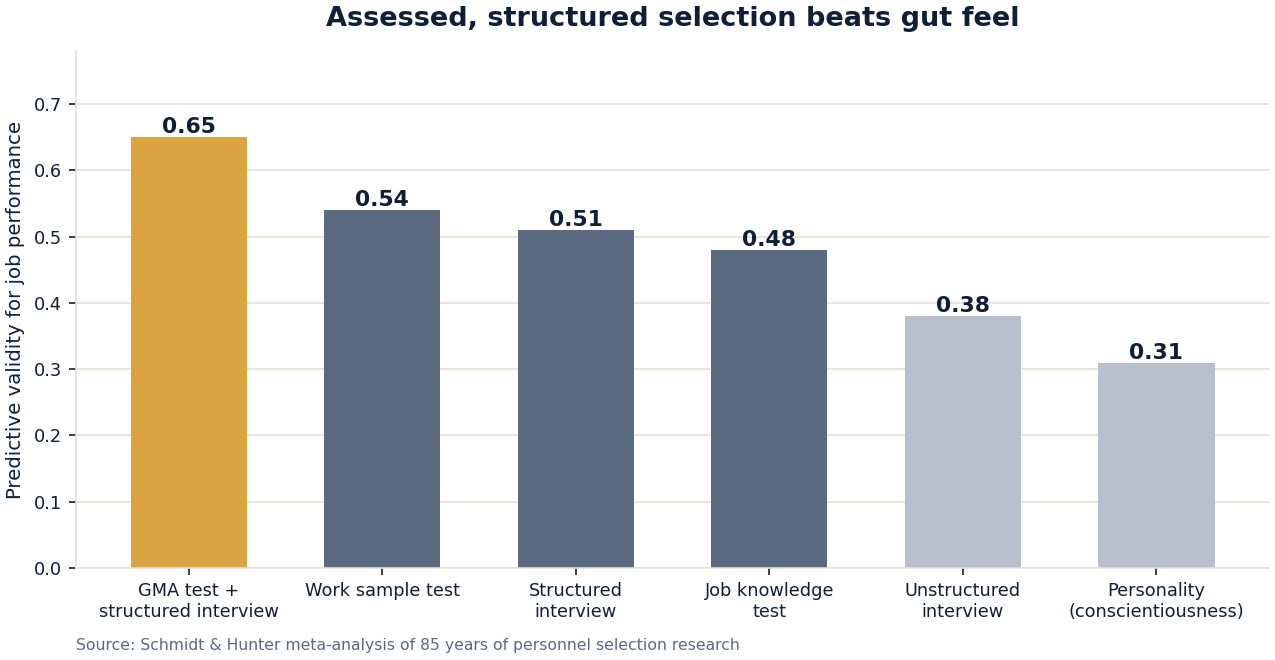
In their landmark meta-analysis of 85 years of selection research, Schmidt and Hunter found that structured assessments predict job performance roughly twice as well as unstructured interviews — with structured interviews and cognitive ability tests reaching a predictive validity near 0.5, close to the practical ceiling for any single tool. The same logic governs development: competencies that are precisely defined and systematically measured produce better hiring, fairer promotion decisions, and training budgets aimed at real gaps. Yet in most organizations the competency model is a list of aspirational adjectives that nobody has scored since launch. This guide shows how to build a competency assessment framework that maps, measures, and closes skill gaps — and stays alive after the design team leaves.
What a competency model actually is
A competency is an observable capability — knowledge, skill, or behavior — that separates strong performance from adequate performance in a role. Competency mapping is the work of linking those capabilities to specific roles: which competencies matter, at what proficiency, with what behavioral evidence. Most useful models run three layers: a handful of core competencies everyone shares, functional competencies per role family, and leadership competencies for people-management roles.
The payoff is focus. McKinsey research finds that 87% of companies either have a skills gap now or expect one within a few years, while the World Economic Forum estimates six in ten workers will need retraining before 2027. You cannot spend your way out of that with generic training. A competency model tells you which gaps are load-bearing for the strategy — and a competency assessment framework is the machine that keeps those measurements current year after year.
Five steps to build your competency assessment framework
- Derive from strategy and job analysis. Interview top performers and their managers, review the strategy, and draft the competencies that actually differentiate performance — eight to twelve per role family.
- Write behavioral indicators. For each competency, define what each proficiency level looks like in observable behavior. "Strategic thinking" is an adjective; "connects this quarter's priorities to the two-year plan in team meetings" is a level.
- Choose assessment methods per competency. Knowledge tests, structured interviews, simulations, and multi-rater feedback measure different things — match the method to what the competency actually requires.
- Set required proficiency by role and level. A senior analyst and a director may share a competency but need different scores on it.
- Assign governance. Name an owner, set an annual review, and track usage. An unowned model decays within eighteen months.
The third step is where most frameworks quietly fail, because organizations borrow instruments that were never designed to measure what their competencies describe.
Choosing assessment methods that hold up
Decades of meta-analytic research — Schmidt and Hunter's synthesis above all — gives us unusually clear evidence about which measurement methods predict performance. Structured interviews and cognitive ability tests sit near 0.5 predictive validity, work samples reach about 0.54, and unstructured interviews lag near 0.38. For behavioral competencies, multi-rater feedback is the practical instrument of choice because it samples real workplace behavior across many situations:
Match methods to competency types deliberately:
| Method | Best at measuring | Validity notes | Typical use |
|---|---|---|---|
| Structured interview | Behavioral competencies, judgment | ~0.5 predictive validity | Hiring, promotion |
| Work sample or simulation | Applied skill under realistic conditions | Among the highest validity (~0.54) | Technical and sales roles |
| Multi-rater (360) feedback | Day-to-day workplace behavior | Strong for development, weak alone for selection | Leadership and EQ competencies |
| Knowledge test | Declarative knowledge | Moderate; decays fast | Compliance, product knowledge |
| Self-assessment | Self-awareness, perception gaps | Weak predictor on its own | Opening development conversations |
No single method covers every competency, and one that claims to usually measures none of them well. If you want a broader tour of the instrument landscape, our guide to corporate assessment tools compares the main categories and when to use each.
Scoring, calibration and closing the gaps
Score every competency on the same 1-4 proficiency scale, anchored in the behavioral indicators you wrote earlier. Then run calibration: assessors rate the same sample, compare scores, and argue until the spread narrows. Without calibration, one manager's 3 is another's 2, and your gap analysis is fiction with a spreadsheet attached.
With calibrated scores, the gap is simple subtraction: required proficiency minus current proficiency, per person, per role. Feed individual gaps into development plans weighted toward on-the-job application — the 70-20-10 structure works because most competencies form through practice, not attendance. Aggregate gaps by role family to steer program investment, and promote-ready gaps into succession planning; our guide to the leadership pipeline and succession planning covers that handoff in detail. At the individual level, our leadership development plan template turns a gap profile into a quarterly plan in under an hour.
Governance: keeping the framework alive
A framework is a living document or it is decoration. Review the model annually against the strategy: retire competencies that no longer differentiate, add ones the business now depends on, and update behavioral indicators as the work changes. Track usage metrics — how many assessments ran, how many development plans cite the framework, how many hiring loops used the structured interview — because usage is the only honest measure of whether the model matters. Connect it upward too: a competency assessment framework that feeds succession planning, workforce planning, and the training budget will be defended in budget season; one that lives in a PDF will not. The WEF's retraining clock is the external deadline — six in ten workers need new skills by 2027 — and organizations that measure continuously will spend that money far better than the ones that guess. For a lighter-weight starting point that can run this quarter, our employee skills assessment guide shows the matrix approach many teams begin with.
Frequently asked questions
What is a competency assessment framework?
It is the system an organization uses to define its competencies, measure people against them, and act on the gaps. The framework typically includes the competency model itself, behavioral indicators per proficiency level, the assessment methods used, and the governance that keeps them current. It connects hiring, development, and promotion to one shared measurement language.
What is the difference between a skill and a competency?
A skill is a single ability, like SQL or active listening. A competency is a broader, observable capability that bundles knowledge, skills, and behaviors — "coaching and developing others" is a competency built from many skills. Skills matrices stay lean; competency models add the behavioral depth needed for hiring and promotion decisions.
How many competencies should a model include?
Eight to twelve per role family is the practical range. Below that, the model is too generic to guide decisions; above that, assessors and managers stop using it. Better to have ten competencies measured every year than forty measured once.
How do you validate a competency model?
Three checks cover most of it: content validity (do top performers and their managers recognize the competencies as differentiating?), criterion validity (do assessment scores predict later performance or promotion outcomes?), and practical validity (do managers actually use the outputs?). If scores never relate to later performance, the model needs revision, not defense.
Can the same framework be used for hiring and development?
Partly. The model and language can be shared, but instruments differ: structured interviews and work samples fit hiring, while multi-rater feedback and self-assessment fit development. Using a confidential development tool like a 360 for selection corrupts both. Keep the uses separate even when the competency definitions are identical.
How often should competency models be updated?
Annually at minimum, with a deeper refresh every two to three years or whenever strategy shifts materially. Roles affected by automation or new technology may need out-of-cycle updates. Treat the WEF's skills-disruption timeline as your external forcing function — waiting five years guarantees the model describes a workforce you no longer employ.
Your next step
If your gaps cluster around leadership competencies, PersonaPulse's Authentic Leadership and Values program (course page here) builds the values-driven competencies most models under-specify, and it ships with ready-made assessments and workbooks you can run as-is. To go deeper on measurement, read our guide to corporate assessment tools, and to connect the framework to talent supply, see succession planning and the leadership pipeline. Browse the full PersonaPulse library to compare all 169 ready-to-deliver programs.