Executive coaching returns a median of seven times its initial investment, according to ICF's global research, and roughly 86% of companies report recovering at least the money they put in. But organizations buy coaching for a handful of senior leaders and wonder why culture does not change. The multiplier sits elsewhere: every manager trained as a coach becomes a permanent coaching resource for the people they already meet weekly. ICF and HCI's research on coaching cultures links them with meaningfully higher engagement, and the mechanism is ordinary enough to train — structured conversations in which the manager asks before telling. This guide gives HR and L&D teams the trainable core: four conversation types, the ROI evidence, the failure modes, and a workshop design with rehearsal at its center.
What manager-as-coach is (and is not)
Manager-as-coach is a conversation stance, not a certification: the manager uses structured questioning so the team member defines the problem, generates options and commits to action. It is development coaching — capability, ownership, growth — and it has a boundary the guide in our coaching vs mentoring vs training comparison draws clearly: performance management, disciplinary issues and direction-setting are not coaching conversations, because the agenda conflict is structural. Skilled managers name the mode out loud — "this one's a coaching conversation" — so the team member knows which game is being played.
The payoff case rests on two findings. First, Gallup attributes roughly 70% of the variance in team engagement to the manager, and coaching behaviors are the most trainable lever inside that number. Second, Gallup's feedback research shows employees who receive meaningful weekly feedback landing in markedly higher engagement bands — and a coaching conversation is the delivery vehicle feedback works best in. Manager-as-coach is therefore not a wellness initiative; it is the operating system for the one-to-ones you are already paying for.
The four conversations every manager needs
| Conversation | The trigger | The manager's core move | Where it usually breaks |
|---|---|---|---|
| Goal-clarifying | Vague ambition, hidden solution | Question the goal until it is the team member's own, specific and behavioral | The stated goal is the manager's solution in disguise |
| Option-generating | A stuck problem | "What are your options?" then silence, then "what else?" | Manager jumps to their best idea; compliance follows |
| Feedback-into-coaching | A behavior to correct or amplify | Situation-behavior-impact, then "how do you see it?" and "what will you try next time?" | Feedback delivered as a verdict; no follow-up loop scheduled |
| Obstacle-removal | Friction the team member cannot clear | "What is blocking you that I can remove this week?" | The question never gets asked; blockers calcify into disengagement |
-
The goal-clarifying conversation. Most "coaching" dies here: the stated goal is a solution in disguise ("I need you to fix the handover"). The trained move is to question the goal until it is the team member's own, specific and behavioral — the front door to any GROW-style structure (Goal, Reality, Options, Will).
-
The option-generating conversation. Managers jump to their best idea, which produces compliance, not ownership. The trained moves: "what are your options?" then silence, then "what else?" — the second options are usually the better ones. Add for-against testing of the team member's own list before any manager input, and put manager ideas in last, as options rather than orders.
-
The feedback-into-coaching conversation. Feedback that changes behavior converts to coaching: situation-behavior-impact, then the questions — "how do you see it?" and "what will you try next time?" The follow-up loop ("this time next week") is what makes it coaching rather than notification.
-
The obstacle-removal conversation. The servant-leader staple from our evidence review: short, recurring, and the fastest trust-builder in the toolkit. Teams whose managers clear obstacles reliably never get the chance to develop learned helplessness.
The measurable signature of a coaching conversation: the team member talks more than the manager, and leaves owning an action they chose. Both are observable in one-to-one audits.
What the coaching ROI data actually says
The external-coaching market supplies the benchmark numbers. ICF's global client research puts the median ROI of coaching engagements at around 7x the investment, with 86% of companies reporting they recovered at least their outlay. The Manchester Review, the academic standard on executive coaching ROI, found an average return of about 5.7 times the initial investment across studied engagements. These are senior-leader figures — but they establish the direction of value, and manager-level coaching skills inherit the mechanism at a fraction of the cost.
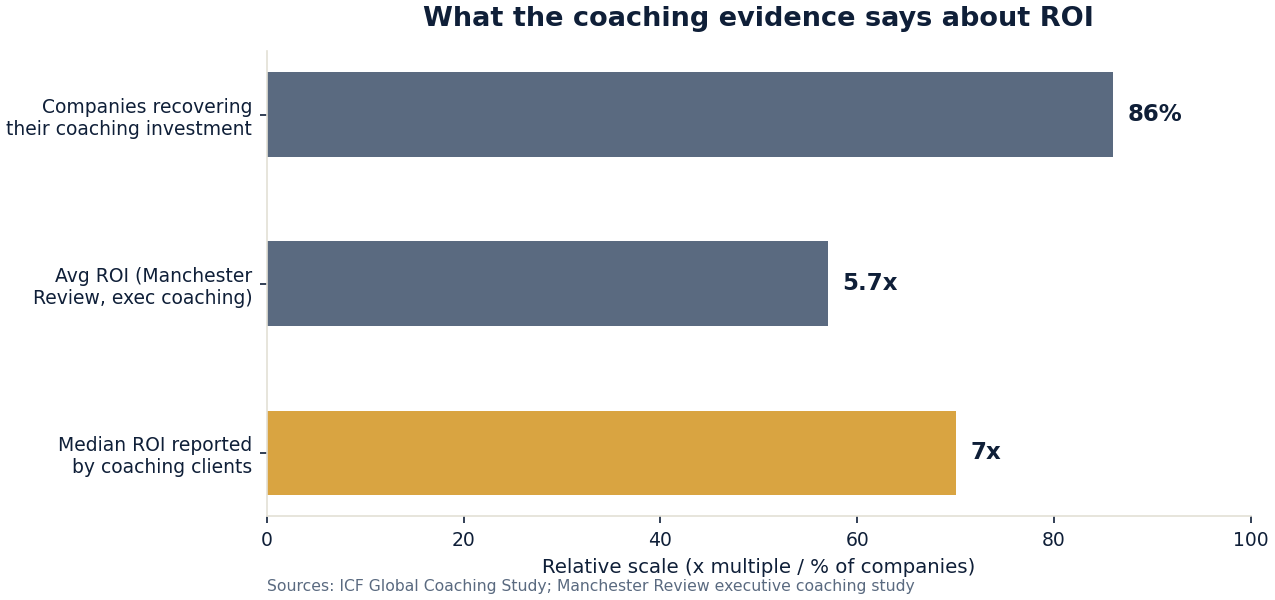
The economic logic at manager level is multiplication. One external coaching engagement touches one leader; one manager trained to coach touches every direct report's weekly one-to-one for the rest of their career. ICF and HCI's coaching-culture research associates strong coaching cultures with meaningfully higher engagement, and Gallup prices disengagement at roughly $8.8 trillion globally — about 9% of GDP. Add LinkedIn's Workplace Learning Report finding that ~94% of employees would stay longer at a company that visibly invests in their development, and manager-as-coach becomes a retention intervention wearing a skills costume.
Why coaching training fails without rehearsal
Question-first conversation is counter-instinctive for problem-solvers — that is precisely why they became managers. Lecture-format coaching courses produce knowledge that evaporates in the first real one-to-one. The design that works:
- Live triad practice every session — coach, coachee, observer-with-rubric; rotate so everyone coaches at least twice.
- Real topics only — the coachee brings a live work problem; the stakes do the retention work.
- Silence training — explicitly rehearse the three-second and ten-second pause; silence is the technique most managers have never once practiced.
- The one-behavior contract — each manager leaves with one coaching move to run within 48 hours and a named observer — the Level-3 evidence engine.
Workshop mechanics matter as much as intent: short input bursts, maximum rehearsal time, and observers scoring behaviors rather than vibes. Our workshop activities guide details triad formats that hold up with skeptical senior populations. The Advanced Leadership Mastery program packages the full coaching-skills module this way — scripts, triad protocols, rubrics and workbook — licensable for $89.50 with unlimited cohorts.
The conversation audit: scoring your own one-to-ones
The audit is the habit that separates training from transformation, and it takes twenty minutes a month. Managers sample two recent one-to-ones and score them against four questions. One: talk ratio — who spoke more? Coaching conversations flip the default; the manager should be under half. Two: question quality — were there at least three open questions the manager could not have answered themselves? Three: ownership — did the team member leave owning an action they proposed, or an action assigned? Four: the pause — was there at least one deliberate silence of three seconds or more?
The first audit is usually humbling and always revealing: most managers discover they run status meetings labelled as coaching. The monthly repetition matters more than any single score — improvement becomes visible in the pattern, and the pattern is coachable in peer circles (pairs exchange one anonymized audit each month and trade one observation). Organizations that wire the audit into their coaching-skills programs report the behavior sticking years later; organizations that skip it watch the question-first reflex evaporate within a quarter. Twenty minutes a month is the cheapest culture intervention in the L&D catalogue.
Building the culture, not just the skill
Skills programs create islands unless the system reinforces them:
- One-to-one audits — twice a year, managers sample-audit their own recent one-to-ones against the four questions above; the audit is private, the habit is not.
- Leader modeling — when a senior leader runs visible coaching conversations (and says so), permission propagates faster than any memo.
- Recognition wiring — "develops others" criteria in promotion conversations; the system advertises what it rewards.
- Pipeline pre-installation — every new manager learns the coaching stance at entry through the first-90-days track, so the skill never has to be retrofitted.
Twelve months of that reinforcement converts a skills program into the culture the ICF/HCI research describes — and it compounds: each cohort arrives already expecting to be coached and to coach. That expectation, not the poster campaign, is what "coaching culture" turns out to mean in practice.
Frequently asked questions
What are coaching skills for managers?
The structured-conversation capability that lets managers grow ownership rather than dependence: goal clarification, option generation before advice, feedback converted to commitment, and recurring obstacle removal. They are practiced with real topics and measured through conversation audits, not attendance sheets.
Can a manager really coach their own team?
For development conversations, yes — that is manager-as-coach. For performance management, discipline and direction-setting, no: the agenda conflict is real, and skilled managers name which mode they are in.
What is the GROW model and do managers need it?
GROW (Goal, Reality, Options, Will) is the most widely used coaching conversation skeleton. Managers need the reflexes more than the acronym — question-first, options before advice, owned commitment — and any competent structure delivers them.
How do you train managers to coach?
Rehearsal-based workshops: triads with observer rubrics, real problems, silence practice and a 48-hour one-behavior contract. Lecture formats fail because question-first conversation is counter-instinctive under pressure.
How is coaching different from mentoring?
Coaching draws answers out through structured questioning; mentoring pours experience in. The full comparison maps when each mode fits — and why most organizations need both, layered.
Where do I get ready-made coaching-skills training?
The Advanced Leadership Mastery kit includes the coaching module with triad protocols and rubrics — $89.50 one-time, unlimited internal delivery.
Your next step
Train the multiplier, not just the summit. The Advanced Leadership Mastery program gives you the coaching-skills module, conversation audits and facilitator guides ready for your next cohort — $89.50, unlimited use. Complement it with Emotional Intelligence Mastery, the natural partner for coaching-quality conversations, and browse the PersonaPulse library for the rest of the curriculum.