The International Coaching Federation's 2025 Global Coaching Study counts 122,974 practitioner coaches worldwide generating an estimated $5.34 billion in annual revenue — a profession that has grown by more than half since 2019. Growth attracts noise, and coaching has attracted plenty of it: weekend "certifications," quiz-mill credentials and programs that issue a PDF for watching videos. So the question anyone serious about coaching asks has changed. It is no longer "should I get certified?" — the market has answered that. It is "which coaching certification actually builds the skill that gets clients?" This guide answers it with the real requirements, the real costs, the red flags, and a practical 24-day path into a verified credential.
What a coaching certification actually certifies
Coaching is an unregulated title: no law stops anyone from printing business cards that say "coach." Certification is what separates a trained professional from an enthusiastic amateur, and a real certification rests on three pillars. The first is accredited instruction hours — structured training in coaching models, ethics, session structure and the core competencies the credentialing body audits. The second is supervised practice — real coaching conversations with real people, observed and debriefed, because coaching is a performance skill, not a knowledge subject. The third is assessed competency — recorded sessions evaluated against a published rubric by someone other than the trainer who sold you the course.
If a program lacks any of the three, you have bought a certificate of attendance, not a certification. The distinction matters commercially. ICF defines coaching as partnering with clients in a thought-provoking and creative process that maximizes their personal and professional potential — and corporate buyers now screen for exactly that standard. The fastest way to judge any program is to ask where its hours land against a credentialing body's requirements, how many observed coaching sessions it includes, and who assesses your final recordings.
The market case for getting certified
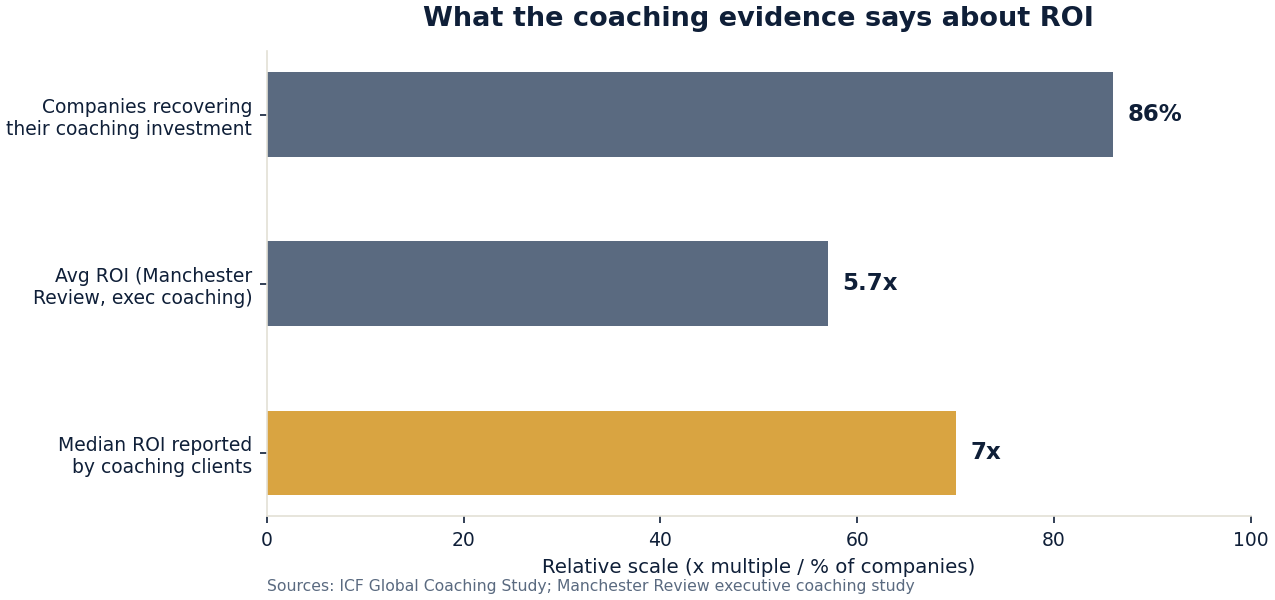
The economics justify the effort on both sides of the table. ICF's client research puts the median return on coaching engagements at around 7x the investment, with 86% of companies reporting they recovered at least their outlay, and the Manchester Review — the academic standard on executive coaching outcomes — found an average return of about 5.7x. Buyers know these numbers, which is why they buy coaching at all. What they increasingly add to the purchase order is proof that the coach was trained.
On the supply side, ICF's study puts average annual coaching income at roughly $52,800 — and credentialed coaches consistently out-earn non-credentialed peers while charging for full-price engagements earlier in their careers. Add LinkedIn's Workplace Learning Report finding that 94% of employees would stay longer at a company that invests in their development, and the demand curve explains itself. The professionals capturing that demand are the ones whose certification survives a procurement check.
The credential landscape: ICF, EMCC and the practical alternative
Three names dominate legitimate credentialing, and one practical alternative now serves career-changers who need real skill on a real-world timeline. The table below summarizes the landscape.
| Credential | Body | Core requirements | Best suited for |
|---|---|---|---|
| ACC — Associate Certified Coach | ICF | 60+ hours of accredited training, 100 client coaching hours, 10 mentor-coaching hours, performance evaluation | New coaches building a first practice |
| PCC — Professional Certified Coach | ICF | 125 training hours, 500 client coaching hours, mentor coaching | Established coaches raising fees and landing corporate contracts |
| MCC — Master Certified Coach | ICF | 200 training hours, 2,500 client coaching hours | Veteran coaches and coach-trainers |
| EMCC Foundation to Master | EMCC Global | Accredited program hours plus supervised practice logged through EQA pathways | Coaches working inside organizations and HR functions |
| Skill-based certifications | Independent providers | Structured training hours, large practice libraries, verifiable completion | Career-changers who want coaching reps and a verifiable credential fast |
The ICF and EMCC routes are the gold standard, and if your plan is enterprise procurement or coach-training as a career, an ACC is the entry ticket. The trade-off is time and cost: accredited-path programs typically run $2,000 to $15,000 once the required practice and mentor hours are counted, and gathering 100 client hours before you feel confident is the classic catch-22 of the profession. That is why the sensible sequence for most new coaches is a rigorous skill-based certification first — to build competence and a portfolio — followed by an ICF credential once the client hours accumulate. Our coaching vs mentoring vs training comparison explains where each of those modes fits if you are deciding which profession you are actually entering.
Five checks before you pay for any certification
Apply the same procurement discipline to your own training that corporate buyers apply to you. Five checks separate programs that build coaches from programs that print paper:
- Hours that count somewhere. Ask exactly how many structured training hours the program delivers and whether they map to a credentialing body's requirements. "Lifetime access to 40 short videos" is not 40 training hours.
- Supervised practice with feedback. You should coach real sessions and be debriefed by an experienced coach who saw them. A program where you never coach a human being is a lecture with a certificate.
- Assessed competency against a published rubric. The final evaluation should be recorded sessions scored on named competencies — not a multiple-choice quiz on definitions.
- A verifiable certificate. Someone other than you should be able to confirm the credential exists — a registry, a verification link or a certificate ID. If verification is impossible, the certificate is decoration.
- A curriculum that includes the business of coaching. Session structures, intake, boundaries and how clients actually get found. Skill without clients is an expensive hobby — our manager-as-coach playbook shows the conversation structures the best programs rehearse.
Programs that pass all five exist at every price point. Programs that fail two or more fail quietly — you discover it after payment, when the promised "certification" arrives as an untraceable PDF.
Red flags: how to spot a certificate mill
The industry's growth has produced a second economy of shortcut sellers, and they advertise openly. Treat the following as disqualifying: certification granted in a weekend with no practice coaching; "instant" or "fast-track" credentials with zero assessed sessions; guaranteed income claims ("earn six figures in 90 days") — no credentialing body on earth guarantees income; no named curriculum or published competencies; no way for a client or employer to verify your certificate; and tuition structured as an upsell ladder where the real content sits behind the premium tier. None of this means affordable is suspect — it means unverifiable is suspect. A $149 program with 48 structured hours, thousands of practice worksheets and a verifiable certificate is a stronger credential than a $3,000 weekend with none of those things, because buyers can check one and not the other.
What certification does for your clients and your income
Certification works through three mechanisms, and only one of them is the badge. The first is competence: coaches who have rehearsed hundreds of structured conversations simply run better sessions, and better sessions drive the referral engine that fills a practice. The second is confidence at the point of sale — credentialed coaches quote full rates earlier because they are not apologizing for inexperience. The third is the filter: procurement teams, HR directors and increasingly private clients ask "what certification do you hold?" and a verifiable answer keeps you in the conversation. ICF's income data shows credentialed coaches out-earning uncredentialed peers, and anecdotally every experienced coach can name the moment a credential ended a fee negotiation. Certification does not create demand — it is the proof of competence that lets you capture the demand that already exists.
A practical 24-day path into a verifiable credential
For aspiring life coaches who want the pillars without the two-year runway, the Life Coaching Mastery certification is the most complete skill-based route available in 2026. It is built as a 24-day program at 120 focused minutes a day — 48 training hours in total — and it passes every one of the five checks above: a full competency curriculum, a library of 1,920 coaching worksheets that force real practice reps, a 20-volume toolkit covering intake through session structures, and a verifiable certificate a client or employer can confirm. The founding-batch price is $149 — a deliberate contrast with the $2,000-to-$15,000 accredited-path norm, because the program's bet is that competence, not scarcity, is what clients pay for.
For L&D teams and trainers on the other side of the table, the same coaching competencies are what your managers lack — and the economics of training them internally beat buying it forever. The Advanced Leadership Mastery program packages the coaching-skills module — triad protocols, observer rubrics, conversation audits and workbooks — licensable for $89.50 with unlimited internal cohorts. Browse the full PersonaPulse library for the rest of the curriculum, from first-time-manager tracks to servant leadership.
Frequently asked questions
Is a coaching certification worth it in 2026?
Yes — for skill and for commerce. The profession has grown past 122,000 practitioners and $5.34 billion in revenue, which means more clients and more competition. A certification that includes supervised practice and assessed competency is what lets a new coach deliver a 7x-ROI-caliber session and prove they are trained when a client asks.
Do you legally need a certification to call yourself a coach?
No — coaching is an unregulated title in virtually every country. But unregulated does not mean unfiltered: corporate buyers and increasingly private clients screen for credentials, and a verifiable certification is the cheapest trust signal you can acquire.
What is the fastest credible coaching certification?
The credible minimum is roughly 48 structured training hours with assessed practice — which the Life Coaching Mastery certification delivers in 24 days at 120 minutes a day. Anything promising a credential in a weekend without practice coaching is a certificate mill.
How much does a coaching certification cost?
Accredited-path programs typically total $2,000 to $15,000 once required training, mentor coaching and practice hours are counted. Rigorous skill-based certifications run far lower — the Life Coaching Mastery founding batch is $149 with 48 training hours, 1,920 worksheets and a verifiable certificate.
ACC or PCC — which should a new coach pursue first?
Start with ACC-level training (60+ hours) and a skill-based certification to build competence, collect your 100 client hours in real practice, then step up to PCC as your portfolio grows. Buying PCC-level training before you have coached a single client is the most common expensive mistake in the profession.
Can a certification guarantee me clients?
No credential can — coaching is a referral and positioning business. Certification is the filter that keeps you in the conversation and the training that makes referred clients stay. Programs that guarantee income are selling the dream, not the skill; the five checks in this guide are your antidote.
Your next step
Decide which table you are sitting at. If you are becoming a coach, enroll in the Life Coaching Mastery certification — 48 training hours, 1,920 practice worksheets and a verifiable certificate for the $149 founding-batch price — and start your 24-day path this week. If you are an L&D leader building coaching capability inside your organization, license the Advanced Leadership Mastery kit for $89.50, deliver it to unlimited cohorts, and browse the PersonaPulse library to build out the rest of your curriculum.