Only about 35% of organizations have a formal succession plan, which means most leadership pipelines are powered by the manager's gut — the least defensible data source in the building. An assessment center offers the alternative: multiple structured exercises, observed by multiple trained assessors, scored against defined dimensions that everyone has agreed in advance. Done well, it is among the most credible tools in talent assessment; done badly, it is expensive theater that candidates remember for the wrong reasons. This guide covers exercise selection, dimension design, scoring practices and the design mistakes that quietly undermine assessment center validity.
What an assessment center is (and is not)
An assessment center is not a place and not a single test. It is a method: several candidates move through several exercises designed to evoke the same dimensions, and several assessors score those behaviors independently before reconciling them in a consensus meeting. The redundancy is the point — no single exercise or single observer gets to decide a career.
The evidence base is solid when the method is followed. In Schmidt and Hunter's landmark meta-analysis, work sample tests show predictive validity around 0.54 and structured interviews around 0.51; assessment centers, at roughly 0.37, sit a little lower individually but earn their keep by sampling observed behavior across multiple situations at once, which no single test does. They also carry a benefit no validity coefficient captures: candidates and stakeholders perceive the process as fair, because everyone faces the same exercises and the same standards. Fairness perception is not cosmetic — it protects your employer brand with exactly the people you most want to keep.
Choosing assessment center exercises
Every exercise should be chosen backward from a dimension, never the other way around. The table below covers the workhorses most centers rely on.
| Exercise | Dimensions it reveals | Best for | Watch-outs |
|---|---|---|---|
| In-basket / inbox exercise | Prioritization, decision quality, delegation | Operational and first-time manager roles | Heavy to build; keep the workload realistic |
| Leaderless group discussion | Influence, listening, collaboration | Emerging leader identification | Talkative is not the same as competent |
| Case analysis and presentation | Strategic thinking, communication, composure | High-potential and promotion decisions | Use fresh cases; strong candidates rehearse |
| Coaching or conflict role-play | Coaching, empathy, feedback delivery | People-manager selection | Requires trained role-players and tight anchors |
| Structured interview | Motivation, self-awareness, values fit | Every candidate | Fixed questions, anchored scoring, no winging it |
| Cognitive or psychometric test | Learning agility, problem solving | Early screening layer | Input only — never a standalone decision |
Three exercises is the practical minimum for a defensible read on any dimension; two is a coin flip with extra steps. Whichever exercises you choose, pilot them internally before the real event — timing, materials and role-player scripts always need one dry run, and the pilot usually surfaces half your fixes for free.
Dimensions: what to measure and how many
Resist the urge to measure everything. Four to six dimensions is the workable ceiling, because each extra dimension thins assessor attention and stretches scoring time. For first-time manager selection, a proven set is coaching, delegation, decision quality, influence without authority and self-awareness — the same competencies most leadership programs teach, which lets assessment results map straight onto development.
Write each dimension as a one-sentence definition plus two or three behavioral indicators, and make sure every dimension appears in at least two exercises. If a dimension is only observed once, you are rating a performance, not a person. The competency assessment framework guide walks through defining and weighting competencies in detail, and the same dimensions should echo what you develop on the job — see the first 90 days guide for the development side of that equation.
Scoring that holds up
Scoring discipline is where assessment centers are won or lost. Use behaviorally anchored rating scales, require assessors to record verbatim behavioral evidence during exercises, and score independently before any discussion. The consensus meeting comes last, and it exists to reconcile evidence — not to average opinions or let the most senior voice settle ties.
The stakes justify the discipline. SHRM estimates a bad hire costs roughly 30% of first-year earnings, and promotion mistakes cost more because they ripple through an entire team. ATD's State of the Industry research puts average direct learning spend at roughly $1,300 per employee per year — an assessment center that routes development budget toward the right people is one of the highest-leverage uses of that money. Document scores, evidence and rationale; if a decision is ever challenged, that file is your defense.
From assessment center to succession pipeline
An assessment center without development follow-through is a sorting hat. Every participant — selected or not — should leave with dimension-level feedback and a development plan, and every selected candidate should feed a visible pipeline with defined next roles. That is how a one-off event becomes the backbone of succession.
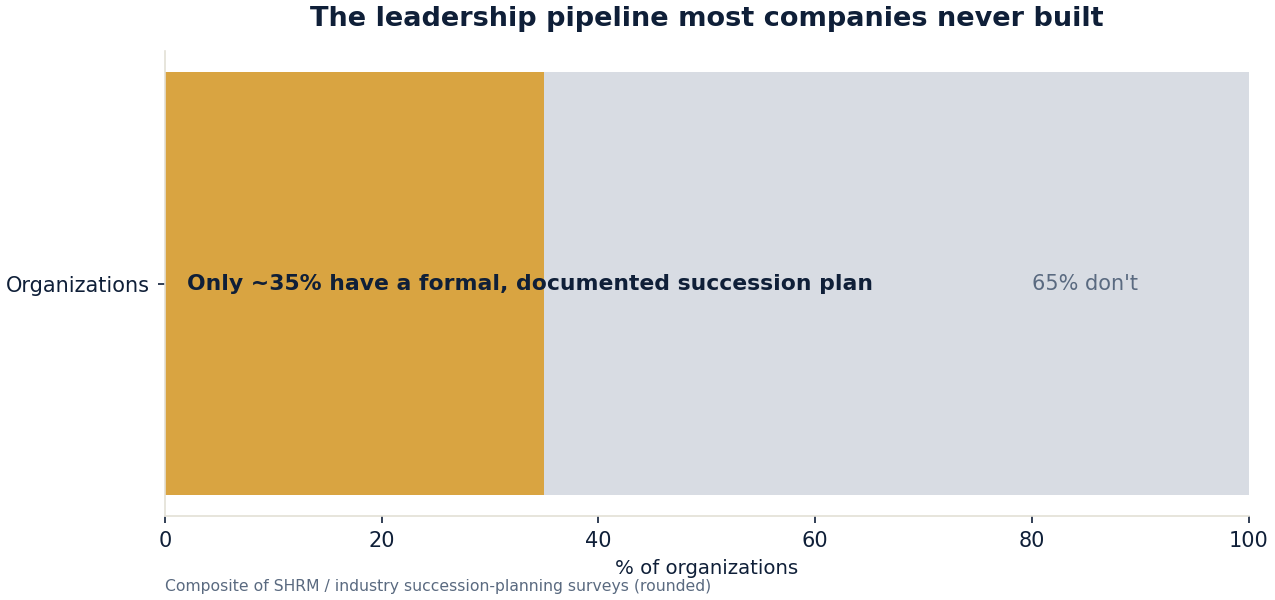
Given that only about a third of organizations operate formal plans, simply running a disciplined annual assessment center already puts you ahead of the majority. To connect assessment output to the pipeline itself, see the succession planning guide; for the measurement layer that keeps leadership decisions honest over time, the leadership assessment test guide compares testing options in depth.
Common assessment center design mistakes
Five mistakes account for most failed centers:
- Too few exercises. One exercise per candidate is an interview with props, not an assessment.
- Assessor drift. Without calibration, scoring standards loosen visibly by the afternoon of day one.
- No candidate feedback. People who invest a full day deserve dimension-level results — and feedback drives development, which is the business case.
- Borrowed competencies. Dimensions copied from another company measure that company's needs, not yours.
- Verdict without follow-up. Scores that never connect to development plans produce sorting, not growth.
Frequently asked questions
How many exercises does a good assessment center need?
Three is the practical minimum to observe each dimension more than once and give assessors enough evidence to score with confidence. Larger centers run five or six exercises, usually across two days.
How long should an assessment center run?
Half a day for a lean three-exercise center, a full day when presentations and role-plays are included, and up to two days for senior-level decisions with psychometrics added. More time only helps if assessor stamina and scoring quality hold.
How many assessors are required?
Plan on one trained assessor per two candidates at a minimum, so every exercise has an observer focused on evidence capture. Assessors must be trained in the rubric and ideally have experience in the target role.
Can assessment centers run virtually?
Yes. In-baskets, case analyses and structured interviews adapt naturally; group discussions and role-plays need stronger facilitation and smaller breakout rooms. Keep the same dimensions and anchors, and re-pilot the timing since virtual exercises often run long.
How much does an assessment center cost?
Costs concentrate in assessor time, exercise design and logistics. Building exercises in-house typically takes about 24 hours of design work, while customizing validated ready-made exercises runs around 2 — the usual reason organizations buy rather than build.
Are assessment centers valid predictors of performance?
Meta-analytic validity sits around 0.37 on its own and climbs when combined with cognitive and structured interview data. Validity depends heavily on design discipline: clear dimensions, trained assessors and anchored scoring.
Your next step
If you are selecting or developing first-time managers, PersonaPulse's First-Time Manager Essentials program includes ready-made assessments, facilitator guides and workbooks, so assessment results connect directly to the training content that fixes what the exercises exposed. For more depth, read first-time manager statistics to build the case for leadership investment, and the leadership development program complete guide to design the program behind the pipeline. The full PersonaPulse library lists all 169 ready-to-deliver programs.