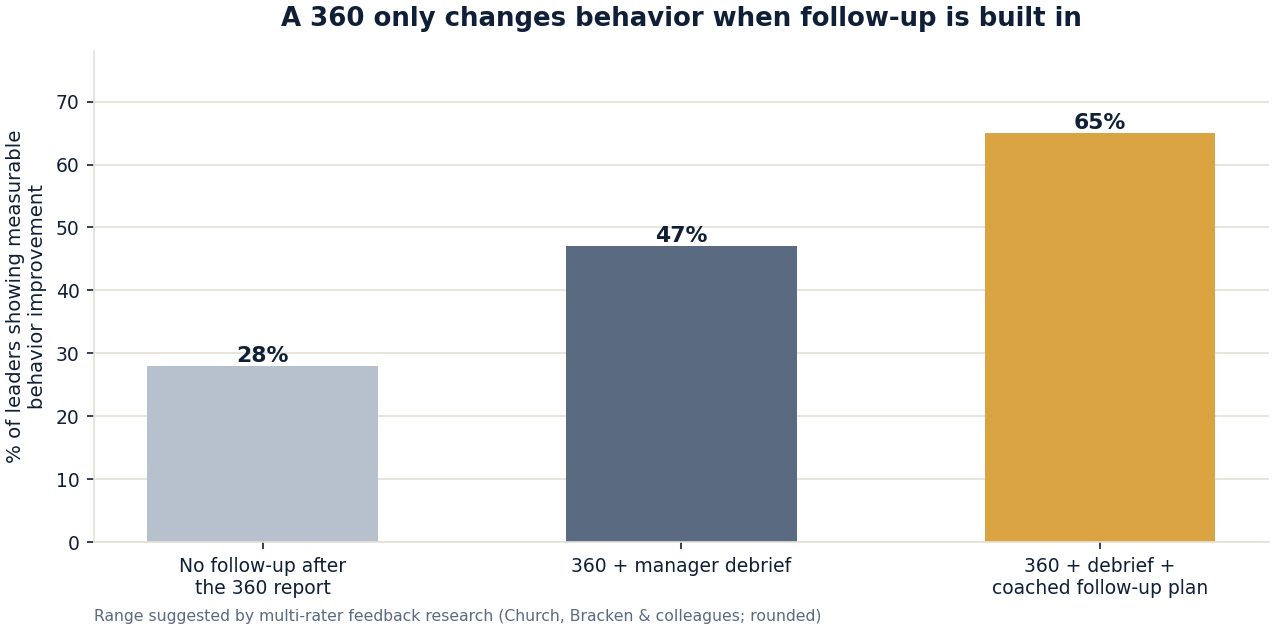
Industry surveys put the adoption of 360-degree feedback among Fortune 500 companies at well over 85%, yet most implementations still fail at the same two points: weak questions and no follow-up. In a widely cited study of 360 follow-up practices, only 28% of leaders improved their behavior when reports were handed over without any debrief; that figure rose to 47% when a debrief followed, and to 65% when the debrief included a coached action plan. The report is not the intervention — everything around it is. This guide covers 360 review implementation end to end: writing questions, choosing raters, running the rollout, and building the follow-up that actually changes behavior.
What 360 degree feedback is — and what it is not
A 360 degree feedback process collects structured ratings and comments about a leader from multiple directions — typically the leader's manager, three to four peers, three to four direct reports, and the leader's own self-rating. The value is not in any single score but in the gaps: where self-perception diverges from how others experience the leader, that is where development has leverage. Done well, it is the fastest way to surface blind spots that no single rater could safely deliver alone.
Done badly, it becomes a weapon. A 360 is a development instrument, not a performance review; the moment scores feed promotion decisions or rankings, raters inflate ratings and candor dies. Confidentiality — a minimum of three raters per category before anything is reported — is a design constraint, not a nicety. Organizations that blur the line between development and evaluation spend years rebuilding the trust the process burned.
Writing 360 feedback questions that work
Good 360 feedback questions are behavioral, observable, and anchored to the competencies the organization actually cares about. Ask how often a behavior occurs — "routinely, often, sometimes, rarely, never" — rather than whether the leader is "good" at something, because frequency language produces far more reliable ratings. Keep the survey to 25-40 items so raters stay thoughtful to the last page, and cap open-ended questions at two or three. Every item should map to a competency in your model, and no item should try to measure two things at once.
The fastest way to see the difference is to compare drafts side by side:
| Weak question | Why it fails | Stronger version |
|---|---|---|
| "Is this leader a good manager?" | Global judgment, not observable, invites halo bias | "How often does this leader set clear priorities and deadlines for the team?" |
| "Does Sarah communicate well?" | Vague, double-barreled, unanchored | "When making decisions, how often does this leader explain the reasoning behind them?" |
| "Is the leader emotionally intelligent?" | Measures a trait label, not a behavior | "How often does this leader stay composed and constructive when the team is under pressure?" |
Notice what the stronger versions share: a specific, repeatable behavior that a peer could witness within a normal month of work.
Rolling out the 360: raters, confidentiality and communication
Rater selection is the first credibility decision. A healthy mix is the leader's self-rating, their manager, three to four peers, and three to four direct reports — enough voices to protect anonymity without drowning the signal. Set a minimum of three raters per category before any results display, keep the survey to fifteen to twenty minutes, and enforce deadlines firmly, because late raters are the classic failure mode of every rollout.
Communication matters as much as mechanics. The leader should personally announce the process, state that it is for development, and tell raters what will happen with the results. Gallup's research finds that employees who receive meaningful weekly feedback are around four times more likely to be engaged than those who do not — the rollout is where you set the expectation that feedback is a rhythm, not an event. Raters who see the leader visibly act on last cycle's feedback give sharper, more honest ratings this cycle.
The debrief: where insight becomes a plan
The debrief is the highest-leverage hour in the entire process, and skipping it is the most common implementation error. The research pattern is stark: with no follow-up, only 28% of leaders improve; with a debrief, 47%; with a debrief plus a coached action plan, 65%:
Run the debrief in three moves. Let the leader read the full report alone first, so their first reaction is private. Then work through the two or three biggest themes — never item twenty-seven — with a trained facilitator or external coach. Finally, translate each theme into one or two concrete behaviors. ICF's client research finds that roughly 80% of people who work with a coach report higher self-confidence, which matters here: leaders need confidence, not just insight, to act on uncomfortable feedback.
Follow-up that turns reports into behavior change
Follow-up is where implementations separate into process and theater. The essentials fit on one page:
- A written action plan with two or three priority behaviors, not twenty.
- Share the plan with raters — public accountability is the single strongest predictor of follow-through.
- Check-ins with the manager or coach at 30, 60, and 90 days.
- A re-survey of the same raters nine to twelve months later, using the same items, to measure movement.
Researchers Allan Church and David Bracken have long argued that a 360 only works as a process rather than an event, and the data agrees. Zenger/Folkman's research adds a hopeful note: leaders who actively ask for feedback are consistently rated as more effective by their own people, so inviting raters into the follow-up is itself a leadership behavior. If the debrief revealed emotional-intelligence gaps — self-awareness, empathy, composure under pressure — pair the action plan with coaching rather than a course alone; our guide to coaching skills for managers shows how internal managers can carry that follow-up week to week.
Frequently asked questions
How many raters should a 360 include?
A typical 360 uses eight to twelve raters: the leader's self-assessment, their manager, three to four peers, and three to four direct reports. Below three raters per category, anonymity is compromised and reporting should be suppressed. Above roughly twelve, quality of thought per rater tends to decline.
Is 360-degree feedback anonymous?
It is confidential, which is a stronger promise: raters are never identified by name, and no category is reported unless it has at least three respondents. Open-ended comments are edited to remove identifying details. True anonymity is impossible with a single manager, so the confidentiality floor matters more than the label.
What is the difference between 360 feedback and a performance review?
A performance review evaluates outcomes and drives administrative decisions like pay and promotion. A 360 measures observed behaviors to drive development, and raters answer honestly only when those two uses stay separate. Blend them, and you get inflated ratings plus a development tool that no longer works.
How often should we run 360 reviews?
Every 12-24 months for the same leader is the standard rhythm — often enough to measure change, far enough apart for new behavior to become observable. Running them more frequently produces fatigue and near-identical data. Many organizations pair a full 360 with lightweight quarterly pulse check-ins between cycles.
What should a leader do first after receiving a 360 report?
Read it alone, sit with it for at least a day, and resist the urge to audit who said what. Then work through the themes with a coach or facilitator and pick two or three behaviors to change. Leaders who debrief within two weeks of receiving results are far more likely to convert insight into an action plan.
Can 360 feedback be used for promotion decisions?
Only with great care and a different design, because development confidentiality does not survive evaluation use. For high-stakes selection, use instruments built for the purpose; our guide to leadership assessment tests compares the options. Most organizations are better served keeping the 360 purely developmental.
Your next step
For the other side of the table, read our companion guide, 360-degree feedback for leaders — it covers how to receive a report, choose what to act on, and stay accountable to your raters. If you want a program that builds the emotional-intelligence competencies underneath strong 360 results, PersonaPulse's Emotional Intelligence Mastery (course page here) ships with ready-made assessments, workbooks, and facilitator guides. Browse the full PersonaPulse library to see every program, or start with the two guides above and design your rollout around follow-up first.