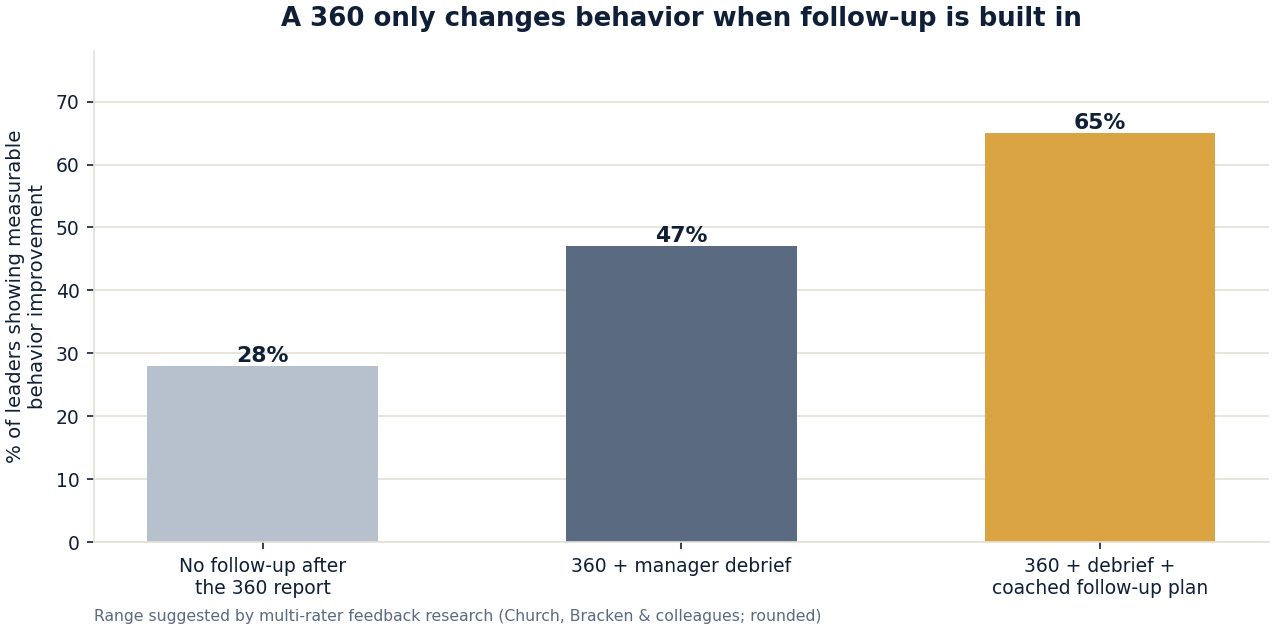
When leaders who receive 360-degree feedback debrief the results with a coach and work a written follow-up plan, roughly 65% show measurable behavior improvement at re-assessment — against 28% of leaders who receive the feedback and get no structured follow-up. That spread, drawn from multi-rater follow-up research in the Church and Bracken tradition, is the entire business case in one sentence: the instrument changes nothing by itself; the system around it changes almost everything. It also explains why so many HR teams carry a 360 story that ends in disappointment. This guide is for HR and L&D teams introducing — or repairing — 360-degree feedback for a leadership population: what the instrument measures, the rollout sequence that protects trust, and the follow-through loop that turns a rating event into a development engine.
What a 360 measures (and what it must NOT measure)
A leadership 360 collects structured behavior ratings on one leader from the full circle around them — manager, peers, direct reports, key stakeholders — plus their self-rating, against a defined competency model. The output is not a score to defend but a pattern to explore: wherever self-perception and the circle diverge, a blind spot is living there. Gallup's long-running research attributes roughly 70% of the variance in team engagement to the manager — which makes a well-run 360 the sharpest targeting tool an organization has.
The critical design rule the literature keeps re-teaching: 360s are development instruments, not appraisal instruments. The moment ratings feed pay, bonus or promotion decisions, raters inflate, politics enter, honesty exits, and the signal that justified the tool dies. Announce the boundary in writing before the first cycle and defend it forever; a single exception poisons the well. Performance systems have their own instruments.
Choose a behavior-anchored model: observable behaviors ("gives specific, timely feedback"), not personality traits or values posters. Anchor the competencies to your leadership curriculum — clusters you will actually train, such as feedback, delegation and change communication, matching what your leadership development program teaches. A 360 that measures competencies nobody will train is a diagnosis without a treatment plan. The competency assessment framework shows how to build the item set from your own model instead of buying a generic one.
The rollout sequence that protects trust
Five steps, in order — skip one and the population notices.
- Name the purpose in a leader's voice. A credible senior sponsor explains: development-only, minimum rater thresholds, anonymity rules, and what happens next. An email from HR lands as procedure; a leader with standing lands it as permission.
- Rater selection with guardrails. Eight to fifteen raters per leader: one manager, four to six peers, four to six direct reports — a three-report minimum before direct-report data displays, so individuals stay unidentifiable. The leader nominates; HR checks the circle is not curated.
- Communication to raters. What the instrument is, what development-only means, the deadline, and the promise that results land first with the leader — never as corridor commentary.
- The debrief, done properly. A trained neutral — HRBP, internal coach or the kit's facilitator — walks the leader through the report: strengths to amplify first, then two behavior priorities. Not fifteen.
- The follow-through loop. The leader shares the two priorities with their circle ("you rated me on these; here is what I am working on"), wires them into their leadership development plan, and commits to a re-measure at nine to twelve months.
Step 5 is where programs live or die. A 360 without public follow-through teaches raters that honesty changes nothing; a leader who closes the loop teaches the opposite — and usually watches their next-round scores respond.
The rater mix is a design decision, not an afterthought:
| Rater group | Typical count | What they uniquely see | Design note |
|---|---|---|---|
| Self | 1 | Intention, private effort, context | The self-versus-others gap is where the debrief starts |
| Manager | 1 | Performance, strategic fit, trajectory | Historically the most inflated ratings — read with care |
| Peers | 4-6 | Collaboration, reliability, influence without authority | Watch for reciprocity inflation; read trends, not absolutes |
| Direct reports | 3-6 | Daily behavior, feedback quality, psychological safety | Below three responses, suppress the section rather than expose anyone |
| Stakeholders | 0-4 | Cross-functional leadership, external impact | Optional; add where matrix work dominates the role |
Handling hostile, gamey and absent raters
Three rater pathologies need protocols, because every population contains them.
The hostile rater — a grievance wearing a survey. Detection is pattern-based: one rater an outlier across all leaders, or comments attacking personality rather than behavior. Behavior-anchored instruments make grievance visible, because "rate the frequency of this observable behavior" is hard to weaponize — and trained debriefers name outliers as data without feeding them.
The gamer — all 5s for everyone. Detection: distribution uniformity. Fix: report self-versus-others comparisons rather than absolute scores, and read within-rater variance in aggregate QA reports. Flat-line raters add noise, not generosity.
The absent rater. Minimum-threshold rules — below three direct-report responses, that section reports "insufficient data" rather than exposing anyone — plus pre-announced windows with one reminder outperform open-ended collection every time. Response rates below 60% distort the picture silently, so chase the window, not the stragglers.
The meta-principle: raters extend honesty to systems that visibly protect it. Publish the anonymity rules, honor them mechanically, and show the population one example of aggregate feedback being used well. Trust in the instrument is a one-way door — lose it in year one and every later cycle inherits the damage. Organizations that skip this groundwork meet the failure later in their bench data: a succession pipeline built on curated impressions.
The five failure modes (and their fixes)
- Weaponization — a 360 requested by a manager angling to document a problem employee. Fix: development-only policy enforced in writing; performance issues get their own channels.
- Rating inflation — every rater scores 4s and 5s. Fix: behavior-anchored scales, minimum rater counts, and a reporting norm of comparing self versus others.
- Debrief by PDF — the leader receives a report and a shrug. Fix: trained debriefer, mandatory conversation, two-priority output, calendar-protected.
- One-and-done — no re-measure, no plan, no visible change. Fix: the nine-to-twelve-month re-measure is scheduled at rollout, before anyone is tired.
- Competency soup — forty items nobody can train. Fix: align the instrument to the curriculum; if the model has more items than the training can serve, the model is wrong.
The 360 is not the intervention. The intervention is the two behaviors the leader works on for the next year — the 360 is the mirror that makes them undeniable.
From debrief to behavior change: the follow-through loop
The follow-up research is unambiguous about where the value sits. Across multi-rater studies, leaders who receive a 360 and no structured follow-up show measurable behavior improvement roughly 28% of the time. Add a debrief conversation and the figure climbs to about 47%. Add a debrief plus a coached, written development plan and it reaches around 65%. Nothing else in the rollout design moves the needle that far.
The coached plan is deliberately small: two behaviors, defined observably, declared publicly, reviewed at a midpoint. The leader's manager has one job in the loop — protect the time and ask about the two behaviors in one-to-ones. Wire the re-measure in from the start and the second cycle writes itself: same instrument, same circle logic, and a delta the leader can see. The measurement mechanics — baselines, Level-3 re-rating, timing — are covered in our Kirkpatrick guide and the 360 implementation guide.
This is also the retention story. LinkedIn's Workplace Learning Report finds about 94% of employees would stay longer at a company that visibly invests in their development — and a leader whose 360 turns into real coaching feels that investment where it counts. With replacement costs running one-half to two times annual salary (Gallup), the instrument is not surveillance; it is the organization spending its attention on a person.
How 360s plug into a leadership curriculum
The strongest sequence: 360 baseline → targeted module attendance → workplace assignments → nine-to-twelve-month re-measure. The baseline tells each leader which two competencies to work on; the curriculum delivers the how; the re-measure proves the delta. Run the cycles in cohorts and the population normalizes the practice within two rounds. DDI finds only about 12% of organizations confident in their bench strength — closing 360-flagged gaps across the whole population is bench-building in the most direct sense.
The Advanced Leadership Mastery program is built for this loop — its modules map to the competency clusters senior leaders most often prioritize from 360 results (strategic leadership, coaching, influence, change communication), it ships the 180/360 templates and debrief facilitator materials, and it licenses for $89.50 with unlimited internal delivery. Pair it with the measurement wiring above and every cycle produces board-grade evidence instead of anecdote.
Frequently asked questions
What is 360-degree feedback?
A structured development instrument collecting behavior ratings on a leader from their manager, peers, direct reports and stakeholders, compared with the leader's self-rating against a competency model. Its purpose is surfacing blind spots and targeting development — never, if it is to keep working, pay decisions.
How many raters does a 360 need?
Eight to fifteen: one manager, four to six peers, and a minimum of three direct reports so individual raters stay anonymous. Below three direct-report responses, honesty collapses and the data should be suppressed; above fifteen, accountability dilutes.
Should 360 results affect compensation?
No. The moment ratings touch pay, raters inflate, politics enter, and the developmental signal that justifies the tool disappears. Keep the boundary in writing and defend it every cycle — performance systems have their own instruments.
How often should leaders get 360 feedback?
Every twelve to twenty-four months for the full cycle, with an interim pulse on the leader's two declared development priorities. More frequent full cycles cause survey fatigue; less frequent, and the follow-through loop loses its deadline.
Who should debrief the results?
A trained neutral — HRBP, internal coach or external debriefer — using a structured conversation that lands on two behavior priorities wired into a written plan. Managers debriefing their own reports compresses the honesty the tool exists to create.
Why do so many 360 programs fail?
The follow-up research points at follow-through, not instrumentation: no debrief, no coached plan, no re-measure. Leaders who debrief and work a coached plan improve measurably at roughly twice the rate of leaders who receive scores and nothing else.
Where can I get 360 templates that match our training?
The Advanced Leadership Mastery kit includes 180/360 templates aligned to its competency modules — $89.50 one-time — plus facilitator materials for running debrief cohorts in-house.
Your next step
If you are building or repairing a 360 process, license the spine. The Advanced Leadership Mastery program ships the competency modules, 180/360 templates, debrief protocols and development-plan worksheets — one license, unlimited cohorts, $89.50. Then wire the re-measure with our Kirkpatrick four levels guide and browse the PersonaPulse library for the supporting curriculum.